


79: Goodall in Italy
A survey of the influence Goodall's courts had on Italian cards.
Goodall's cards seem to have been well-known in continental Europe during the first half of the 20th century. They were known in America as well, but Italy still uses Goodall-derived courts today, so I thought I'd present a brief survey of the designs, nearly all of which have been altered from the original in some way. I have a nice piece of evidence of their presence in Italy before World War I in the form of a sample book by Viassone, which contains samples of Goodall's cards as well, alongside other European makers, such as Piatnik and Dondorf. It dates from c.1912.
Let's start, then, with the originals.

G6, wide, in use from c.1900-30 (after 1922 printed by De La Rue)

G7, Society (bridge) size, in use from c.1910-25

G8, redrawn wide for use in cheaper packs, used from c.1909-35
All the above appear in the Viassone sample book.
After the take-over by De La Rue redrawn versions of the courts were produced.

GD9, c.1923-40 with a revival by Waddington in the 1960s and 1970s.

GD10, bridge size, c.1923-40

GD12, c.1932-40, continued by Waddington, c.1943-75 (GDW12).
I'll now go through the Italian makers and illustrate their versions of the originals.
ARMANINO

Copy of GD9, 1941
BARRO

A very haphazard version of GD10, retaining some original characteristics, c.1940
CAMBISSA

Copy of GD9, c.1970
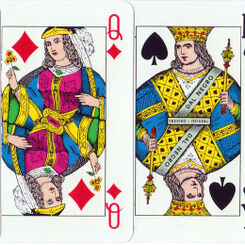
DAL NEGRO

Copy of GD9; right-hand QH is the cover of a calendar for 1937. These designs are still in use today.
ITALCARDS

These are a modification of the design with fewer recognizable features; these courts are also used by Maestros Naiperos Españoles. Current
MASENGHINI/MODIANO
These two firms seem to have the same courts. It appears Masenghini was taken over by Modiano at some point.

Copy of GD9, though the KH & JH are altered slightly and are distinctive of these makers.
Modiano also made packs for the Greek market and the AS sometimes has Nina on or EMP (in Greek letters) for the Greek Playing Card Monopoly.

MODA 90

A somewhat crude redrawing of GD9, current
SOLESIO

Not a close copy, but there are a few characteristics of the original such as the queens' crowns and the JS's attribute, 1928
VIASSONE

Copy of GD10, 1924

Copy of GD12 on wide cards, 1943

By Ken Lodge
United Kingdom • Member since May 14, 2012
I'm Ken Lodge and have been collecting playing cards since I was about eighteen months old (1945). I am also a trained academic, so I can observe and analyze reasonably well. I've applied these analytical techniques over a long period of time to the study of playing cards and have managed to assemble a large amount of information about them, especially those of the standard English pattern. About Ken Lodge →

Activity for 79: Goodall in Italy
Sign in to comment or save this article.

Related Articles
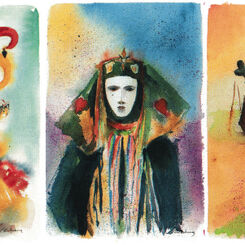
EFFEGIEFFE
Corporate gift: a non-standard "Venice Carnival" deck by Dal Negro.
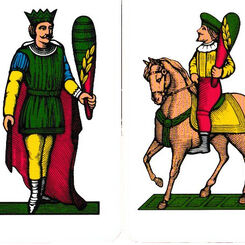
Modiano Napoletane Cards
From Trieste with Pride – a 150th Anniversary Edition of the Neapolitan Pattern.
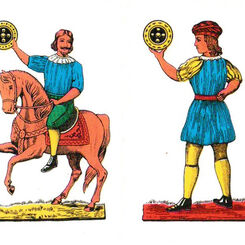
Sicilian Playing Cards
Sicilian Playing Cards by Dal Negro (Carte da Gioco).
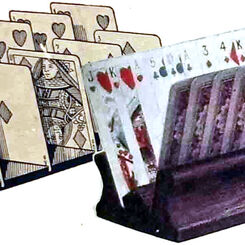
Double Dummy Bridge
In the early 20th century several firms began to promote whist or bridge as a game for two.
Czech National Patterns by S.D. Modiano
Modiano produced cards with the Prague and Trappola patterns in the early 20th century.
Emilio Tadini playing cards
Beautiful dreamlike playing card designs by Emilio Tadini.
Le carte da gioco Arcimboldo
Courts and suit-signs inspired by the works of the Italian Renaissance painter, Giuseppe Arcimboldo....
Modet Sardegna
Costumes, masks and symbols from the island of Sardinia, with designs by Luciano Dettori and Tonino ...
Dal Negro Bridge set
Dal Negro Bridge set featuring old Vienna pattern courts.
Triestine Pattern
The Triestine pattern is derived from the Venetian (Trevisane) pattern but with its own characterist...
Primiera Bolognese
Primiera Bolognese by Modiano, c.1975
Bergamasche Pattern
Bergamasche Pattern by Modiano, 1970s.
Piacentine Pattern
Piacentine Pattern, several double-ended versions.
Lombardy (or Milanesi) pattern
The origins of the Lombardy pattern probably lie in the early 19th century when it was a full-length...
Trevisane pattern
The double-ended version of the ‘Trevisane’ pattern originated in the early 19th century.
Tarocco Piemontese | Piedmontese tarot
The double ended version of the Piedmontese Tarot evolved during the second half of the nineteenth c...
Sicilian Pattern
The Sicilian pack has a similar composition to the Neapolitan pack, and is small and squat in appear...
Florentine Pattern
Originally one of several designs which emerged during the nineteenth century, the Florentine patter...
Brescia pattern
The Brescia pattern contains elements which come from a past age.
Most Popular
Our top articles from the past 60 days


