


Four Centuries
“Four Centuries” playing cards by Esselte Öbergs with court cards depicted as caricatures from different historical periods.
Öbergs “Four Centuries”
“Four Centuries” (4 Sekel) playing cards by Esselte Öbergs A.B. with the court cards depicted as colourful caricatures from different historical periods in each suit, wearing imaginative costumes, also following distinct colour codes. The indices are ‘Kn’ (Knekt) for the knaves, ‘D’ (Dam) for the queens, ‘K’ (Kung) for the kings and ‘E’ (Ess) for the aces.
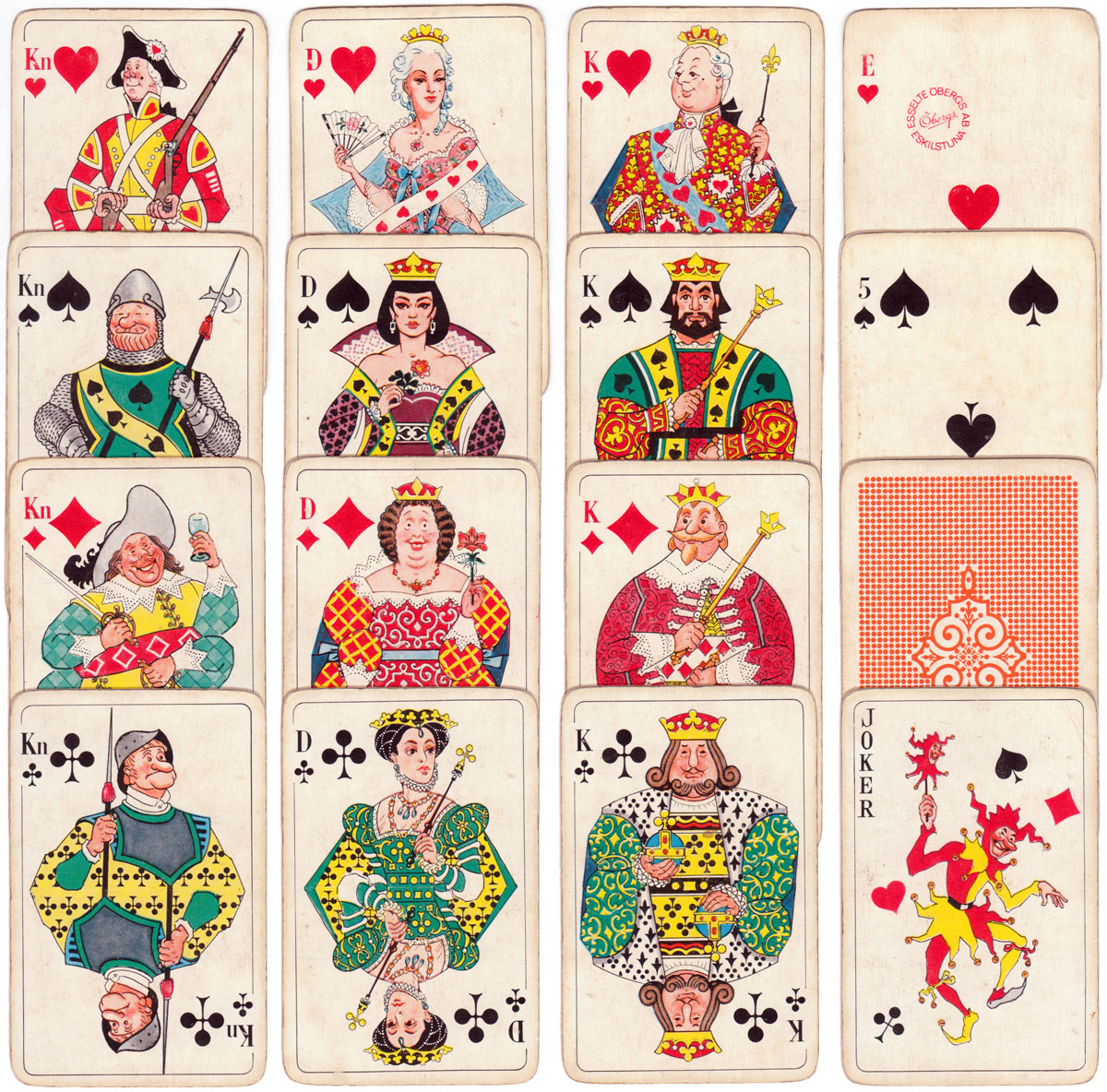
Above: “Four Centuries” (4 Sekel) playing cards by Esselte Öbergs A.B., Eskilstuna, designed by Nils Melander, c.1970.

By Rex Pitts (1940-2021)
United Kingdom • Member since January 30, 2009
Rex's main interest was in card games, because, he said, they were cheap and easy to get hold of in his early days of collecting. He is well known for his extensive knowledge of Pepys games and his book is on the bookshelves of many. His other interest was non-standard playing cards. He also had collections of sheet music, music CDs, models of London buses, London Transport timetables and maps and other objects that intrigued him.
Rex had a chequered career at school. He was expelled twice, on one occasion for smoking! Despite this he trained as a radio engineer and worked for the BBC in the World Service. Later he moved into sales and worked for a firm that made all kinds of packaging, a job he enjoyed until his retirement. He became an expert on boxes and would always investigate those that held his cards. He could always recognize a box made for Pepys, which were the same as those of Alf Cooke’s Universal Playing Card Company, who printed the card games. This interest changed into an ability to make and mend boxes, which he did with great dexterity. He loved this kind of handicraft work.
His dexterity of hand and eye soon led to his making card games of his own design. He spent hours and hours carefully cutting them out and colouring them by hand.

Activity for Four Centuries
Sign in to comment or save this article.

Related Articles
Oxygène
Armenian miniatures were Stepan Kiourktchian’s inspiration for this pack for a Franco-Armenian assoc...
Balearic Souvenir Cards
Mediterranean Souvenir deck by Rioba Studio, Pollença, Mallorca.
Les Chevaliers de la Toison d’Or
Medieval manuscript art at its finest.
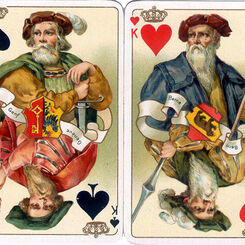
Schweizer Trachten
Schweizer Trachten No.174 (Costumes Suisses) by Dondorf.
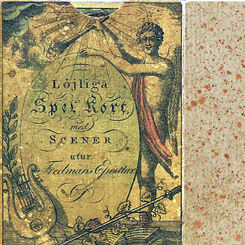
Löjliga Spel Kort
Facsimile edition of “Löjliga Spel Kort” (1825) illustrated playing cards from Sweden, showing scene...
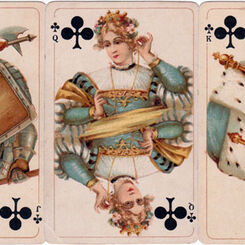
Jacob Bagges AB
Playing cards published by Jacob Bagges AB Stockholm, close copies of Dondorf designs.
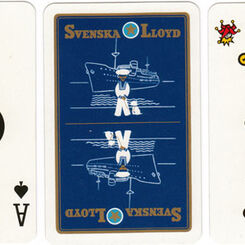
Öbergs ‘Svenska Lloyd’
‘Svenska Lloyd’ shipping company playing cards published by J.O. Öberg & Son, Eskilstuna, c.1955.
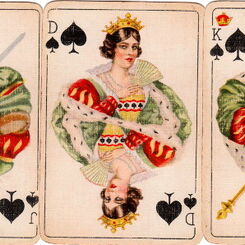
Åkerlund & Rausing
Swedish style pack by Åkerlund & Rausing, Stockholm, 1931-1937
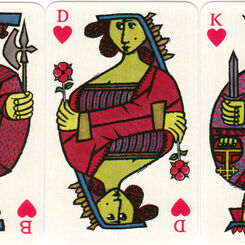
Öbergs ‘Comedia’
Öbergs “Comedia” playing cards designed by Stig Lindberg from Sweden, c.1958
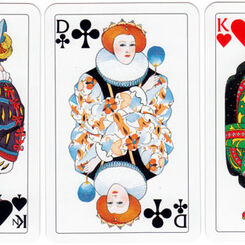
Offason “Beau”
Offason AB “Beau” playing cards designed by Åke Arenhill from Sweden, c.1990.
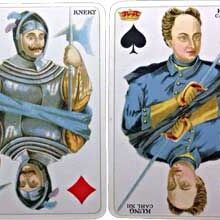
Vasa Dynasty
The House of Vasa was the royal house of Sweden 1523–1654 and subsequent rulers have emphasized thei...
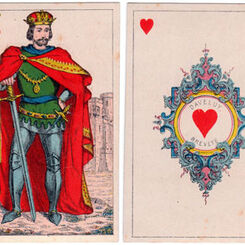
Première Croisade
Deck evoking the ‘Première Croisade’ with single-ended courts by Daveluy, Bruges, c.1850.
L. P. Holmblad, c.1845
Holmblad ordered his earlier designs to be re-drawn and updated. Comparison of packs from this era s...

Jeu Moyen Age
Quénioux believed that aesthetic feelings are the highest values: “C’est précisément cet amour de l’...
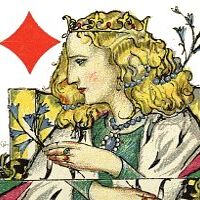
Granbergs No.101 Standardkort
Olle Hjortzberg (1872-1959) designed these playing cards for Granbergs AB in c.1924 in ‘Art Nouveau’...
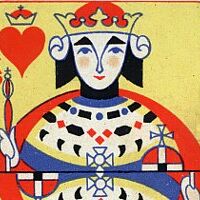
Einar Nerman Patience
Einar Nerman (1888–1983) was a talented Swedish artist born in Norrköping who designed playing cards...
Standard Swedish Pattern
Standard Swedish type playing cards manufactured by J.O. Öberg & Son, Eskilstuna, 1929.
Danbrit
Danbrit playing cards by Alf Cooke, 1930s
501 playing cards by Alf Cooke
“Five 'o One” playing cards, a version of the Dondorf Rhineland pattern, manufactured by Universal P...
The History of Playing Cards
Playing cards appear in European records in the late 14th century, but their earlier history lies fu...
Most Popular
Our top articles from the past 60 days


