American Bank Note Company
The American Bank Note Company was a long-established firm producing national currency, finely engraved stock certificates and other security printing, including postage stamps. They also entered the playing card market c.1908-1914.
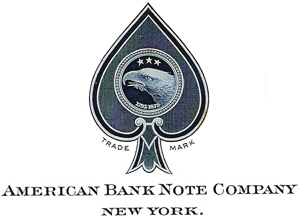
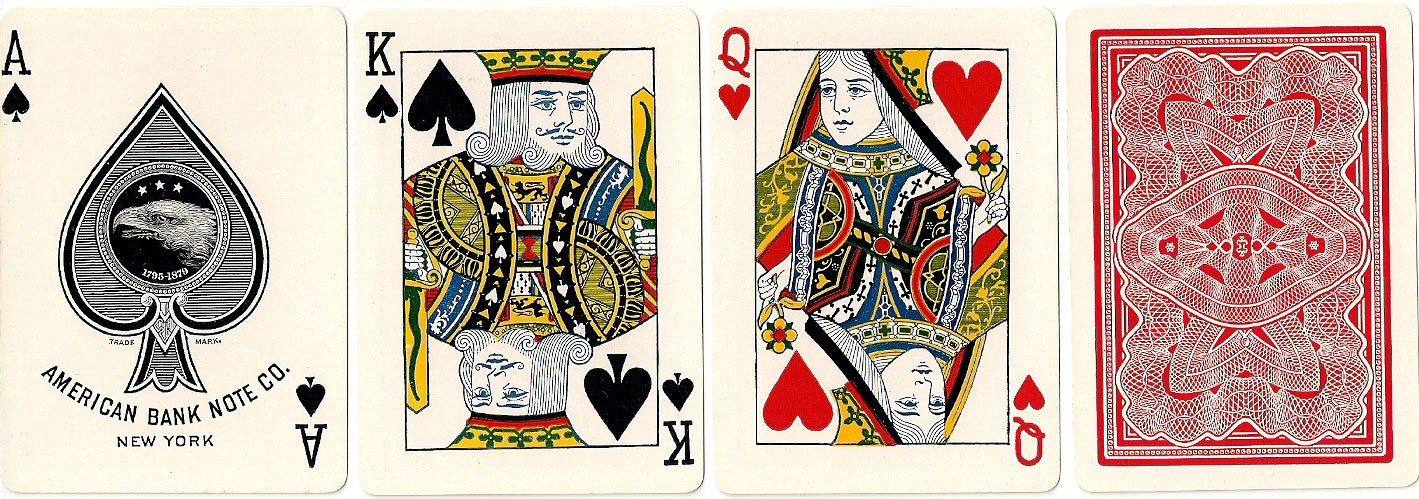
The American Bank Note Company was a long-established firm producing national currency, finely engraved stock certificates and other security printing, including postage stamps and American Express “Travelers Cheques.” Like others before them they entered the playing card market, but only to pull out again after a short time (c.1908-1914). Their Ace of Spades design includes the dates 1795-1879 which refer to the year the company was originally founded as Murray, Draper, Fairham & Co., as well as the year in which it merged with the National Bank Note Company and the Continental Bank Note Company. In spite of its excellence in other areas of printing, the Company probably found the making of playing cards to be more problematic than they had anticipated and hence they quit at an early date.
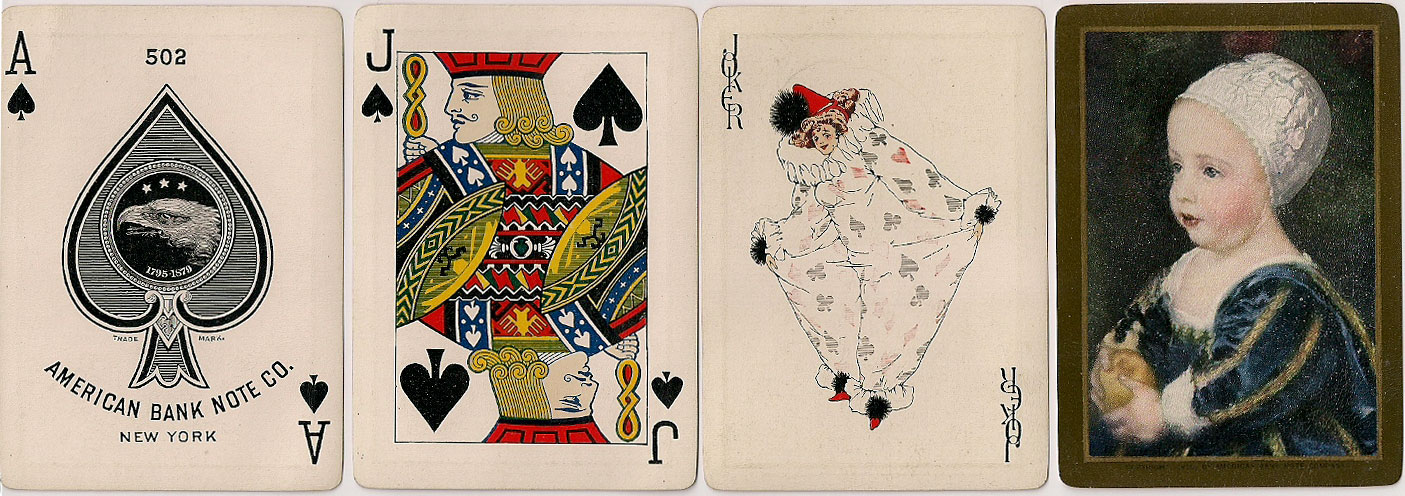
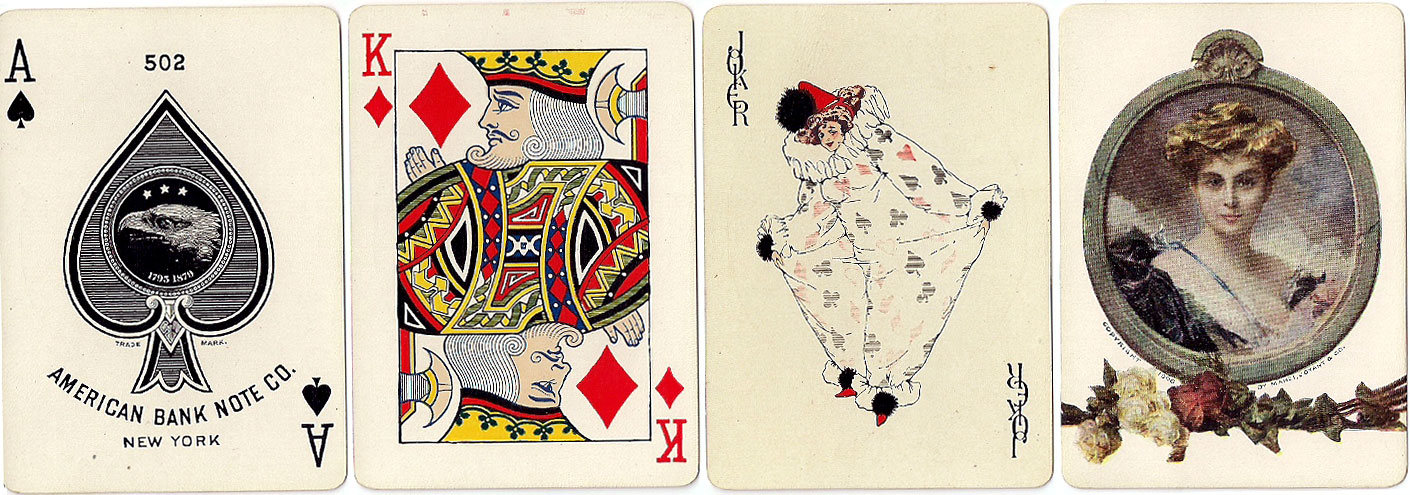
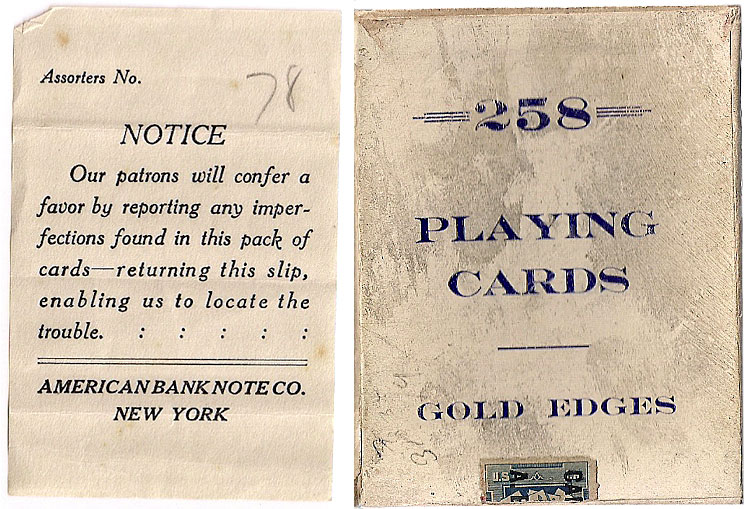
Above: American Bank Note Co. No.502 playing cards with fine pictorial back designs. The tiny lettering on the back of the lower card reads "Copyright 1910 American Bank Note Company". The No.258 box and quality control slip in fact appeared with the above No.502 decks with the same display card, which confirms that numbers on boxes and Aces of Spades were often mixed up. The American Bank Note Company used the same Ace of Spades in all their decks, sometimes numbered and named, or sometimes plain. The Joker was likewise used in most of their decks. (Click images to zoom)
The stock on which playing cards are printed should consist of thin sheets of paper pasted together with a black paste to ensure their opacity. American Bank Note Company decks do not have the opaque black paste liner. When a card is held before a bright light, both sides of can be seen! The cards would appear to have been printed on a single sheet of paper. Possibly this problem contributed to the decision to sell the playing card business to the Russell Playing Card Company in 1914. Whatever the reason, the surviving decks by The American Bank Note Company, all of which are now over one hundred years old, are true Americana.
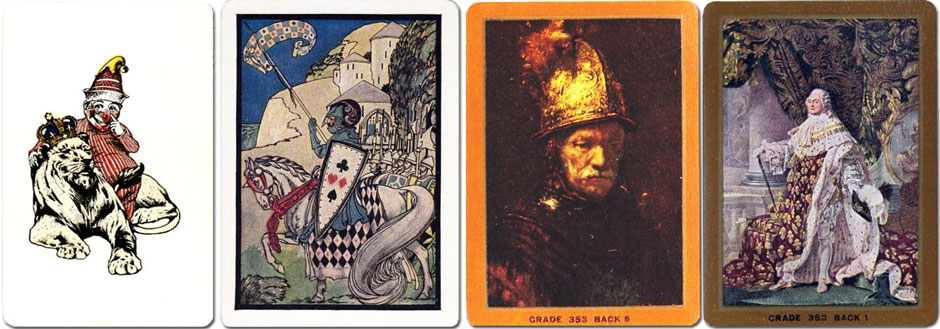
Above: a less common Joker with Punch sitting on a lion, and three different pictorial back designs issued by the American Bank Note Company. The right-hand card depicts King Louis XVI, King of France and husband of Marie Antoinette who is on the card beneath him.
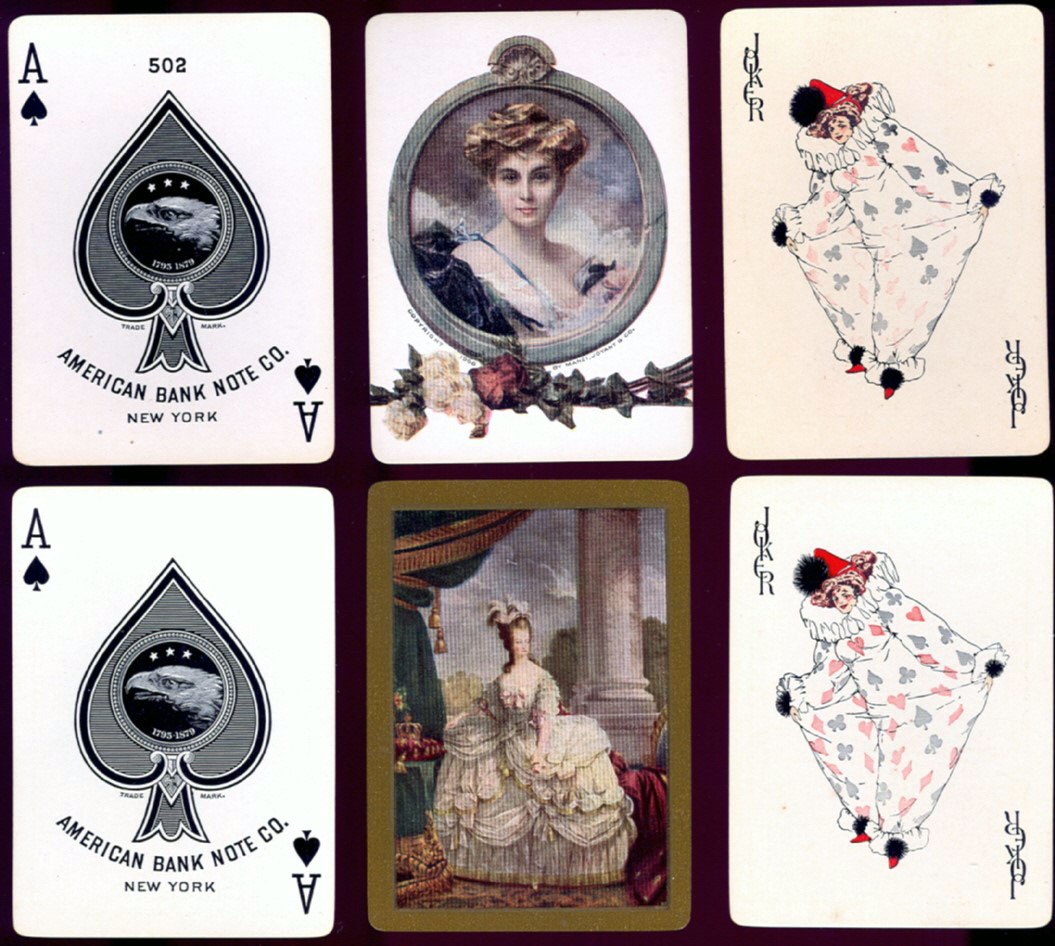
Above: American Bank Note Co. playing cards with elegant pictorial back design, c.1910 (click to zoom).

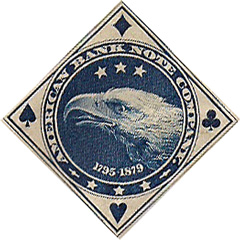
← Left: a company seal from a playing card wrapper.
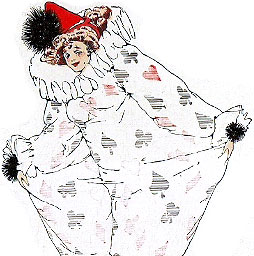
Right: detail from the standard Joker →
see more►
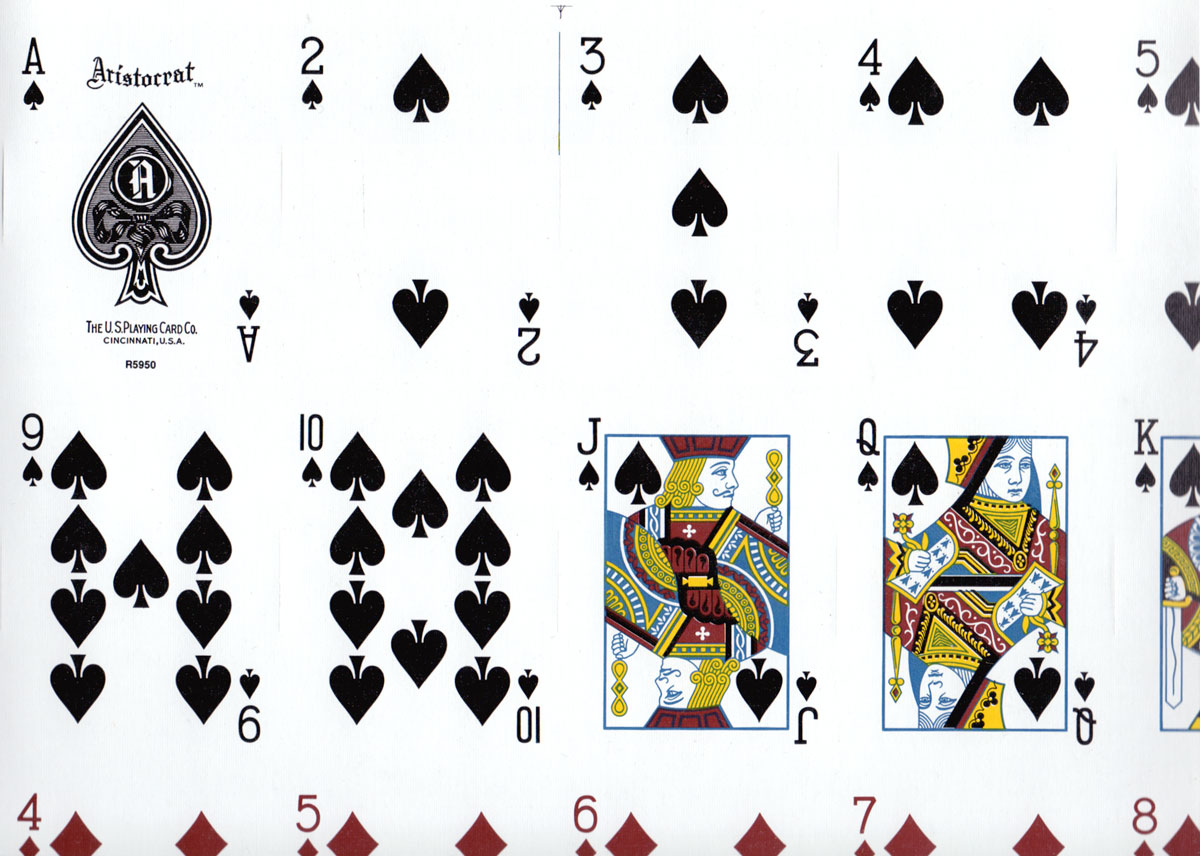
There were at least two or three variations of the ‘stock certificate’ or ‘bank note’ back design and when the company was eventually purchased by the Russell Playing Card Company they were continued in Russell’s Aristocrat brand.
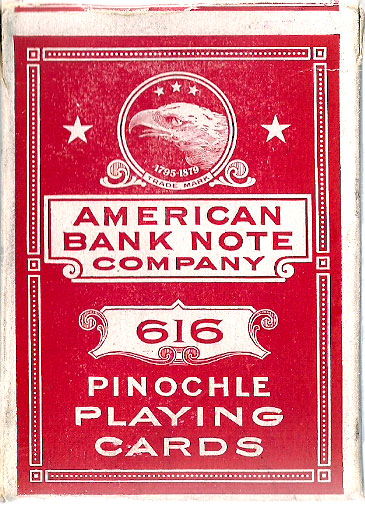
Above: American Bank Note Co. Pinochle 616 playing cards with 'banknote' or 'stock certificate' back design. Although it had been out of print for many years, USPCC reprinted a similar 'banknote' back in 2011 on their "Aristocrat" brand.
Legacy
In 1913 the Willis W. Russell P.C. Co. merged with the Kalamazoo Playing Card Co. to form the Russell Playing Card Company which, in 1914, acquired the playing card business of the American Bank Note Company who had decided to discontinue their playing card line. Accordingly, it would appear that the American Bank Note Company produced playing cards for about a six year period, i.e. c.1908-1914 but nevertheless left a lasting heritage in the industry in the form of their successors. The American Bank Note Company's court card designs include a right-hand pip on the QH with the consequent shifting of her head to the left and the left-facing profile JS. These, along with the “Baggy Clown” Joker, were acquired by U.S.P.C.C. via their purchase of Russell P.C.Co. in 1929. They were used by U.S.P.C.C. since c.1955 in Congress, Aristocrat and other bridge-size decks and have been copied with modifications by a number of other makers (e.g. Stancraft), as well as being the inspiration for Australian and Chinese imitations.
REFERENCES
Dawson, Tom & Judy: The Hochman Encyclopedia of American Playing Cards, U.S. Games Systems Inc., 2000
Lodge, Ken: The Standard English Pattern (second revised and enlarged edition), Bungay, Suffolk, 2010
Starling, Rod: American Bank Note Pictorials, in 'Clear the Decks', the Newsletter for 52 Plus Joker (edited by Judy Dawson), September 2011.
All images on this page are from the collection of Rod Starling, author of "The Art and Pleasures of Playing Cards".

By Rod Starling (1936-2023)
United States • Member since January 09, 2013
Rod Starling was one of the founding members of the 52 Plus Joker card collectors club. He authored many articles for the club's quarterly newsletter, Clear the Decks. His collection encompasses both foreign and American decks. Rod also authored a book titled The Art and Pleasures of Playing Cards.

Leave a Reply

Your Name
Just now Your comment here. Your comment here. Your comment here. Your comment here. Your comment here. Your comment here. Your comment here. Your comment here. Your comment here. Your comment here. Your comment here. Your comment here. Your comment here. Your comment here. Your comment here. Your comment here. Your comment here. Your comment here. Your comment here. Your comment here. Your comment here. Your comment here. Your comment here. Your comment here. Your comment here. Your comment here. Your comment here. Your comment here. Your comment here. Your comment here. Your comment here. Your comment here.
Related Articles
A Look Back with Hope for the Future
“A Look Back with Hope for the Future” by Rod Starling
Baggy Clown Joker
Evolution of American Bank Note Co's “Baggy Clown” Joker.
Card Fabrique Company
Card Fabrique Company had connections with several other manufacturers and their complete history is...

Grimm's Forest Playing Cards
A non-standard pack created to play an original board game; inspired by the Brothers Grimm fairy tal...
Gangster playing cards
A small set of gangster and mafia inspired cards created by Jacob Reynolds.

Perfection Playing Card Co.
Tip-Top No.350 playing cards manufactured by Perfection Playing Card Company, Philadelphia, c.1887

Kismet Temple
The deck was made to honour Conrad V. Dykeman as Imperial Potentate of the Kismet Temple of the Anci...
Pyramid P.C.C.
The company introduced a number of standard brands until it was absorbed into U.S.P.C.C. and its aff...
Navy No.303
The second edition of 1883 has slightly larger indices and a more simplified Ace of Spades showing t...

Kalamazoo Playing Card Co
This firm commenced producing playing cards with the name Kalamazoo Paper Box & Card Co in 1903.
Steamboats No.66
Steamboats #66 playing cards manufactured by the Kalamazoo Paper Box & Card Co., c.1903.
Superior Steamboats No.9
This deck was of slightly superior quality than it's predecessor “National Steamboats No.9” and is e...

Tigers No.101
In 1881 Russell, Morgan & Company commenced playing card production by issuing six grades of cards w...
Tales from the Stage
"Tales from the Stage" - an article about theatrical playing cards by Rod Starling
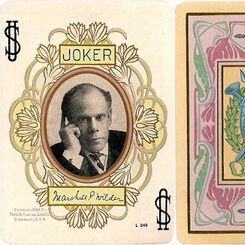
Stage Playing Cards, 1908
This beautiful deck features an oval half-tone photo of a theatre star on each card, many of them le...
De Luxe No.142
A wide size version of De Luxe No.142 had been published in c.1920, with a similar Ace of Spades and...
Lighthouse No.922
“Lighthouse No.922” playing cards were introduced in c.1920.
Triton No.42
There have been at least three different versions of the Triton deck, with different Jokers, differe...
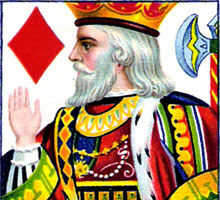
Norwood #85, c.1909
The deck features a colourful Ace of Spades and Joker, decorated Aces, unique courts and two beautif...
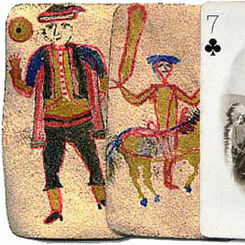
U. S. A.
The manufacture of playing cards in America only began during the second half of the 18th century, a...
Most Popular
Our top articles from the past 60 days