


Rhineland Pattern
This pack was probably the culmination of a mixture of designs from 19th century Germany which emerged as one of Dondorf's more popular house patterns by around 1900.
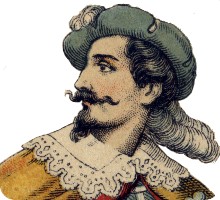
Dondorf: “Rhineland Pattern”
...a Dondorf House pattern.
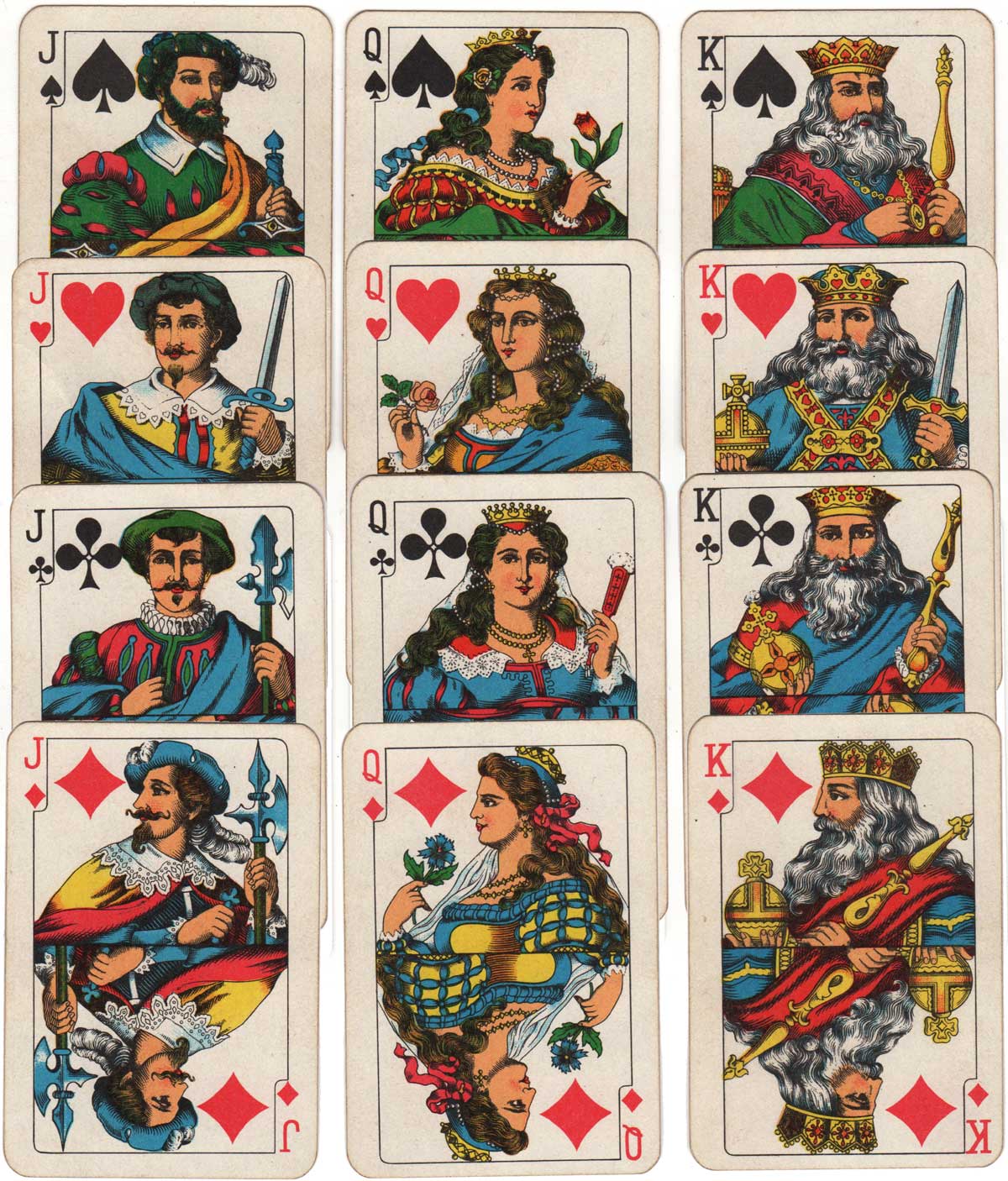
This pack was probably the culmination of a mixture of designs from 19th century Germany which emerged as one of Dondorf's more popular house patterns by around 1900. The four Kings each have white wavy hair and beards, giving rise to the nickname “Jewish Pattern”. Its popularity was increased by its being widely used and copied by Austrian, Belgian, Dutch, Polish, Portuguese and other manufacturers, some of whom created new variants. Some versions have scenic Aces (historical or geographical) which vary from pack to pack; others have plain Aces. The pattern continued to be produced after the takeover by V.A.S.S. in 1933.
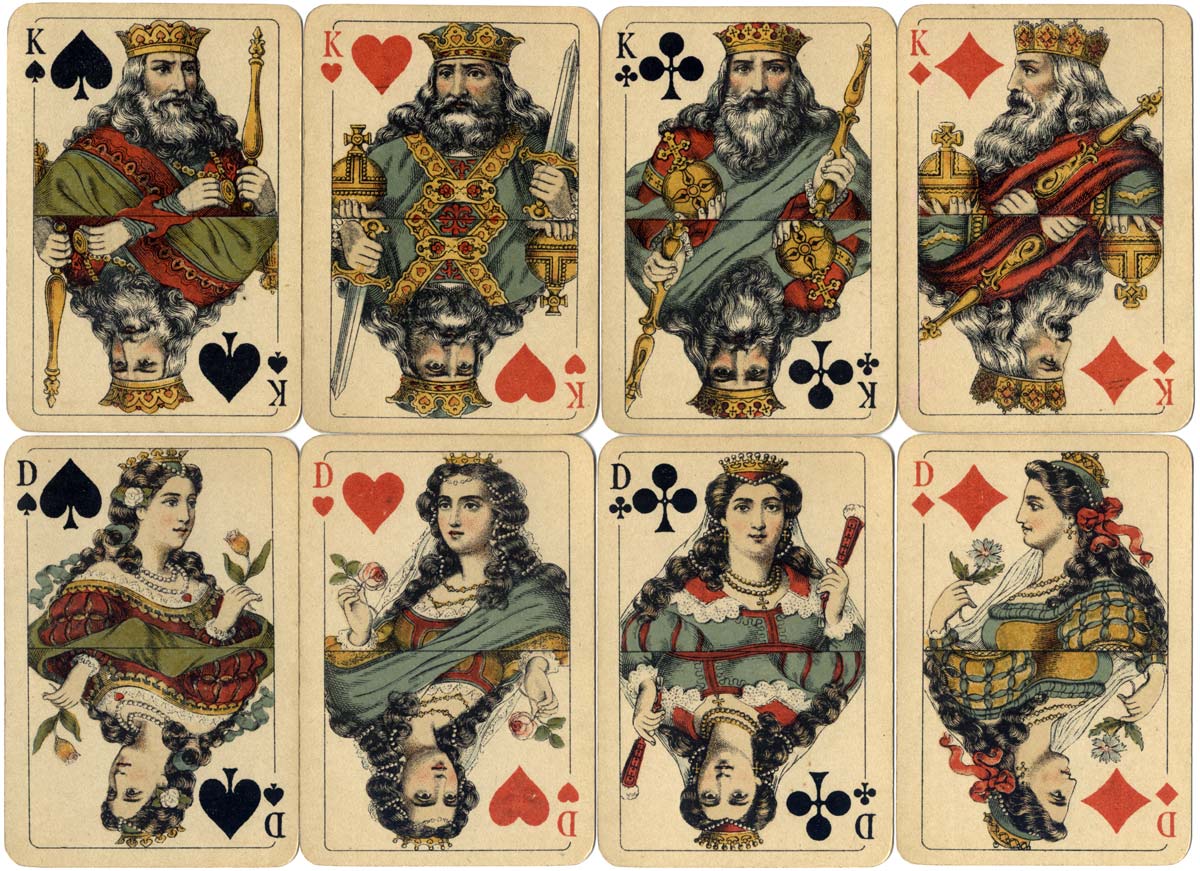
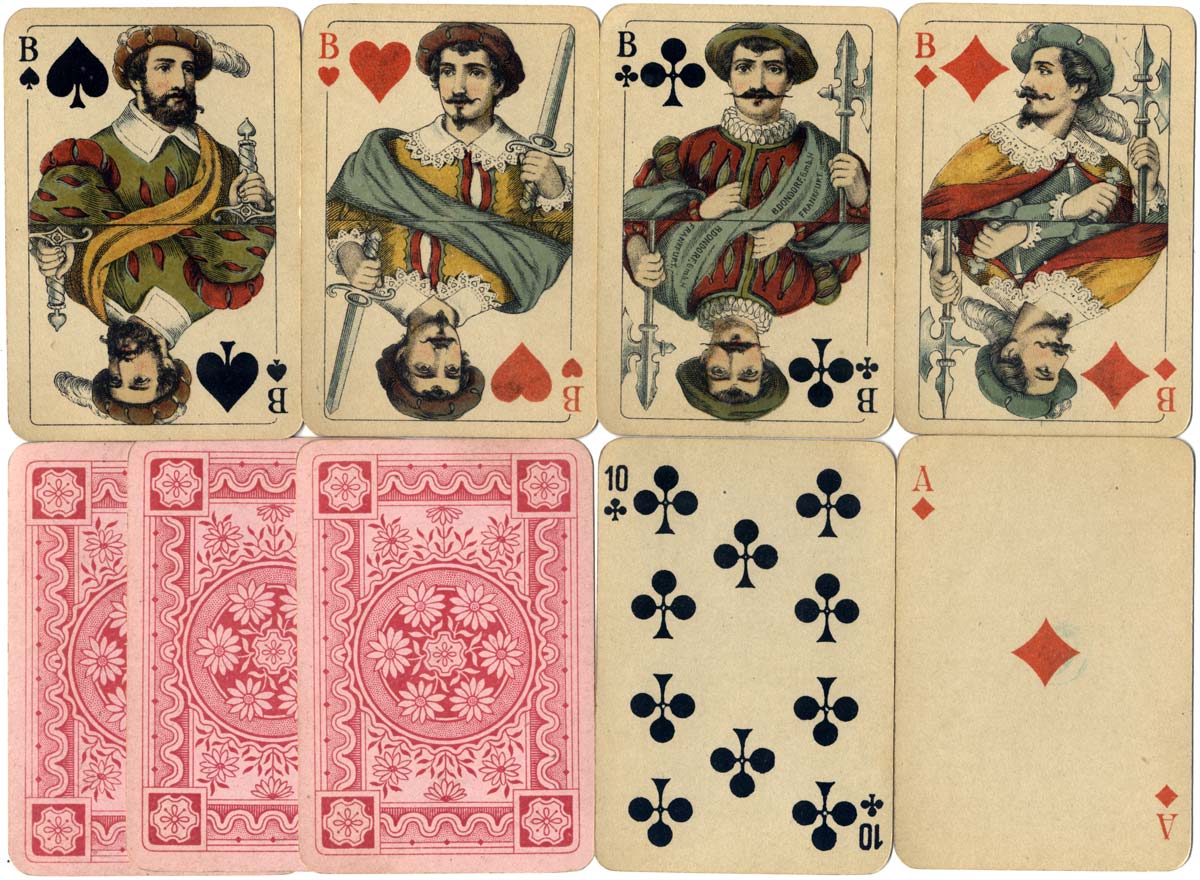
Above: Whist No.122 manufactured by Dondorf GmbH, c. 1910, sometimes referred to as “Jewish Pattern” because of the Rabbinical look of the bearded Kings. This example of the “Rhineland Pattern” has plain Aces.
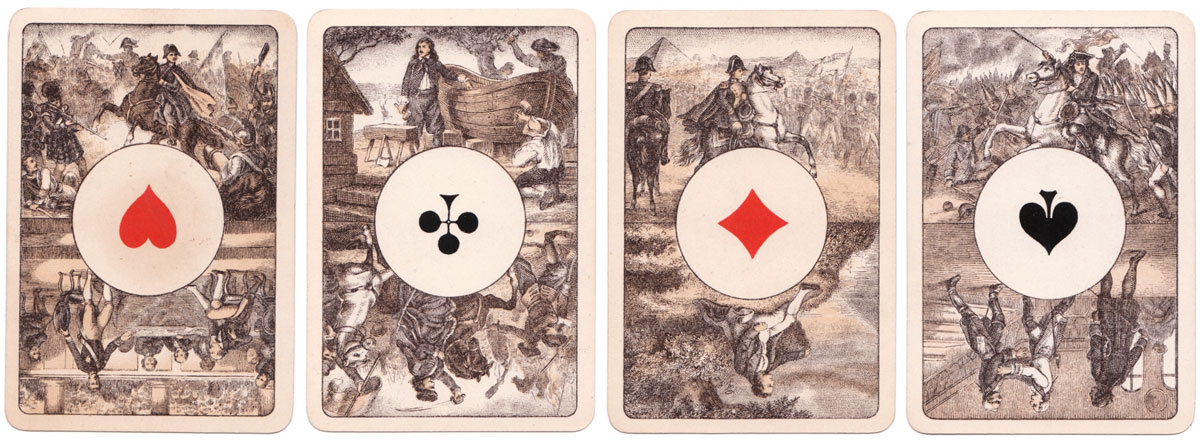
Above: this slightly earlier example of the “Rhineland Pattern” with no indices has special Aces for Java showing scenes are of Dutch history (click to see up-side-down). Images courtesy Rex Pitts.
Rhineland Pattern by KZWP, 1980s
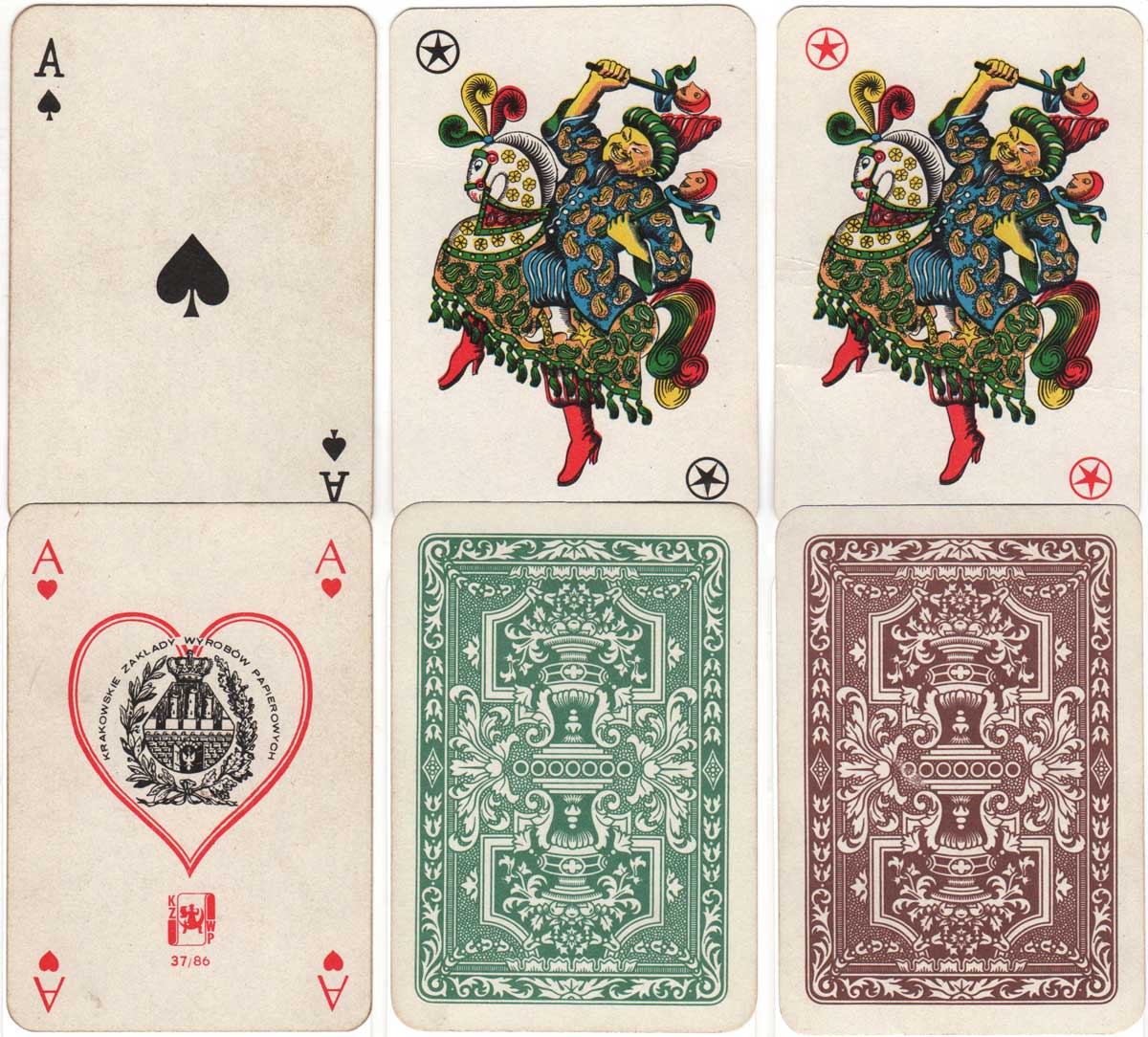
Above: Rhineland pattern with English indices printed by KZWP, c.1986. The ace of hearts has a different font for the indices, and has four indices while the other cards all have two. Housed in an unmarked silk-lined bridge box with no indication of a brand name. Image courtesy Matt Probert.
Rhineland Pattern by F. X. Schmid for The Netherlands, c.1990
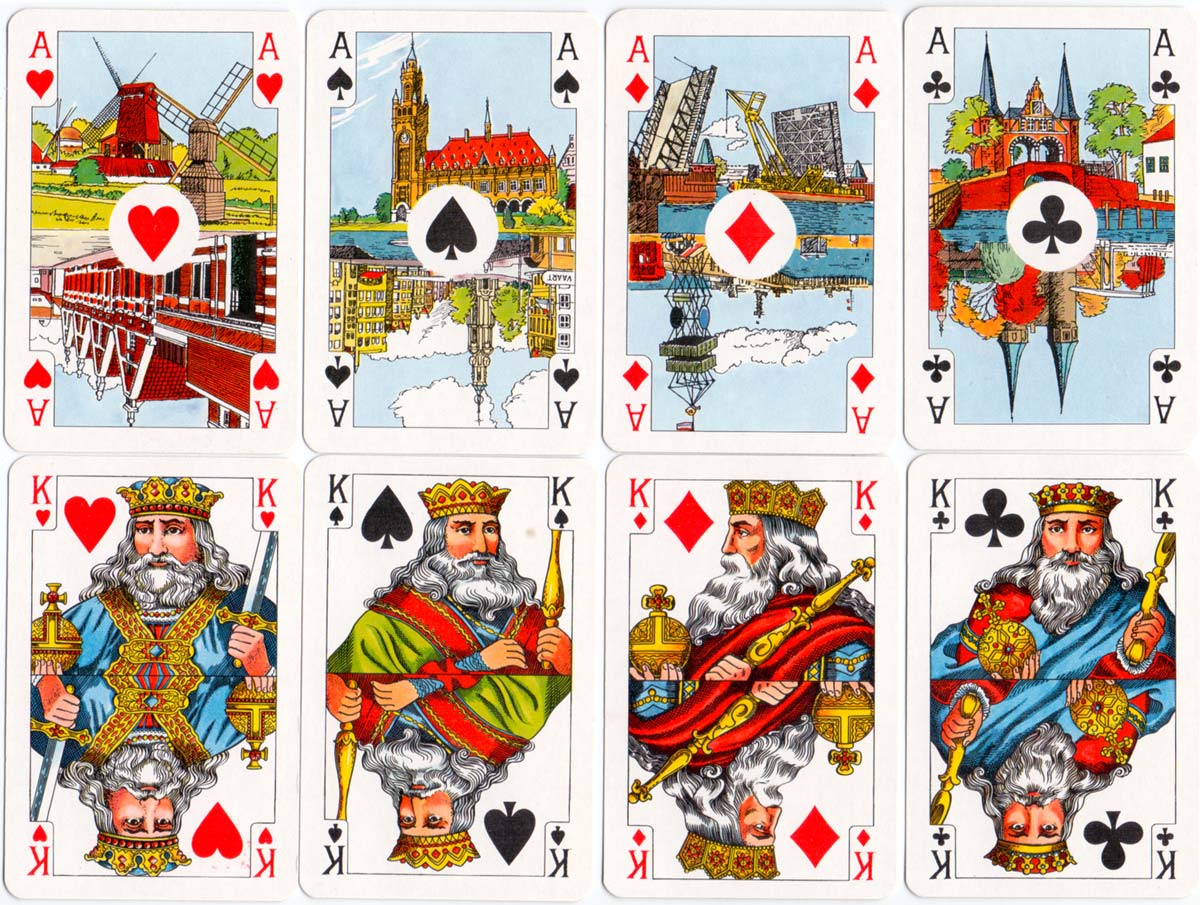
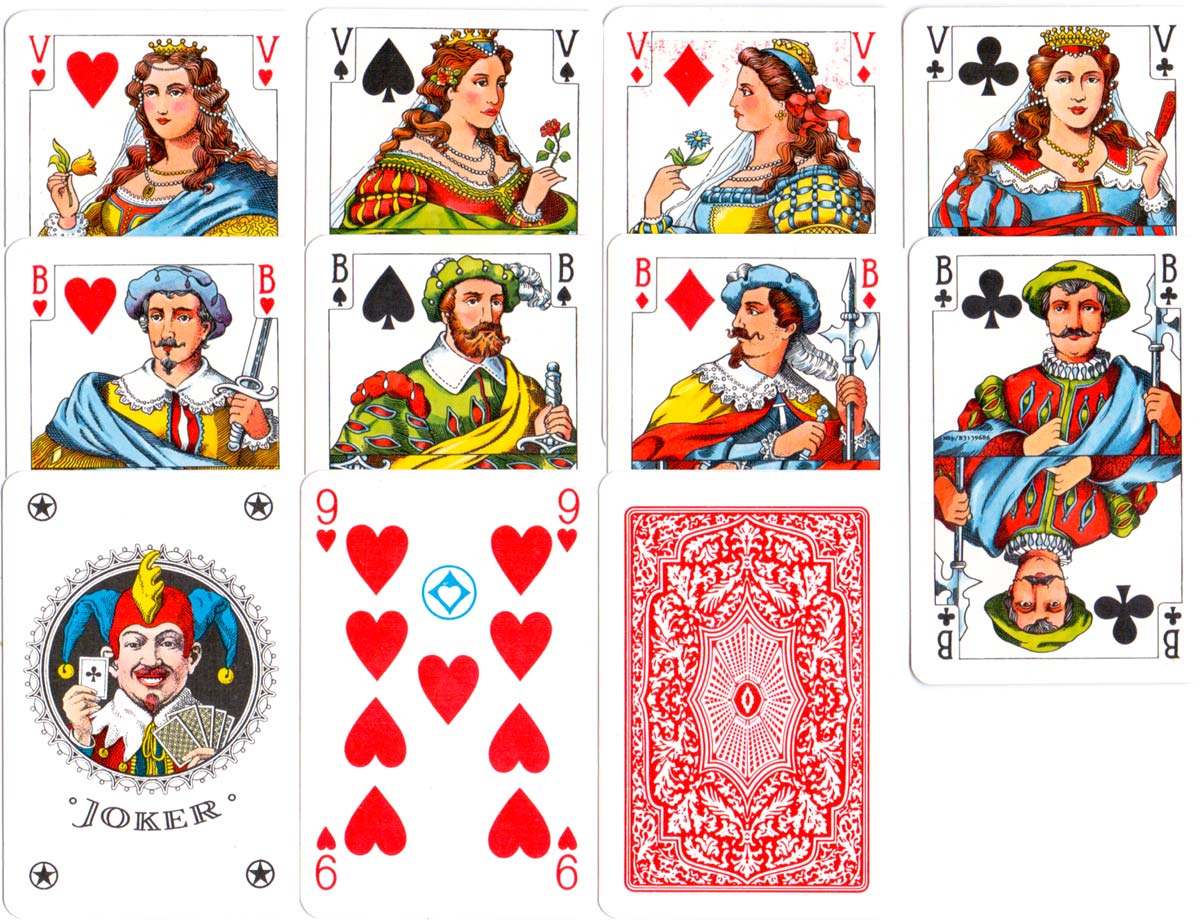
Above: Rhineland Pattern for The Netherlands by F. X. Schmid, c.1990.
Rhineland Pattern by Ferd Piatnik & Söhne, Vienna, 1996
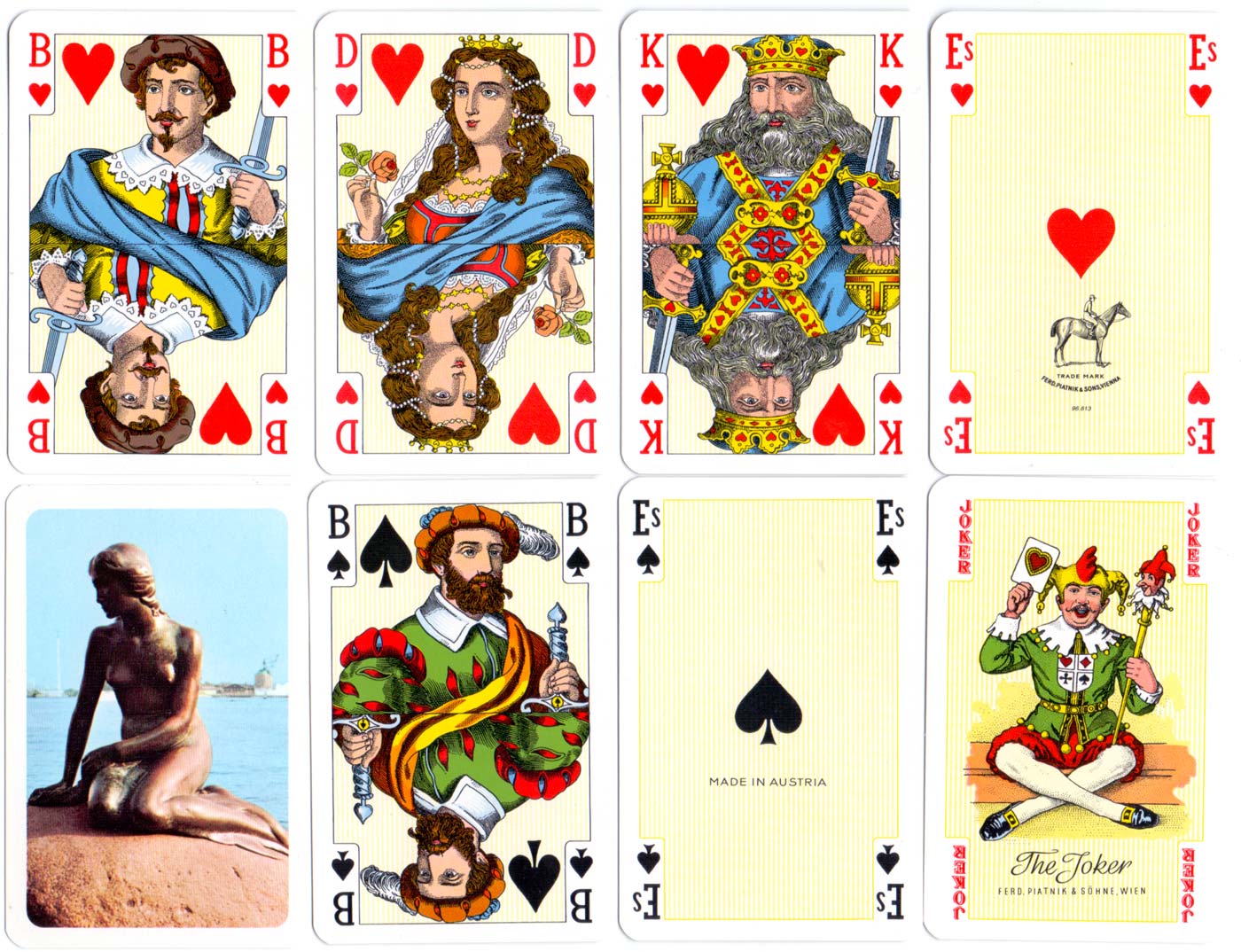
Above: Rhineland Pattern for Copenhagen by Ferd Piatnik & Söhne, Vienna, 1996.

By Rex Pitts (1940-2021)
United Kingdom • Member since January 30, 2009
Rex's main interest was in card games, because, he said, they were cheap and easy to get hold of in his early days of collecting. He is well known for his extensive knowledge of Pepys games and his book is on the bookshelves of many. His other interest was non-standard playing cards. He also had collections of sheet music, music CDs, models of London buses, London Transport timetables and maps and other objects that intrigued him.
Rex had a chequered career at school. He was expelled twice, on one occasion for smoking! Despite this he trained as a radio engineer and worked for the BBC in the World Service. Later he moved into sales and worked for a firm that made all kinds of packaging, a job he enjoyed until his retirement. He became an expert on boxes and would always investigate those that held his cards. He could always recognize a box made for Pepys, which were the same as those of Alf Cooke’s Universal Playing Card Company, who printed the card games. This interest changed into an ability to make and mend boxes, which he did with great dexterity. He loved this kind of handicraft work.
His dexterity of hand and eye soon led to his making card games of his own design. He spent hours and hours carefully cutting them out and colouring them by hand.

Activity for Rhineland Pattern
Sign in to comment or save this article.

Related Articles
Munich is Trumps
Famous men and women associated with Munich on a pack with dual suits.
Das Nassauische Kartenspiel
Pack conceived by Berthold Conradi, commemorating the 700th anniversary of the granting of town righ...
Englische Karten nr.190
Dondorf Nr.190“Englische Karten”, 1867-1895.
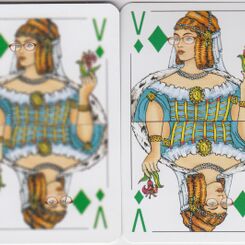
Specsavers playing cards
to help you see better when playing cards
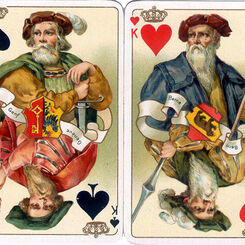
Schweizer Trachten
Schweizer Trachten No.174 (Costumes Suisses) by Dondorf.
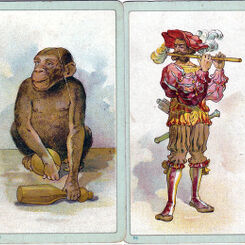
Zwarte Piet
Zwarte Piet by Dondorf for the Dutch market, 1906.
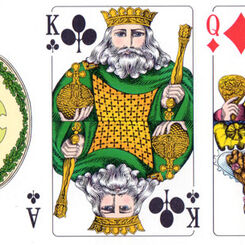
Rhineland Pattern by KZWP
Rhineland pattern by KZWP.
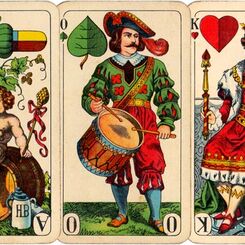
Later Bavarian Pattern
Later Bavarian single-ended pattern by Vereinigte Altenburg-Stralsunder Spielkarten-Fabriken
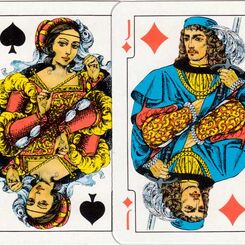
Kasztelanskie
“Kasztelańskie No. 460” playing cards manufactured by Krakowskie Zaklady Wyrobów Papierowych, Crakow...
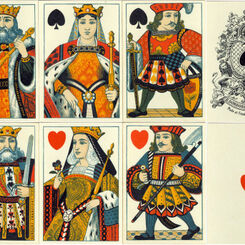
Birma Karte or Englische Karten
Based upon older ‘standard’ patterns, the Kings and Queens are three-quarter length figures whilst t...
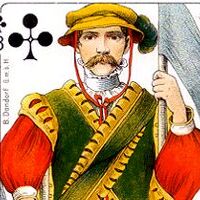
Hauptstadte Spiel
Each Ace shows views of two European capital cities.
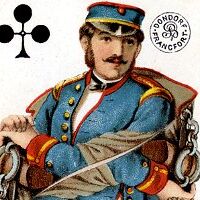
Fynste Java Speelkaarten
Dondorf's "Fynste Java Speelkaarten No.17" was published to commemorate the second marriage of King ...
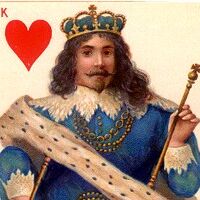
Whist No.178 ‘Stuart Zeit’
Although not historically accurate this example is subtitled “Stuart period”, with rich costumes cre...
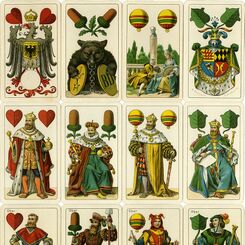
Einköpfige Deutsche Spielkarte No.303
Dondorf's ‘Einköpfige Deutsche Spielkarte No.303’ (‘Single-ended German Playing Cards’) were produce...
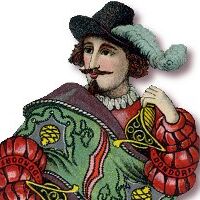
Club Karte
There have been many variations in the design of “Club Karte” including the introduction of borders,...
10: Playing Cards in Germany
The playing card manufacturers of Germany from 1900 until 1939 provide a complicated set of relation...
Tarot Microscopique
French-suited tarot cards made by B. Dondorf, c.1870.
Polish Playing Cards
Poland has been involved in playing card production since the 15th century.
Most Popular
Our top articles from the past 60 days


Stephen Scharber
07 March 2026, 04:18SavedSaved this article to Stephen Scharber's Collection
Glo Lexa
28 April 2026, 00:43SavedSaved this article to Suit systems