L’Utile col Diletto
Geographical and Heraldic Tarocchi cards from Bologna, 1725.
“L’Utile col Diletto, ossia geografia intrecciata nel giuoco de Tarocchi”
Geographical and Heraldic Tarocchi cards, Bologna, 1725

A flood of educational cards appeared during the seventeenth and eighteenth centuries, mostly geographical or heraldic, although the trend had begun even earlier. An interesting tarot deck was produced in 1725 by Rev. Luigi Montieri as an educational game in order to teach geography, heraldry and European politics. The Trump cards contain geographical data and the numeral cards armorial shields of who was important at the time. Every card has a stencil-coloured image or suit symbol in the top quarter of the card so that it can be used as a pack of cards. It so happened that Trump No.21 (Il Matto) describes the government of Bologna as ‘mixed’, although technically at that time Bologna was part of the Papal States. This annoyed the papal legate, Cardinal Ruffo, who arrested the priest and all the staff involved in the publication. An edict followed banning the deck and ordering seizure of all copies which were burned.
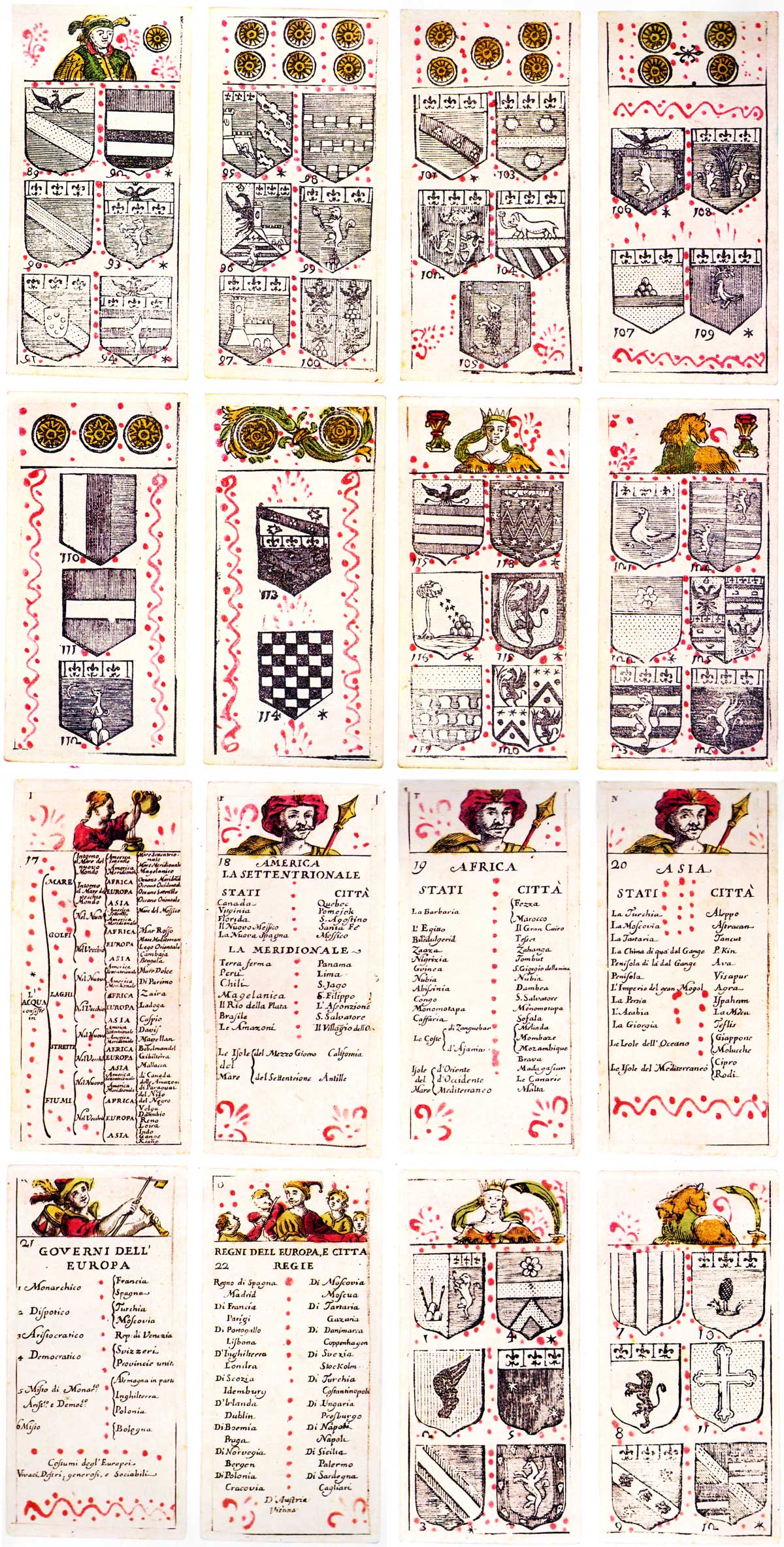
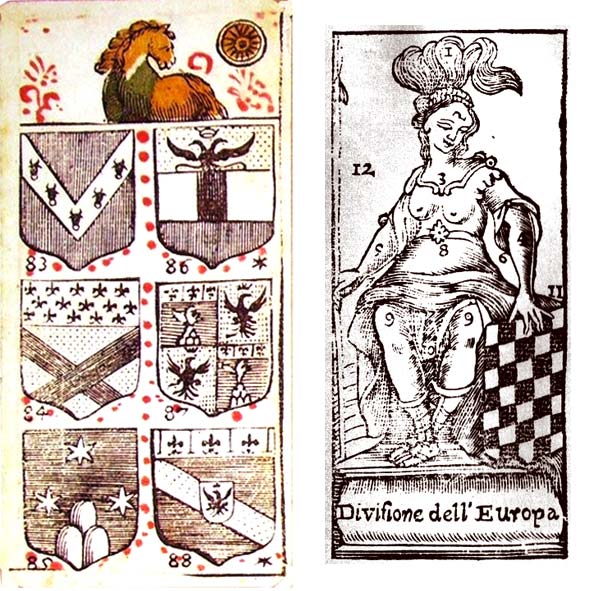
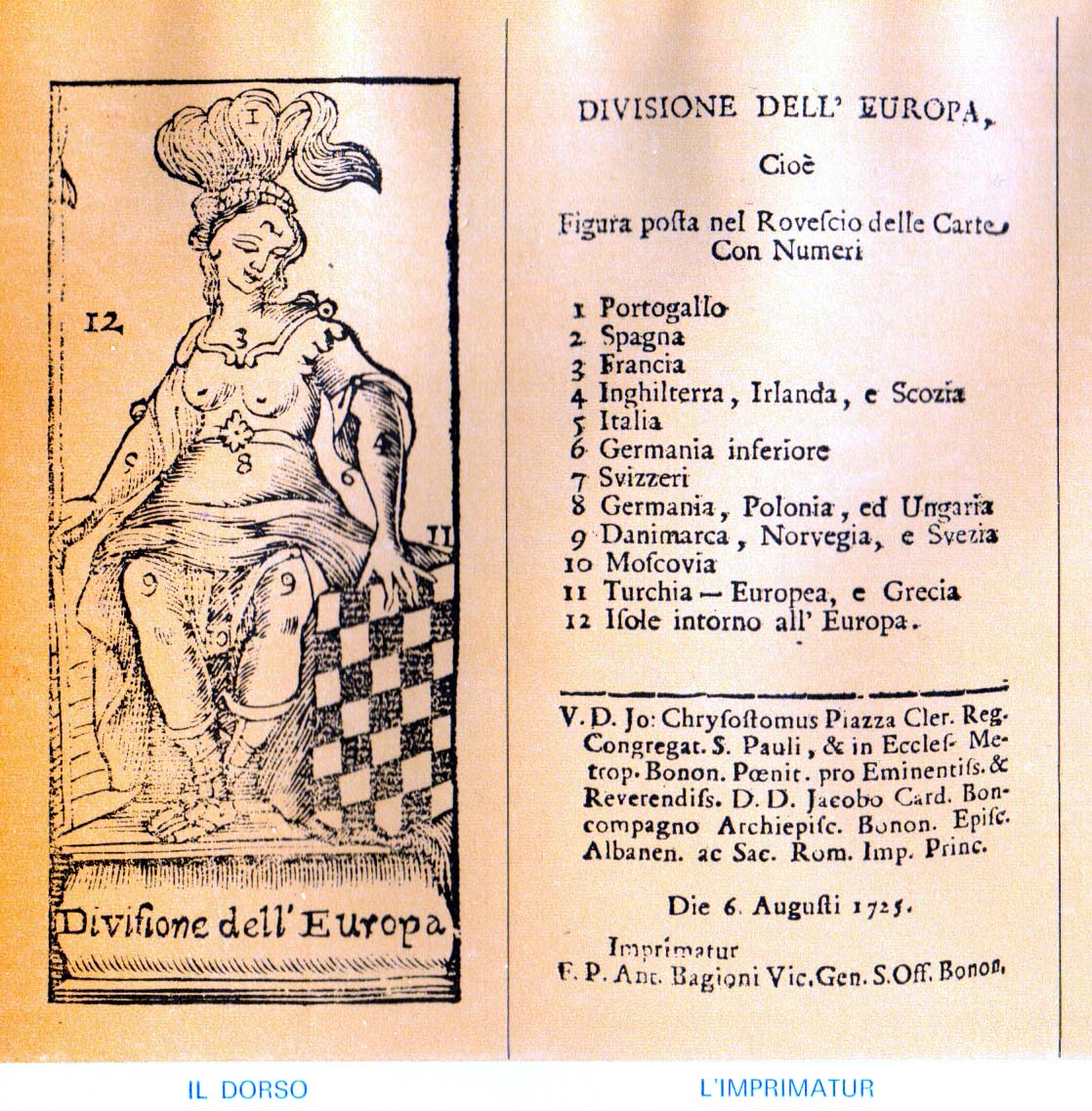
Above & left: “L’Utile col Diletto, ossia geografia intrecciata nel giuoco de Tarocchi”, a set of 62 Geographical and Heraldic Tarocchi cards created by Luigi Montieri and published in Bologna, 1725. The reverse shows an allegorical figure titled “Divisions of Europe”. The accompanying booklet titled “L'utile col diletto, ossia geografia intrecciata nel Gioco dei Tarocchi, con le insegne degli Illustrissimi ed Eccelsi Signori Gonfalonieri ed Anziani di Bologna dal 1670 al 1725” gives a key to the heraldic attributions and divisions of Europe which are illustrated on the cards. The Trump cards contain the geographical tables and the minor cards the armorial shields. The former are etchings, the latter woodcuts. Every card has its symbol or suit-mark at the top. This is of course a non-standard version of the tarocchino of Bologna; originally the 2, 3, 4 and 5 of the numeral cards were omitted, but in the present sequence the 7, 8, 9 and 10 of each suit are omitted, probably to save space in the top parts of the cards.
This elaborate production involved preliminary research and then organising woodcuts, etchings, stencil colouring, turned-over backs and a separate explanatory booklet. These turned-over backs sometimes obscured parts of the image on the front but produced a very sturdy card. In particular the small capital letters on the 22 trumps are sometimes obscured, which when arranged in descending order, with the Fool at the bottom, form the words: LOUIS C MONTIERI INVENTOR.
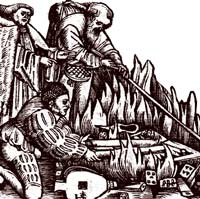
The deck was suppressed soon after publication by order of the Pope on account of being considered vain and improper, and for describing the government of Bologna as ‘mixed’. An edict followed ordering seizure of all copies which were burned. Rev. Luigi Montieri and the staff involved in the publication were arrested. However, the scandal was petty and might have aroused resentment in a city proud of its ancient liberties. Following some diplomatic efforts the case was dropped and three days later all those arrested were released, but the ban remained in place so it was not possible to print more copies. An original copy survives in the Museum of the city of Bologna. Cards illustrated from the facsimile edition by Edizioni del Solleone, 1973.
REFERENCES
Arienti, Vito: Il Solleone, dieci anni di azioni promozionali, editoriali, provocatorie di amicizia, di collezionismo nel mondo Europeo della cartagiocofilia 1969-1978, Edizioni del Solleone, Lissone (Milano) 1978.
British Museum : number 1896,0501.137 ►

By Simon Wintle
Spain • Member since February 01, 1996
I am the founder of The World of Playing Cards (est. 1996), a website dedicated to the history, artistry and cultural significance of playing cards and tarot. Over the years I have researched various areas of the subject, acquired and traded collections and contributed as a committee member of the IPCS and graphics editor of The Playing-Card journal. Having lived in Chile, England, Wales, and now Spain, these experiences have shaped my work and passion for playing cards. Amongst my achievements is producing a limited-edition replica of a 17th-century English pack using woodblocks and stencils—a labour of love. Today, the World of Playing Cards is a global collaborative project, with my son Adam serving as the technical driving force behind its development. His innovative efforts have helped shape the site into the thriving hub it is today. You are warmly invited to become a contributor and share your enthusiasm.

Activity for L’Utile col Diletto
Sign in to comment or save this article.

Related Articles
Learning to play Cribbage
I learned to pay cribbage when I was very young, aged around six or seven.
Carte Romantiche Italiane
Scenes of life and the theatre in Milan towards the second half of the 19th century.
Carte Osteologiche
Skulls and bones of all descriptions have become the suits and pips in this 40-card pack from Italy....
Schwarze Katze (or Gioco del Gatto Nero)
Reproduction of a 40-card transformation pack with designs by “WS”, adapted for the game of Black Ca...
Minchiate Fiorentine
Minchiate Fiorentine created by Costante Costantini, published by Edizioni del Solleone.
Il Mercante in Fiera del Solleone
Traditional Italian card game with bold designs by Costante Costantini.
Italia playing cards
Small, narrow cards designed by Osvaldo Menegazzi, bearing a strong resemblance to a Swedish pattern...
Natural History Tarocchi
Natural History Tarocchi by Ferdinando Gumppenberg, Milan.
Carte Méthodique
Reproduction of a French pack by François Silvestre intended to teach heraldry, produced in Paris in...
Jeu Grotesque
Jeu Grotesque was first published in France c.1800.
Sola-Busca Tarocchi
The Sola-Busca Tarocchi, c.1491
Arms of English Peers
The Arms of English Peers playing cards were first published in 1686. Heraldry, or a knowledge of th...
Mitelli ‘Gioco di Passatempo’
Il Gioco di Passatempo contains 40 figurative playing cards depicting moral virtues and vices, dated...
Portuguese pattern
19th century Portuguese pattern, re-printed from original woodblocks.
Minchiate Fiorentine, 17th C.
17th century Minchiate cards reprinted from the original woodblocks.
Corona Ferrea
Trumps depict historical scenes primarily of the political period known as the Holy Roman Empire fro...
Piedmont Pattern
The Piedmont pattern is a very close relative to the French 'Paris' pattern. The courts are not name...
The Visconti-Sforza Tarot, c.1460
This pack of tarot cards appears to have have been made in the Bembo workshop in Cremona for Bianca ...
Neapolitan Pattern
Cartine da Gioco Vesuvio miniature Neapolitan pattern.
Hand-Painted Tarocchi Cards
Hand-painted Tarocchi cards sometimes known as ‘Charles VI tarot’, North Italy, 1475-1500.
Most Popular
Our top articles from the past 60 days