


Antonio Brugada (Madrid, c.1808)
Una temprana aproximación al modelo gaditano.
English Summary: This rare Spanish-suited pack was produced in Madrid around 1808 by Antonio Brugada, a cardmaker associated with the Royal Playing Card Factory (Real Fábrica de Naipes de Madrid). Its importance lies in the fact that it appears to anticipate several features later associated with the Cádiz pattern, known from the Marchand pack of 1812, generally regarded as the earliest surviving example of that pattern. The pack provides valuable evidence for the development of Spanish playing-card patterns during a period of transition immediately preceding the emergence of the Cádiz model from the earlier Spanish National pattern.
Esta rara baraja española fue producida en Madrid hacia 1808 por Antonio Brugada, fabricante vinculado a la Real Fábrica de Naipes de Madrid. Su principal interés radica en que anticipa varios rasgos que más tarde caracterizarían al denominado modelo de Cádiz, conocido por la baraja de Marchand de 1812 ¹, considerada generalmente el ejemplo más antiguo conservado de dicho modelo.

Anuncio de 1775, recorte de prensa. Haz clic en la imagen para ampliarla.
La historia de los Brugada presenta algunas incertidumbres. Un anuncio de 1775 indica que Antonio Brugada había estado anteriormente al frente de la Real Fábrica, aunque la documentación conservada es incompleta. Se sabe que un Brugada seguía relacionado con la fábrica en 1804, pero no siempre es posible determinar si las referencias corresponden a Antonio o a su hijo Juan Brugada, quien continuó la actividad familiar a nombre de Juan de Brugada e Hijo hasta 1835. La transformación de la Real Fábrica en Fábrica de Tabacos por orden de José I Bonaparte en 1809 añade nuevas dificultades para averiguar la posterior ubicación y actividad de la Real Fábrica.
Se conocen muy pocos ejemplares de naipes atribuidos a Brugada, lo que confiere especial interés a esta baraja. El ejemplar conservado consta de 40 cartas; no obstante, se desconoce si fue fabricado originalmente con esa composición para algún juego en particular o si faltan los ochos y nueves de una baraja completa de 48 naipes.
Más allá de las incertidumbres sobre su origen exacto, este conjunto constituye un valioso testimonio de la evolución de los modelos españoles en los años inmediatamente anteriores a la consolidación del modelo gaditano.

Antonio Brugada (Madrid, c.1808)
De Brugada no se conocen más allá de tres barajas: la del WCMPC, otra en el Museo Fournier y otra más en manos particulares, lo que convierte a este ejemplar en una referencia importante para estudiar su producción. APG.
Reference
1. WCMPC Collection : L Marchand, Cadiz, 1812 ►

By Alberto Pérez González
Spain • Member since December 21, 2016
I am a researcher and my primary interest lies in playing cards manufactured in Cádiz (not the 'Cádiz' type in general). I have authored several articles in the annual Asescoin magazine 'La Sota'. Among them are: “Madrid’s Playing Cards from the 17th to the 20th Century”; “New Contributions to the Study of Playing Cards in the Valencian Country”; “The Fouquets: 'Navarra pattern' in the Netherlands”; “Divided Playing Cards: Combining Ingenuity with Skill”; “Here Be Dragons: Speculations on the Evolution of the so-called 'Portuguese' Pattern”; “Playing Cards in Chile: News and Chronicles from the Viceroyalty Era”...
I have written and designed the book “Los Naipes de Cádiz” (296 pp). Additionally, I have contributed to the design, layout, and collaboration in Enrique García Martín’s book “Naipes, Arte y Fantasía” (444 pp).

Activity for Antonio Brugada (Madrid, c.1808)
Sign in to comment or save this article.

Related Articles
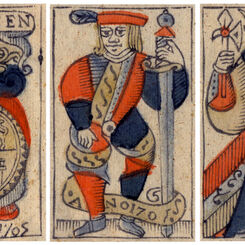
The archaic “Classic Madrid” Pattern
Centralisation, standardisation and consolidation of the Spanish card tradition.
La baraja de Almagro
De la chimenea al monumento nacional: la baraja de Almagro y el renacer del corral de comedias.
Early German playing cards
Some early examples of popular German playing cards from the XV and XVI centuries.
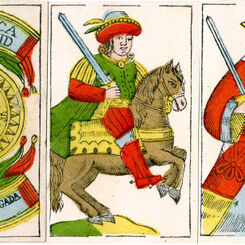
Juan de Brugada
Spanish National pattern by Juan de Brugada e hijo, Real Fábrica de Madrid, 1821.
Toledo, 1584
Archaic Spanish-suited deck with 48 cards made in Toledo in 1584.
64: The descendants of the French regional patterns: 2
A continuation oF the development of the off-spring of the Paris patterns and a few examples of how ...
Trentine Pattern
Trentine Pattern
Navarra Pattern, 1682
Navarra pattern produced for the Pamplona General Hospital Monopoly in 1682.
Suicide King
The King of Hearts, holding a sword behind his head, is sometimes nicknamed the “Suicide King”. He c...
Malta
The so-called ‘Dragon Cards’, with winged monsters on the four Aces, are an enigmatic aspect of earl...
Lyon Pattern type iii
This pattern was used in various parts of eastern France but was ultimately replaced by the official...
1: Playing Cards and their History: An Introduction and some links to other sites
What was considered the first mention of playing cards in England is in 1463 when Edward I banned th...
Netherlands
Playing cards have been known in the Low Countries since the 14th century
Navarra, XVII Century
Facsimile of 17th century Spanish-suited playing cards produced by Erregeak, Sormen S.A., Vitoria-Ga...
History of Blackjack
Over the years the origin of Blackjack, like many other games, has eluded researchers for a long tim...
Paris Pattern
The Paris pattern was established as such around the middle of the seventeenth century (based, perha...
Mamluk Playing Cards
Nã'ib, the game of lieutenants... these cards are amongst the earliest Arabic playing cards ext...
Italian Playing Cards
The first reliable evidence that playing cards were being used in Italy is from 1376, when a game ca...
The History of Playing Cards
Playing cards appear in European records in the late 14th century, but their earlier history lies fu...
History of English Playing Cards & Games
The History of English Playing Cards dates probably from the mid 15th century
Most Popular
Our top articles from the past 60 days


