


Four Empires - Clemente Roxas
‘Four Empires’ playing cards produced by Clemente Roxas, c.1805.
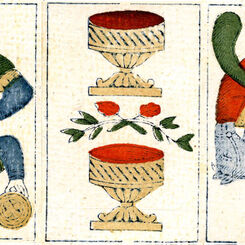
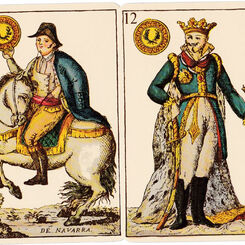
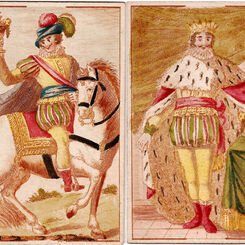
Clemente Roxas produced this fine, luxury pack of playing cards on the theme of ‘four empires’ or ‘four quarters of the world’ reflecting aspects of Spanish history in around 1805. The courts in the four suits depict full-length costume figures of American Indians, the Arabs, the Roman empire and the Spanish colonists of America. It was produced with or without index numbers. The letters "Dn. C.R." can be seen on the base of the pedestal on the king of cups. The ace of coins bears the arms of Castile and León surmounted by crown. Beneath this a lion grasps a sword and a globe. Columns and drapery serve as decorative support to the arms, whilst a tower and a ship can be recognised in the distance. On the four of coins four naked children sit around a table playing cards.
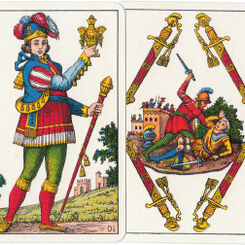
On the ace of cups two satyrs hold the large cup symbol steady while two naked putti cavort on the four of cups. The ace of clubs shows two turbaned figures raising the suit symbol, whilst the four of clubs has a vignette depicting a party of naked children dancing in a circle; the four of swords shows Mars being aroused by a genius holding a blazing torch as the god reaches for his helmet.
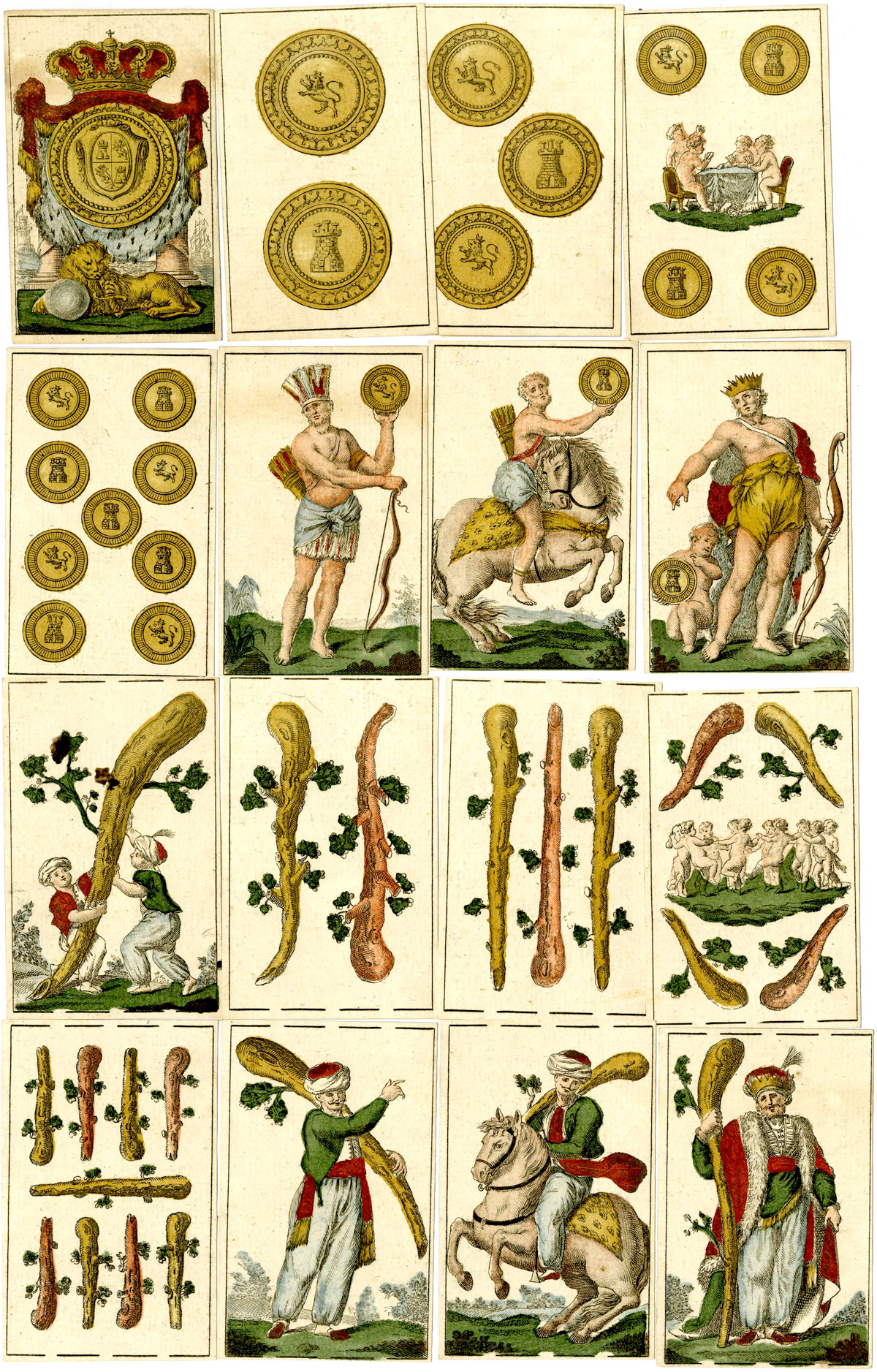
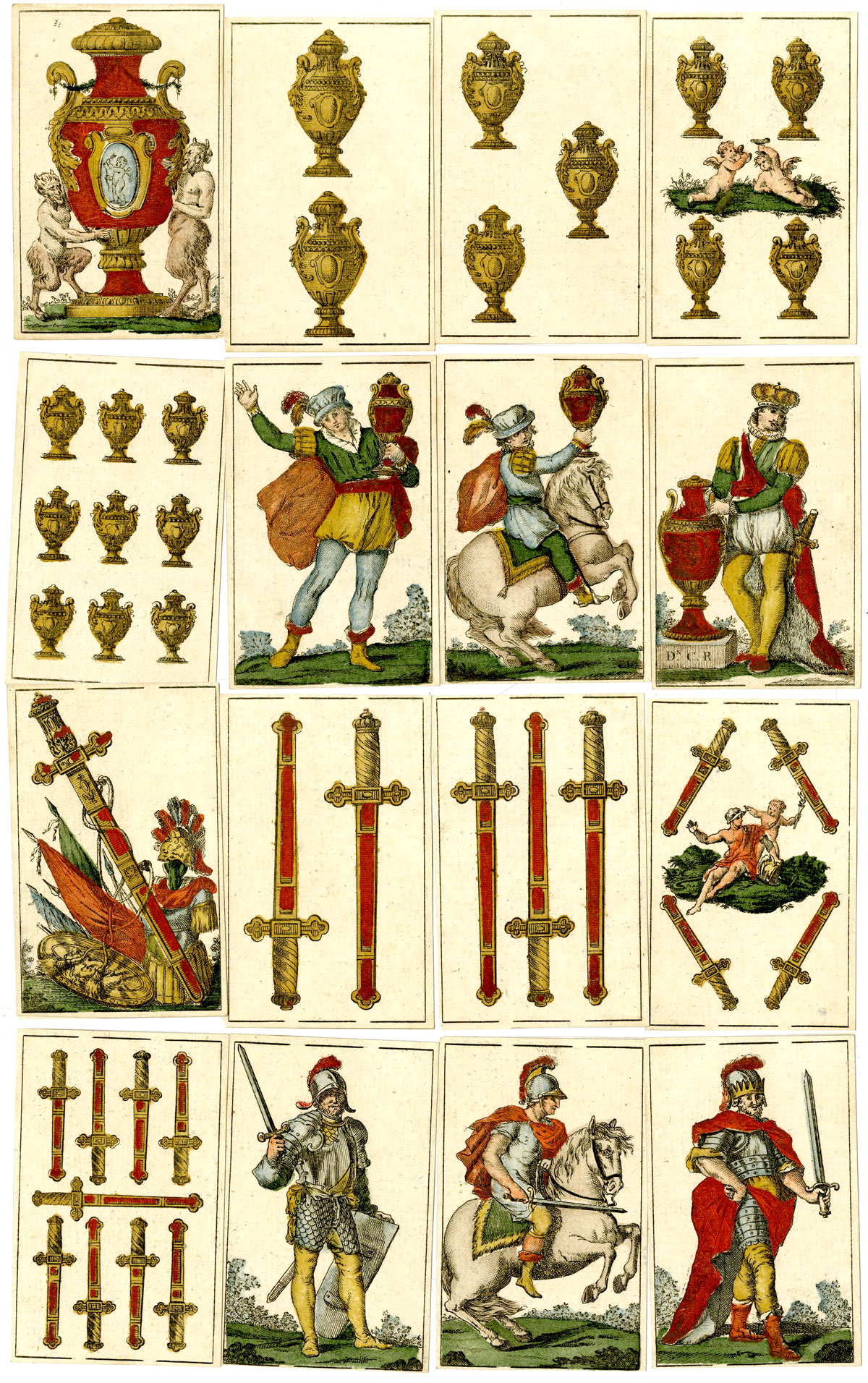
Above: ‘Four Empires’ playing cards produced by Clemente Roxas, c.1805. 48 cards. Hand-coloured etching, backs printed in green with a design of entwined ivy leaves. © The Trustees of the British Museum • Clemente Roxas: four corners of the globe►
References
Willshire, W. H.: A Descriptive Catalogue of Playing and Other Cards in the British Museum, Trustees of the British Museum, 1876, reprint 1975 (Spanish 263).
WCMPC Collection: Acquisition No. 556►

By Simon Wintle
Spain • Member since February 01, 1996
I am the founder of The World of Playing Cards (est. 1996), a website dedicated to the history, artistry and cultural significance of playing cards and tarot. Over the years I have researched various areas of the subject, acquired and traded collections and contributed as a committee member of the IPCS and graphics editor of The Playing-Card journal. Having lived in Chile, England, Wales, and now Spain, these experiences have shaped my work and passion for playing cards. Amongst my achievements is producing a limited-edition replica of a 17th-century English pack using woodblocks and stencils—a labour of love. Today, the World of Playing Cards is a global collaborative project, with my son Adam serving as the technical driving force behind its development. His innovative efforts have helped shape the site into the thriving hub it is today. You are warmly invited to become a contributor and share your enthusiasm.

Activity for Four Empires - Clemente Roxas
Sign in to comment or save this article.

Related Articles
Luxury No. 2167
A Piatnik classic that lives up to its title.
The Art of Erté
Luxury playing cards displaying artwork by Erté, published in 1983 by Sobranie of London.
Loewe: Moda Europea Siglo XVII
Luxury pack for the Spanish fashion house Loewe, with 17th century costume designs by Margot Hamilto...
From Empire to Commonwealth
Flags, locations and admission dates of 52 Commonwealth countries.
Amorcillos
‘Amorcillos’ (Cupids), a masterpiece from the golden age of Spanish playing cards by Clemente Roxas,...
Cartes Universelles
Four Continents fantasy playing cards by Daveluy, Bruges, Belgium, 1860-1885.
Four Continents playing cards
made by Fulladosa y Comp of Barcelona
Cards Eh!
“Cards Eh!” playing cards with general information about Canada produced by JK Productions of Richmo...
Neptune No.105 Playing Cards
An exotic pack made by A.Van Genechten of Turnhout
Alphonse Arnoult Spanish-suited pack
Luxurious Spanish-suited pack made by Alphonse Arnoult, Paris, France, c.1850.
Clemente Roxas double-ended Spanish pack
Double-ended Spanish-suited playing cards published by Clemente de Roxas in Madrid, 1814.
Sarde Pattern
Sarde pattern published by Modiano, c.1975, based on early XIX century Spanish model.
Goyesca
Baraja ‘Goyesca’ facsimile of original deck published in Madrid by Clemente de Roxas, 1814.
Baraja “Neoclásica”, Madrid, 1810
Baraja “Neoclásica” engraved by José Martínez de Castro, first published by Clemente Roxas, Madrid, ...
Game of Cities
Game of Cities published by E.E Fairchild Co, 1932.
Vier-Erdteile c.1870
Dondorf's Luxus-Spielkarte “Vier-Erdteile” (“Four Continents”) was first published in c.1870 and has...
Dondorf
The luxury playing card factory founded in Frankfurt am Main by Bernhard Dondorf in 1833 existed for...
Silver Cards from Peru
Spanish-suited silver cards, richly embellished and enamelled, from a former Spanish Viceroy in Peru...
José Martínez de Castro, page 2
The most noteworthy feature of its history is that this design has since been adopted for use in Sar...
The Visconti-Sforza Tarot, c.1460
This pack of tarot cards appears to have have been made in the Bembo workshop in Cremona for Bianca ...
Most Popular
Our top articles from the past 60 days


