


Hodges’ Constellations
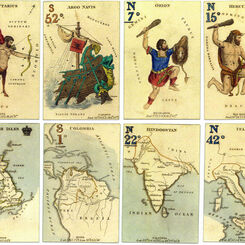
Hodges’ pack dealing with astronomy had numeral cards carrying diagrams of constellations and their pictorial representations.
Charles Hodges’ Constellation cards, 1828
Hodges’ pack dealing with astronomy, the ‘Astrophilogeon’, was first published around 1828 in conjunction with a series of map cards. These astrological cards carried diagrams of constellations and their pictorial representations. These include the twelve Zodiac signs which is the name given to that part of the sky through which the sun travels during the year:
The Ram, the Bull, the Heavenly Twins,
And next the Crab, the Lion shines -
The Virgin and the Scales,
The Scorpion, Archer, and the Goat,
The Man that Bears the Watering Pot,
And Fish with glittering tails.
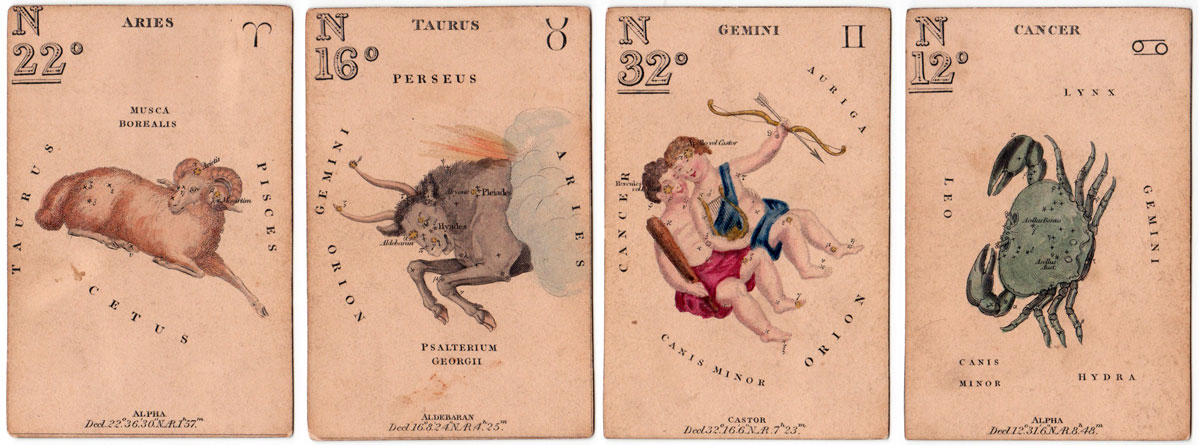
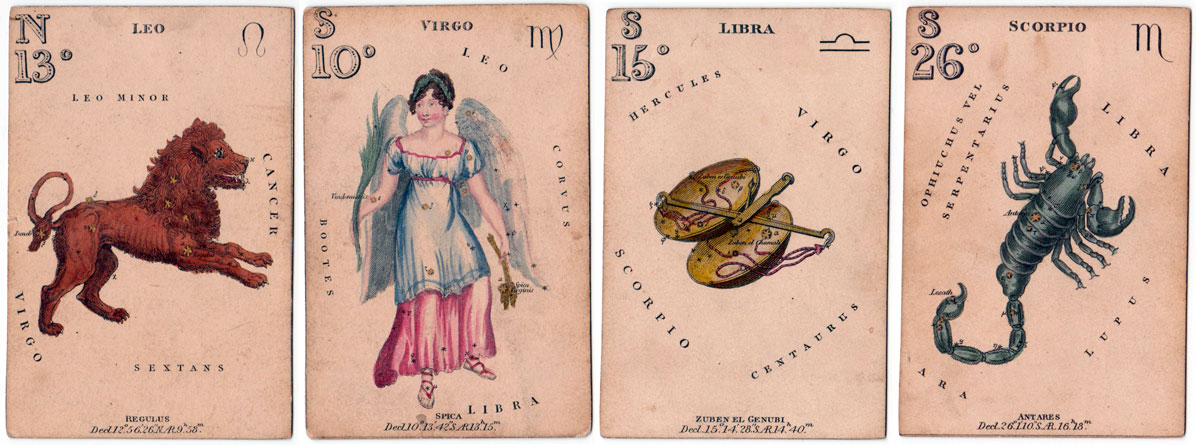
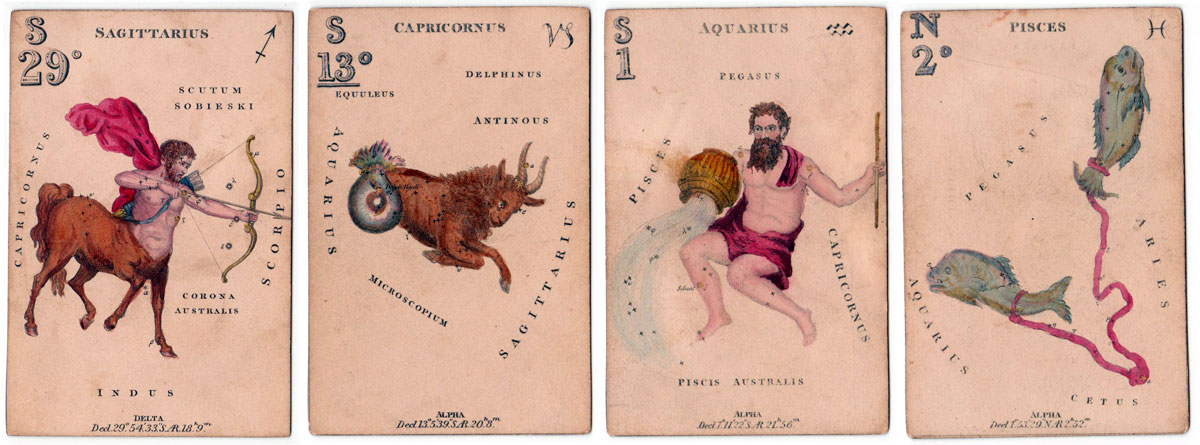
Apart from the 12 Zodiac signs, or constellations, the rest of the cards depict other constellations which are given the shapes of gods or godesses, ancient heroes or heroines, beasts and birds, all playing their part in the great heavenly drama. On dark nights, perhaps while guarding the sheep from the wolves, the Greek father would teach his son the names of the constellations and their positions. Each one had a story. The Swan and the winged horse are flying an eternal race, while Andromeda struggles with her chains...
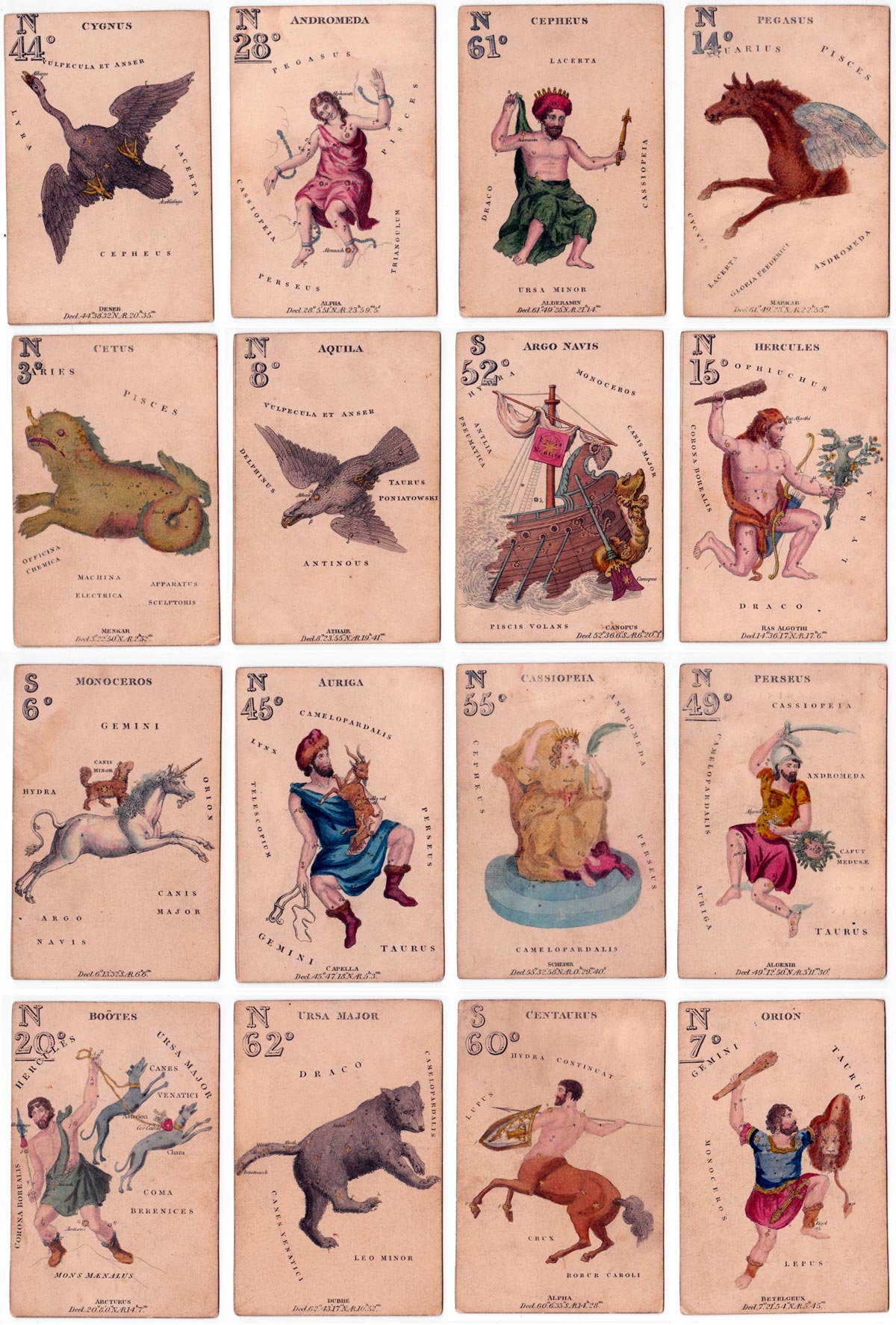
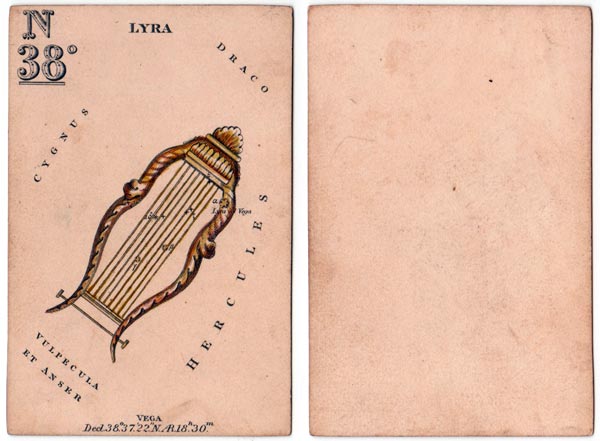
Above: Hodges' astronomy cards showed diagrams of constellations and their pictorial representations. Images courtesy Rex Pitts.
The Zodiac was established about 2000 B.C. by the Babylonians. It was adopted by the Greeks and regarded with superstitious awe. The various movements of the sun, moon and planets formed the basis upon which astrologers cast horoscopes.
These Constellation cards were published in conjunction with map cards, and the object of the game was to obtain pairs of map and constellation cards from similar parts of the terrestrial and celestial globes.

By Rex Pitts (1940-2021)
United Kingdom • Member since January 30, 2009
Rex's main interest was in card games, because, he said, they were cheap and easy to get hold of in his early days of collecting. He is well known for his extensive knowledge of Pepys games and his book is on the bookshelves of many. His other interest was non-standard playing cards. He also had collections of sheet music, music CDs, models of London buses, London Transport timetables and maps and other objects that intrigued him.
Rex had a chequered career at school. He was expelled twice, on one occasion for smoking! Despite this he trained as a radio engineer and worked for the BBC in the World Service. Later he moved into sales and worked for a firm that made all kinds of packaging, a job he enjoyed until his retirement. He became an expert on boxes and would always investigate those that held his cards. He could always recognize a box made for Pepys, which were the same as those of Alf Cooke’s Universal Playing Card Company, who printed the card games. This interest changed into an ability to make and mend boxes, which he did with great dexterity. He loved this kind of handicraft work.
His dexterity of hand and eye soon led to his making card games of his own design. He spent hours and hours carefully cutting them out and colouring them by hand.

Activity for Hodges’ Constellations
Sign in to comment or save this article.

Related Articles
Zodiac No. 1182
Constellations captured on cards.
Learning to play Cribbage
I learned to pay cribbage when I was very young, aged around six or seven.
Heathen Divinities
Handmade playing cards from the British Museum depicting classical Greek and Roman gods and goddesse...
Gone to Pot: Gardener’s playing cards
‘Gone to Pot’: special playing cards for keen gardeners, United Kingdom.
History of London illustrated playing cards
A catalogue in 54 cards of some of the treasures held within the Museum of London collections.
Possible early astrological playing cards
Two early woodcuts that I believe to be playing cards.
Ethics Education playing cards
Ethics Education playing cards produced by the Centre for Military Ethics at King’s College London, ...

Night & Day playing cards
‘Night & Day’ playing cards produced by London Underground, United Kingdom
Tea & Coffee Lovers playing cards
Tea & Coffee Lovers playing cards produced by Cultzilla.
House of Commons Playing Cards
House of Commons playing cards designed to serve as a civic guide to the UK Parliament.
Aesop’s Fables
Aesop’s Fables playing cards by I. Kirk, c.1759.
Pantheon or Heathen Mythology
Pantheon or Heathen Mythology cards for instruction of youth, c.1770.
Arms of English Peers
The Arms of English Peers playing cards were first published in 1686. Heraldry, or a knowledge of th...
Star Stack
Star Stack playing cards feature illustrations of famous astronomers and important astronomical cons...

University of Essex
Playing Cards produced for the University of Essex during 2005-2007.
De Reszke Cigarettes “What the Stars Say”
De Reszke Cigarettes “What the Stars Say” astrology cards issued by J. Milhoff & Co., 1934.
Suicide King
The King of Hearts, holding a sword behind his head, is sometimes nicknamed the “Suicide King”. He c...
Charles Hodges
Charles Hodges produced engraved geographical and astronomical decks, London, c.1827-30.
Zodiac Bridge
Zodiac Bridge was designed by René Marcel Rivière and printed by AGM Müller in c.1989. A different s...
Picture Show — Zodiac Fortune Telling Cards
Zodiac Celebrities fortune-telling cards presented with 'Picture Show' magazine, 1930. The cards wer...
Most Popular
Our top articles from the past 60 days


