


Luigi Del Pieve Minchiate
Luigi Del Pieve and the “Alli Sorte” Minchiate of Florence.

Among the quieter corners of Florentine print history, few names have been as elusive as Luigi Del Pieve. Until recently, only scattered references hinted that he had worked as a card maker in the early nineteenth century. That changed when four hand coloured Minchiate cards surfaced in my collection, all printed with Del Pieve’s name and the motto Alli Sorte.
These cards were produced in Florence circa 1805 to 1808, printed from woodblocks on handmade laid paper and coloured through stencils in warm ochres, vermilion or cinnabar reds, and verdigris greens. The group consists of The Chariot numbered X, Capricorn numbered XXVII, the Queen of Batons, and Aquarius numbered XXXII. Each bears the vertical printer’s legend DEL PIEVE on the face, while the backs show a dotted border design with a Mercury or Hermes like figure holding a caduceus above the words Alli Sorte, meaning by chance or to luck. The Minchiate zodiac series places Aquarius at number thirty two, which suits the present identifications.
In Florence there is a notable concentration of distinctive back designs and fiscal markings during the years of French administration. By the middle of the eighteen tens such motto backs largely decline as fiscal controls and evolving production methods reshape the trade. The Alli Sorte device sits within this tradition. Its Mercury figure evokes dexterity in play and commerce while also serving as a workshop signature. Parallel eighteenth century Minchiate in the British Museum confirm the standard Tuscan techniques of woodcut outline and stencil colour on laid stock.
The cards can be dated just before the appearance in Florence of the Francia fiscal stamp, which is seen on many Florentine packs during Napoleonic rule from about 1808 to about 1814. A well documented Del Pieve group within that window shows Francia and DelPieve ink stamps on trumps and courts together with the so called Poverino back that depicts a trumpeter on horseback within a dotted border. That same documented group records turn over edges where the back paper wraps to the face and gives card dimensions close to ninety eight by fifty eight millimetres. Set against that Francia era profile, the present quartet without Francia stamps appears to represent an earlier and independent Del Pieve production.
The Francia stamp belongs to the broader European practice of taxing playing cards and marking packs. For readers new to these marks and how they aid dating, the International Playing Card Society provides a clear primer that explains why such imprints are evidentiary.
Florentine packs frequently exhibit turn over edges in which the back paper is wrapped onto the face to form a narrow border. When present, turn over edges reinforce an artisanal finish. If absent, that can indicate a different finishing workflow while remaining consistent with hand production within the same workshop tradition. The Francia era Del Pieve example cited above makes this finish explicit.
Luigi Del Pieve and his workshop can be sketched from scattered notices tied to the Napoleonic and Restoration years. Del Pieve is recorded as producing playing cards in Florence in 1807 and 1808 in association with Giuseppe Busi. An unnamed Del Pieve is listed as making playing cards including Minchiate between about 1814 and 1819. By 1817 Gaetano Del Pieve is registered as working alone, and in 1827 he partners with Cosimo Adami, the collaboration continuing until about 1830. These points suggest a family atelier that bridged the Francia period, handing down blocks, skills, and customers from Luigi’s activity to Gaetano’s stewardship.
Surviving Francia era examples attributed to Del Pieve show the workshop’s materials and finish at close range. They are hand coloured woodcuts on laid stock, the trumps and courts carry ink stamps reading Francia and DelPieve, the backs bear the Poverino trumpeter within a dotted frame, the edges are finished with back paper turned over onto the face, and typical cards measure close to ninety eight by fifty eight millimetres. These traits align with Tuscan practice and provide a technical yardstick for comparing earlier or unstamped work such as the present Alli Sorte group.
To my knowledge, no other published example has been recorded with this exact Alli Sorte back that combines the DEL PIEVE face legend with a Mercury figure and motto on the reverse. While motto backs are known on earlier Italian Minchiate such as the British Museum alla Fortuna pack, the wording and iconography here appear distinct. In this light the quartet offers direct evidence that Minchiate was still being made entirely by hand in Florence on the eve of the Napoleonic fiscal regime, even as newer techniques such as lithography were beginning to spread elsewhere in Europe.
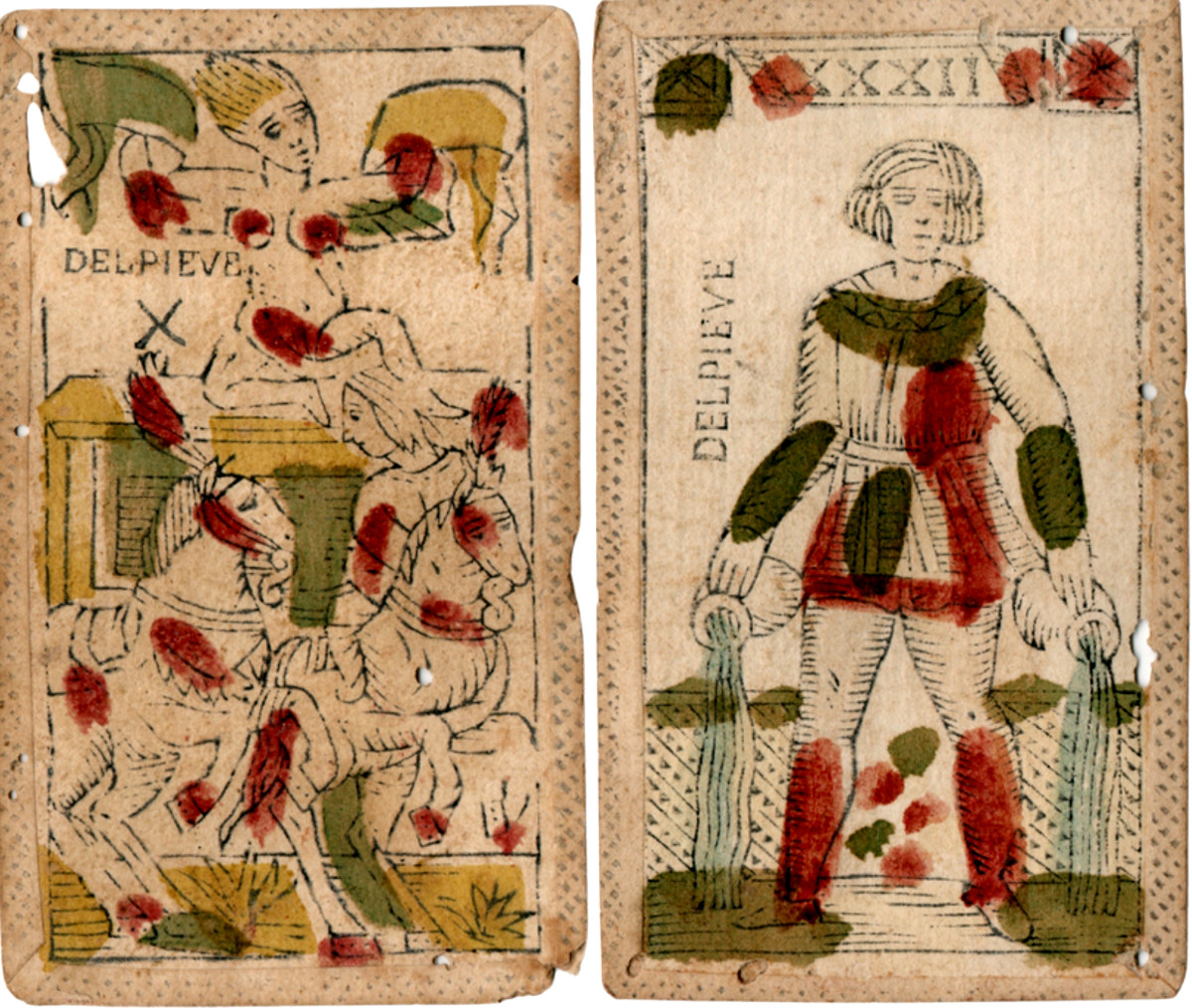
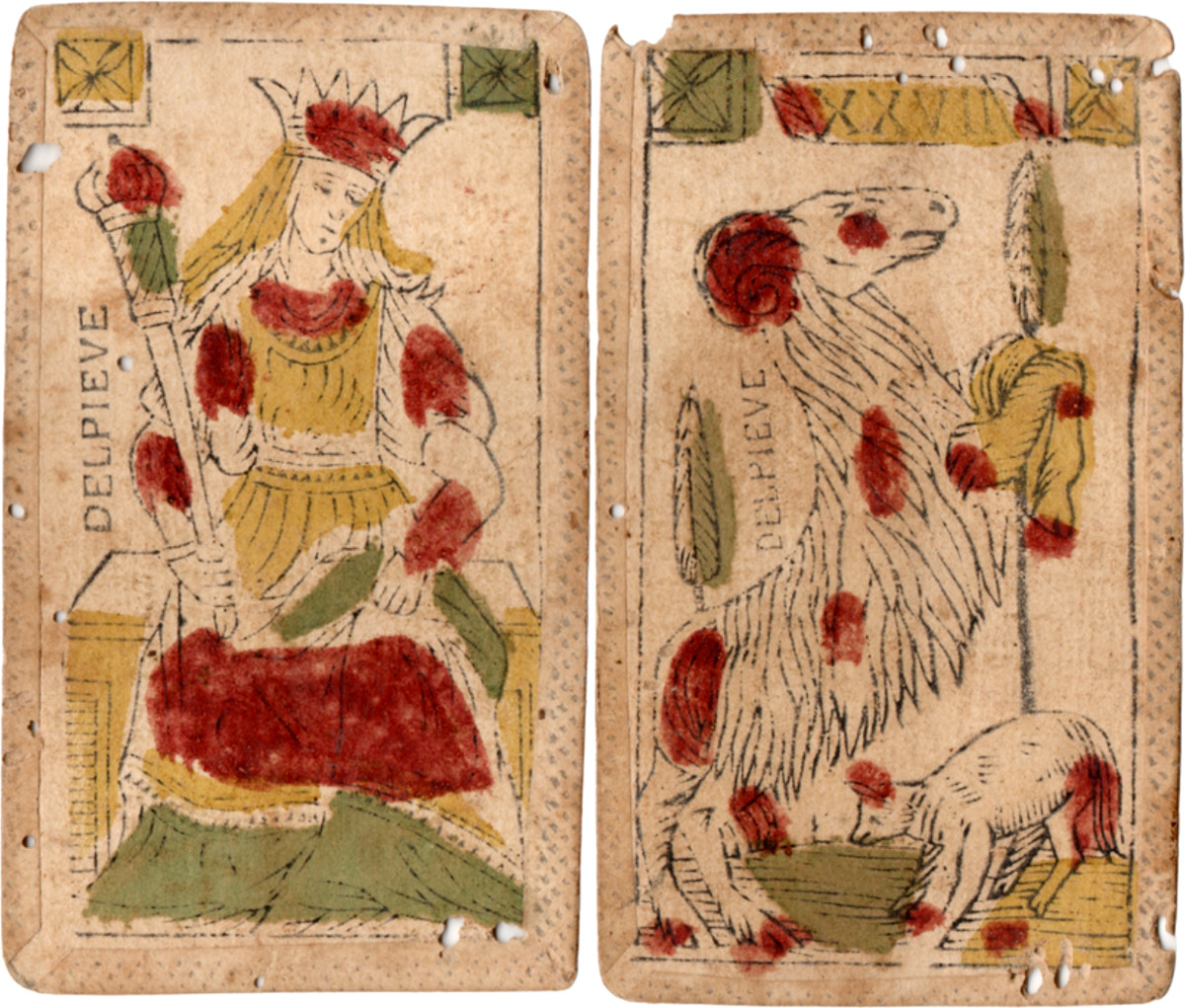
Above: four hand-coloured Minchiate cards by Luigi Del Pieve, Florence c. 1805 - 1808. Woodcut on laid paper with stencil colour, backs printed “Alli Sorte” showing Mercury with caduceus.
References
Berti & Gonard, Le Minchiate Fiorentine, Lo Scarabeo, 1994. Del Pieve (Francia Edition) partial deck, Dominic Winter Auctioneers, Sale 2103, Lot 67 (2018).
Dominic Winter Auctioneers, Lot 487, Italian playing cards, Minchiate pack, Florence, Del Pieve, circa 1808 to 1814. Records Francia and Del Pieve ink stamps on trumps and courts, the Poverino trumpeter back within a dotted border, turn over edges, and approximate card size of ninety eight by fifty eight millimetres. Demonstrates the Francia stamped Del Pieve corpus during the Napoleonic years and describes physical characteristics that serve as a benchmark for comparison.
Kaplan, S. R. Encyclopedia of Tarot, Vol. II (1986), pp. 290 - 296.
Tarot History Forum: Minchiate overview and ordering. Notes the extended Minchiate series and supports identification of Aquarius as number thirty two among the zodiac trumps. Serves as a specialist discussion point on numbering used by collectors and historians.
Trionfi dot com: Tuscany playing card production 1815 to 1861. Notes that Cosimo Adami begins in January 1827 together with Gaetano Del Pieve and continues alone from 1831. Supports the family workshop narrative and the Adami partnership in the later period.
British Museum - more early Michiate packs can be viewed online for comparison:
- British Museum, object number 1896,0501.39. Complete Minchiate with backs printed with Medici arms and the legend alla Fortuna, catalogued to the eighteenth century. Demonstrates that printed motto backs are securely present in the eighteenth century and provides a close comparator for a legend back on an Italian Minchiate pack.
- British Museum, object numbers 1876,0510,1009 to 1073. Minchiate group catalogued circa 1675 with Medici arms and the word Fortuna on the reverse. Demonstrates the existence of legend backs in Florence in the late seventeenth century and establishes the longevity of the motto back tradition.
- British Museum, object number 1896-0501-36. Incomplete Minchiate made up from several packs with printed backs and described as hand coloured woodcut on laid pasteboard, catalogued to the eighteenth century. Corroborates continued use of printed backs and hand coloured woodcut technique in Italian Minchiate.
Two later cards
This example does not have turned over edges.

Above: 2 Minchiate cards, c.1820.

By Vicky Visagie
South Africa • Member since October 28, 2025
Vicky is a researcher and collector dedicated to the preservation of historical tarot and occult cards. He has been interested in the tarot for many years and collects across many printers and countries to document the breadth of traditions rather than a single school. His work records makers and workshop practices, printing and colouring techniques, backs and stamps, and paper and finish details, providing evidence for reliable attribution and dating. Through careful cataloguing and conservation-minded handling, he seeks to safeguard the material record for future generations and to support scholars, curators and fellow collectors with clear, verifiable descriptions. He is honoured to serve as a custodian of these artefacts and to document them responsibly. Selected rare lines in his collection include Conver Marseille, Keusters of Rouen and Brussels, Del Pieve Minchiate, Gumppenberg Soprafino, Marseille Type II by Bourlion, the Knapp Hall tarot, and Kitchner.

Activity for Luigi Del Pieve Minchiate
Sign in to comment or save this article.

Related Articles
Minchiate Fiorentine
Minchiate Fiorentine created by Costante Costantini, published by Edizioni del Solleone.
Portuguese-suited cards
Portuguese-suited cards with dragon aces, made in Italy, 1613.
Trentine Pattern
Trentine Pattern
Primiera Bolognese
Primiera Bolognese by Modiano, c.1975
Hermanos Solesio
“Money Bag” pattern by Hermanos Solesi, late 18th c.
Sola-Busca Tarocchi
The Sola-Busca Tarocchi, c.1491
Minchiate Fiorentine, 17th C.
17th century Minchiate cards reprinted from the original woodblocks.
Suicide King
The King of Hearts, holding a sword behind his head, is sometimes nicknamed the “Suicide King”. He c...
Etruria Minchiate
The Cavaliers are man/beast creatures. The Valets (or Pages) are male for clubs and swords, and fema...
Agostino Bergallo
Agostino Bergallo Spanish pattern made for South American countries
Giuseppe Cattino
Playing cards manufactured in Italy by Giuseppe Cattino and Paolo Montanar for Spanish markets.
Pedro Bosio
Cards of the Spanish National Pattern manufactured by Pedro Bosio, probably during the 18th century ...
Trevisane pattern
The double-ended version of the ‘Trevisane’ pattern originated in the early 19th century.
Mamluk Playing Cards
Nã'ib, the game of lieutenants... these cards are amongst the earliest Arabic playing cards ext...
XV Century Italian Playing Cards
Cards from a pack of an early form of north Italian playing cards, with the swords back-to-back and ...
Sicilian playing cards by Antonio Monasta.
"Il Leon" Sicilian playing cards, 40-card pack based on Spanish designs, made in Sicily by Antonio M...
Minchiate Fiorentine
The Florentine game of Minchiate is played with a pack of 97 cards. The subjects and arrangements of...
Italian Playing Cards
The first reliable evidence that playing cards were being used in Italy is from 1376, when a game ca...
Playing cards in the Upper Rhine region
Documentary evidence suggests that card playing established itself in Italy in 1376, and then spread...
The History of Playing Cards
Playing cards appear in European records in the late 14th century, but their earlier history lies fu...
Most Popular
Our top articles from the past 60 days


