

16th century cards discovered in Peru
Fragments of playing cards and 2 dice were unearthed in a 16th century rubbish tip adjacent to a Spanish house in the lower Rimac Valley in Peru, providing evidence of games played by early Spanish settlers.
16th Century Spanish Playing Cards discovered in Archaeological Dig in Peru
33 fragments of playing cards and 2 dice were unearthed in a 16th century rubbish tip adjacent to a Spanish house in the lower Rimac Valley in Peru, providing evidence of games played by early Spanish settlers. In amongst the rubbish associated with the cards there was also a paper document dated 1516.
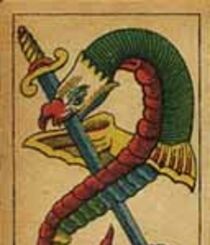
The cards are from more than one pack, and fall into two groups. The first group comprises cards of the archaic Spanish-suited "Dragon" type of pack, whilst the remaining cards are of a different early Spanish-suited pattern. Together these cards provide stunning evidence of early Spanish playing card production exported to Central and South American countries very soon after the 'discovery' of the New World.
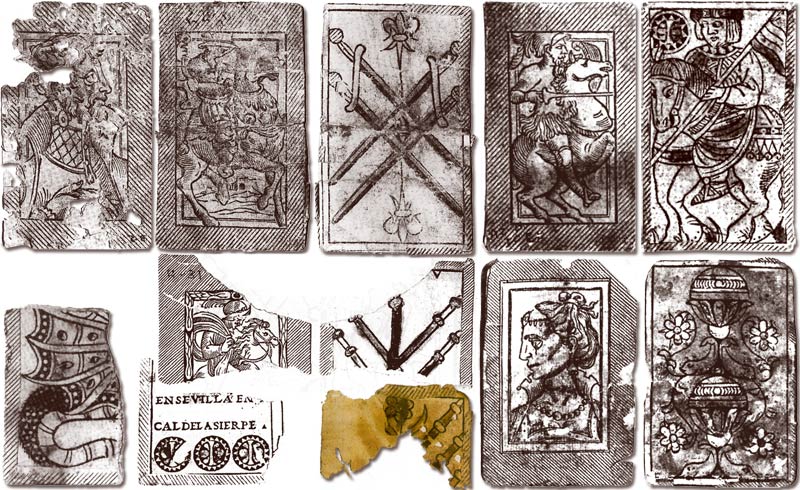
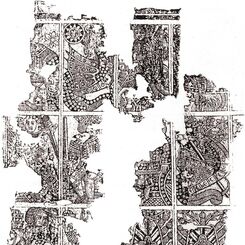
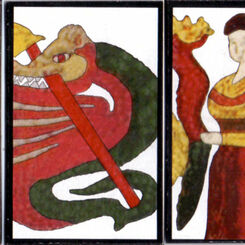
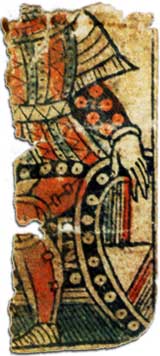 Above & Right: fragments of playing cards of the "Dragon" type made in Seville (Spain) discovered in archaeological excavations in the Lower Rimac Valley, Peru, during 1964-66. The backs of the cards, showing warriors and portraits of individuals in 16th century European fashion, were designed to wrap around the edges of the cards thereby providing a border around the fronts. This can be seen on the four of swords, the cavalier of coins, the two of cups and the fragment of the "Dragon" Ace at the lower left. The inscription "En Sevilla en Cal de la Sierpe" appears on one card. The two of cups is supported on two tiny dolphins. [Source of images: Cárdenas Martin, 1999]
The fragment of the King of Swords (right, enlarged) shows that the quality of the woodcutting is very fine and detailed. The colours used are: black, red, blue and ochre. These cards are example of a distinctive pattern known as "Dragon Cards" owing to the winged dragons or sea monsters on the four aces. The kings are seated on thrones. Cards such as these have been found in various parts of the world, having been exported by early Hispanic colonisers. Early Spanish/Portuguese type playing cards found in Netherlands →
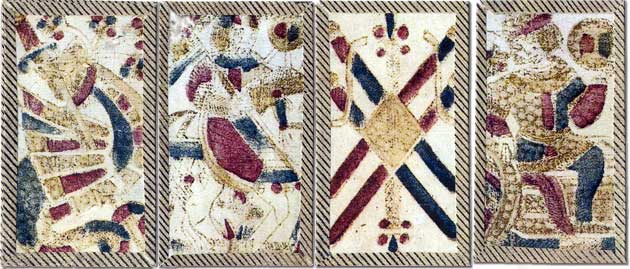
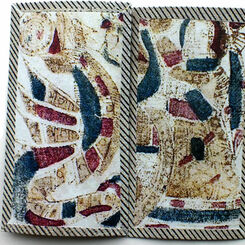
This pattern has long been extinct. A fine example is preserved in the Archivo de Indias in Seville manufactured by Francisco Flores, along with a sheet of similar allegorical back designs with Mexican imagery, and the contract for one Alonso Martínez de Orteguilla to administer the manufacture and sale of playing cards in New Mexico in 1583 (see mock-up of four cards shown below). The deduction which might be made is that cards like these were being manufactured in Spain and exported into the newly colonised 'New Spain' since some time in the 16th century, possibly as early as 1516.
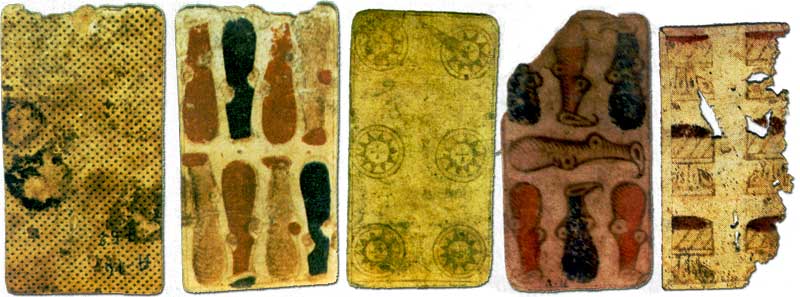
Above: 5 cards from the second set discovered in the excavations, which belong to standard Spanish-suited packs of the day. Only the right-hand card appears to have the 'turned over' edges as in the first set, and they are of a simpler design on the front and back, which would amount to efficiency gains in production. Unfortunately no court cards are available to identify the pattern, but they are consistent with other known 16th century examples. As it happens, Seville was an attractive destination for gamblers during the sixteenth century learn more →
References
Cárdenas Martin, Mercedes: Dados y Naipes del Siglo XVI en una Huaca del Valle del Rimac, Peru, Boletín de Lima Vol.XXI, No.116 (1999) pp.42-60.

By Simon Wintle
Spain • Member since February 01, 1996 • Contact
I am the founder of The World of Playing Cards (est. 1996), a website dedicated to the history, artistry and cultural significance of playing cards and tarot. Over the years I have researched various areas of the subject, acquired and traded collections and contributed as a committee member of the IPCS and graphics editor of The Playing-Card journal. Having lived in Chile, England, Wales, and now Spain, these experiences have shaped my work and passion for playing cards. Amongst my achievements is producing a limited-edition replica of a 17th-century English pack using woodblocks and stencils—a labour of love. Today, the World of Playing Cards is a global collaborative project, with my son Adam serving as the technical driving force behind its development. His innovative efforts have helped shape the site into the thriving hub it is today. You are warmly invited to become a contributor and share your enthusiasm.

Leave a Reply

Your Name
Just now Your comment here. Your comment here. Your comment here. Your comment here. Your comment here. Your comment here. Your comment here. Your comment here. Your comment here. Your comment here. Your comment here. Your comment here. Your comment here. Your comment here. Your comment here. Your comment here. Your comment here. Your comment here. Your comment here. Your comment here. Your comment here. Your comment here. Your comment here. Your comment here. Your comment here. Your comment here. Your comment here. Your comment here. Your comment here. Your comment here. Your comment here. Your comment here.
Related Articles
Portuguese-suited cards
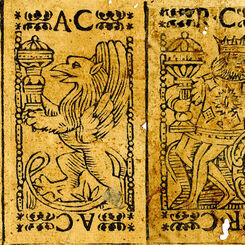
Portuguese-suited cards with dragon aces, made in Italy, 1613.
Toledo, 1584
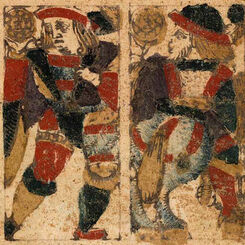
Archaic Spanish-suited deck with 48 cards made in Toledo in 1584.
Navarra Pattern, 1682
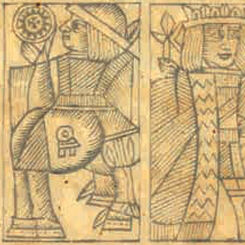
Navarra pattern produced for the Pamplona General Hospital Monopoly in 1682.
Navarra Pattern
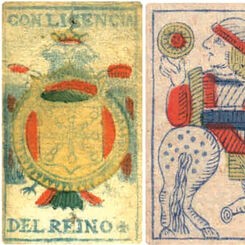
Navarra Pattern produced for the Pamplona General Hospital Monopoly.
Navarra Pattern, 1793
Navarra pattern by an unknown cardmaker with initials I. I., 1793.
XV Century Catalan playing cards
XV Century Catalan Playing Cards, featuring four female Sotas, four Aces and four cards from the sui...

Malta
The so-called ‘Dragon Cards’, with winged monsters on the four Aces, are an enigmatic aspect of earl...
Navarra, XVII Century
Facsimile of 17th century Spanish-suited playing cards produced by Erregeak, Sormen S.A., Vitoria-Ga...
Moorish playing cards
These two uncoloured, uncut sheets of early Moorish playing cards were formerly preserved in the Ins...

Gothic Spanish-suited cards
These cards may be a typical example of early 'standard' Spanish playing cards, maybe from before Co...
Francisco Flores
Playing cards in this style have been discovered in various parts of the world, suggesting that they...
Cards for export to Peru by Heraclio Fournier
'El Caballo' brand (No.5P) playing-cards manufactured in Spain by Heraclio Fournier S.A. especially ...
Phelippe Ayet, c.1574
Archaic, late medieval Spanish-suited playing cards printed by Phelippe Ayet, c.1574.
Baraja Morisca — Early XV century playing cards
Primitive Latin suited pack, dated by paper analysis as early XV century, which makes this one of th...

Real Fábrica de Macharaviaya
This is the official Spanish National pattern of the 18th century. Design and production was control...
Portuguese Type Cards made in Belgium
Portuguese Type Playing Cards made in Belgium, c.1878.
Early Spanish/Portuguese type
Fragment of a sheet of archaic Spanish-suited 'Dragon' playing cards found during restoration of a h...
Estanco de Naipes del Perú
In October 1888 the Republic of Peru Congress passed Law no.26 establishing taxes on playing cards, ...
Silver Cards from Peru
Spanish-suited silver cards, richly embellished and enamelled, from a former Spanish Viceroy in Peru...
Tensho Mekuri - Japan
Tensho Mekuri cards hand-made by Patricia Kirk, 2003.
Most Popular
Our top articles from the past 60 days


