


Paper Empires by Jason McKinstry
A review of Jason McKinstry’s Paper Empires, Volume I, an illustrated study of early American playing-card makers and the firms behind them.
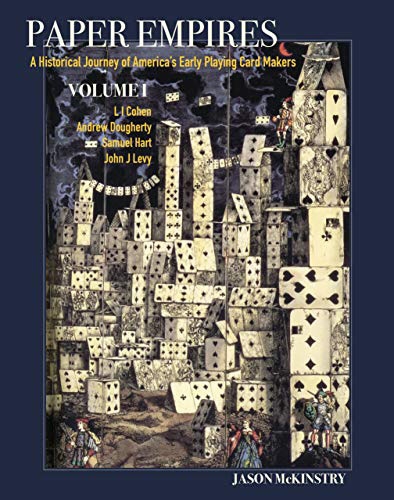
Above: Paper Empires Vol I by Jason McKinstry.
Books on playing cards don’t come out that often, and really good, readable ones even less so. It is therefore a genuine pleasure to have this new book on the history of American Playing Cards – and the emphasis is as much on history as it is on cards. The author of Paper Empires, Jason McKinstry, will be known to many as a 52 Plus Joker member and as a frequent contributor to Card Culture.
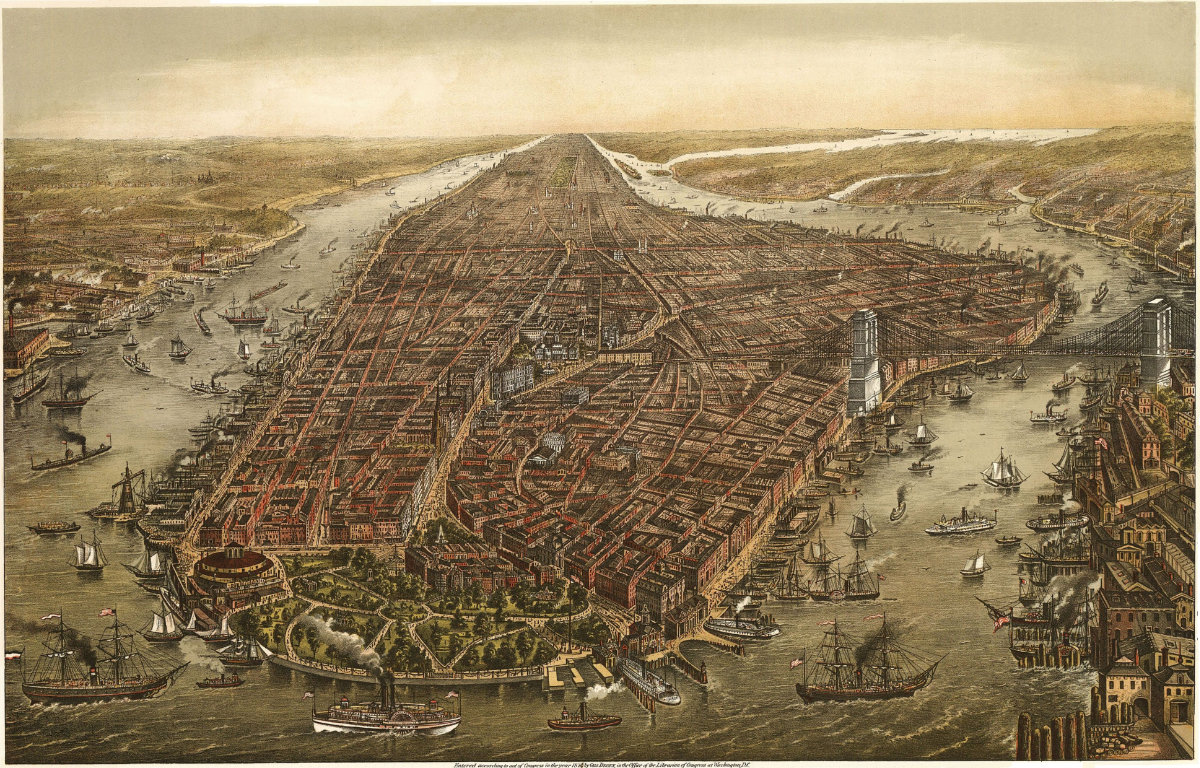
The new book is highly visual so those who want just to look at the pictures will have plenty to keep them occupied and they will not be disappointed. These illustrations include maps, portraits of the people involved, contemporary illustrations, advertisements promotions and price lists, houses and factories, news cuttings, share certificates, burial grounds and of course a lot of representative cards.
Jason has also had a simple but brilliant idea that I have never seen before: many of the illustrations have has to be shrunk to fit in with the text and at the end of the book a good selection of these are reproduced again at a much large size.
In order to appreciate the nature of the era Jason is covering here, those unfamiliar with the history might try reading my article ‘American Cards 1800-1900 in one page’ on page 15. Jason’s Volume I begins after the pioneer period at exactly the point where industrialization is about to begin. We learn all about the rapid growth period up to the arrival of USPCC.
By far the most successful of the 19th Century firms are referred to as the ‘Big Seven’: that's the first of L I Cohen, Samuel Hart, Andrew Dougherty, John A Levy, Lawrence & Cohen, New York Consoloidated Card Co. (NYCC). In fact we could think of these as a ‘Big Three’, i.e. NYCC and its constituent parts, Doughert and USPCC. NYCC's L I Cohen was the entrepreneurial inventor of a four-colour printing machine that changed playing card making for good. He and his family ruled the industry for around fifty years with only Dougherty as serious competition.
Paper Empires tells this story in full detail and by the end of each chapter – one per maker (L I Cohen, Andrew Dougherty, Samuel Hart and John J Levy here) you feel you know the person. Jason’s infor mation on Dougherty is particularly extensive. In each case one feels the presence of the real per son behind ‘the name on the box’, which is a real achievement by Jason.
There is a choice of format – paperback or digital (in the various formats used.). See Jason’s website. Perhaps the best thing is the ‘Vol I’ in the title: I am looking forward to Vol II, previewed in the first volume.

By Paul Bostock
United Kingdom • Member since May 07, 2024
Paul has been a collector of playing cards since his early teenage years, the mid 1970s. In the last 20 years or so he has specialised in standard English cards and their story. His collection, including many other English Standards, are featured on his website plainbacks.com. Paul is currently editor of Clear the Decks, the Journal of 52 Plus Joker, the American club for playing card collectors, and is a member of the IPCS Council, an EPCS member and a Past Master of the Worshipful Company of Makers of Playing cards, a City of London livery company.

Activity for Paper Empires by Jason McKinstry
Sign in to comment or save this article.

Related Articles
Library Display
Three seconds to spark a love of playing cards: one collector's library display challenge.
Old Testament playing cards
Old Testament playing cards with illustrations by Jan Padover, USA, 2012.
Mediaeval Playing Cards
Finely executed late 19th century pack from the USA featuring courts in medieval costume.
A Look Back with Hope for the Future
“A Look Back with Hope for the Future” by Rod Starling
42: Andrew Dougherty
Andrew Dougherty was one of the biggest American card-makers in the 19th century
Union Playing Card Co.
Not much is known about this early manufacturer who is reckoned to have traded between c.1860s-1890s...
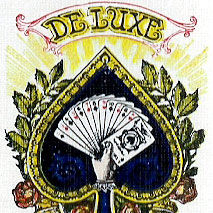
De Luxe No.142
A wide size version of De Luxe No.142 had been published in c.1920, with a similar Ace of Spades and...
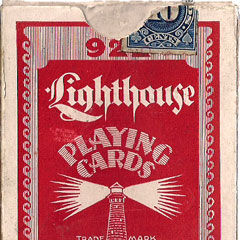
Lighthouse No.922
“Lighthouse No.922” playing cards were introduced in c.1920.
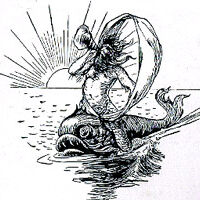
Triton No.42
There have been at least three different versions of the Triton deck, with different Jokers, differe...
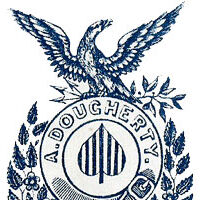
Andrew Dougherty c.1850
The idiosyncratic courts used in this deck were used by several other U.S. manufacturers, including ...
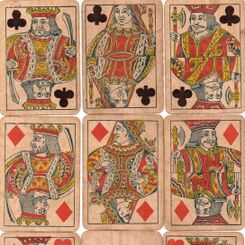
13: Some North American Cards
I deal with some of the US makers in more detail on other pages, but here is a brief introduction.
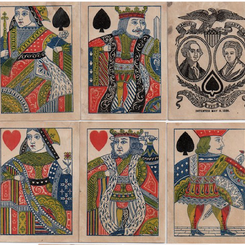
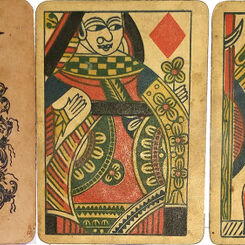
Excelsior
Excelsior by A. Dougherty, c.1870.
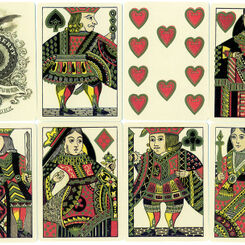
Illuminated Playing Cards, c.1865
Facsimile edition of Andrew Dougherty's Illuminated deck, c.1865, published by U.S. Games Systems, I...
Lawrence & Cohen
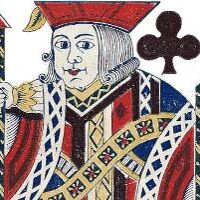
Lawrence & Cohen were successors to Lawrence, Cohen & Co.
Lewis I. Cohen
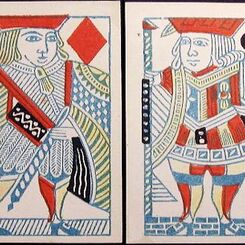
Lewis I. Cohen made his first deck of cards in 1832. In 1835 Mr Cohen invented a new machine to prin...
New York Consolidated Card Company
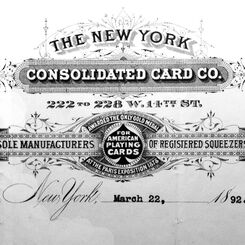
The New York Consolidated Card Company was formed in 1871 by the merging of Lawrence & Cohen, Samuel...
Samuel Hart, 1846-1871
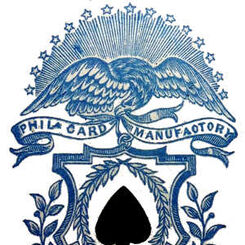
Samuel Hart was a prolific manufacturer of playing cards who commenced business sometime around 1845...
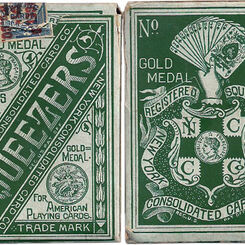
Squeezers No.35
By 1877 the New York Consolidated Card Co's "Squeezers" were a great success on account of the indic...
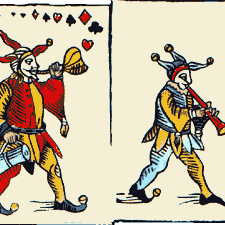
The Joker Card
The 'Joker' is believed to have been invented by American Euchre players who, when modifying the rul...
Most Popular
Our top articles from the past 60 days