
The United States Playing Card Company
Over the years the pressures of competition and other market forces have led to many smaller manufacturers being taken over by larger ones. The outcome is that the U.S.P.C.C. is now the largest manufacturer in the United States.
 Tigers No.101
Army No.303
Navy No.303
Army & Navy No.303
Steamboat No.999
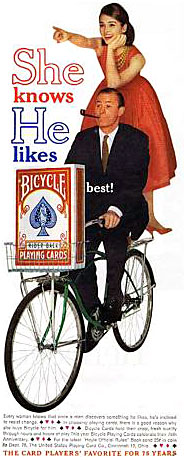
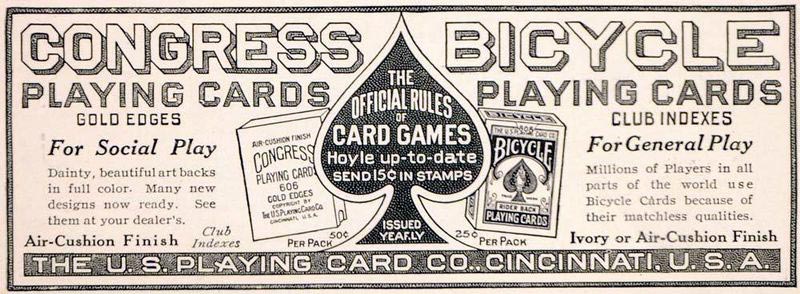
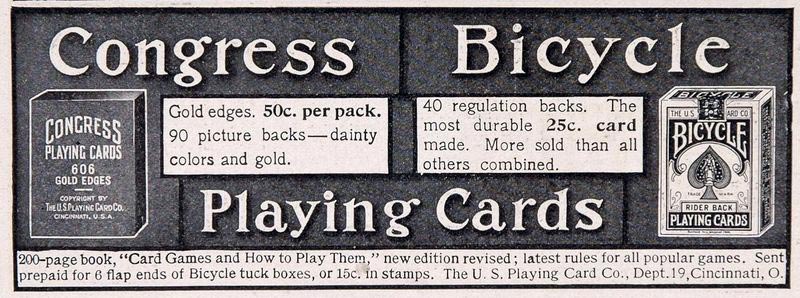
Bicycle No.808
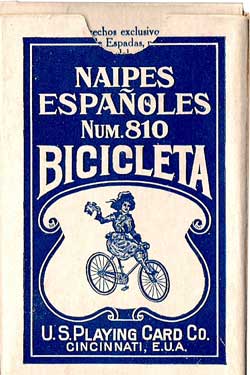
Bicicleta No.810
Tourists No.155
Congress No.606
Cabinet No.707
Capitol No.188
American Skat
No.4 Special Whist
Jumbo Bridge No.88
Squared Faro No.366
Monarch Bicycle
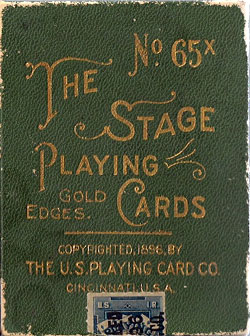
The Stage No.65
The Stage, 1908
Craddock Soap Theatrical
Trophy Whist No.39
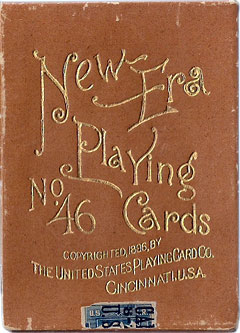
New Era No.46
Circus No.47
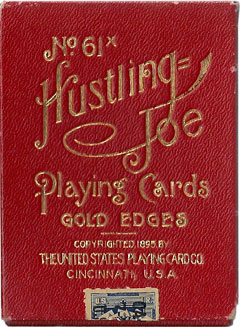
Hustling Joe No.61
Ye Witches No.62
Los Leones No.71
Anheuser-Busch Spanish-American War deck
Norwood No.85
No. 500
Vanity Fair Transformation
Movie Souvenir
Cuba Souvenir
Panama Souvenir
Peru Souvenir
Historic Boston
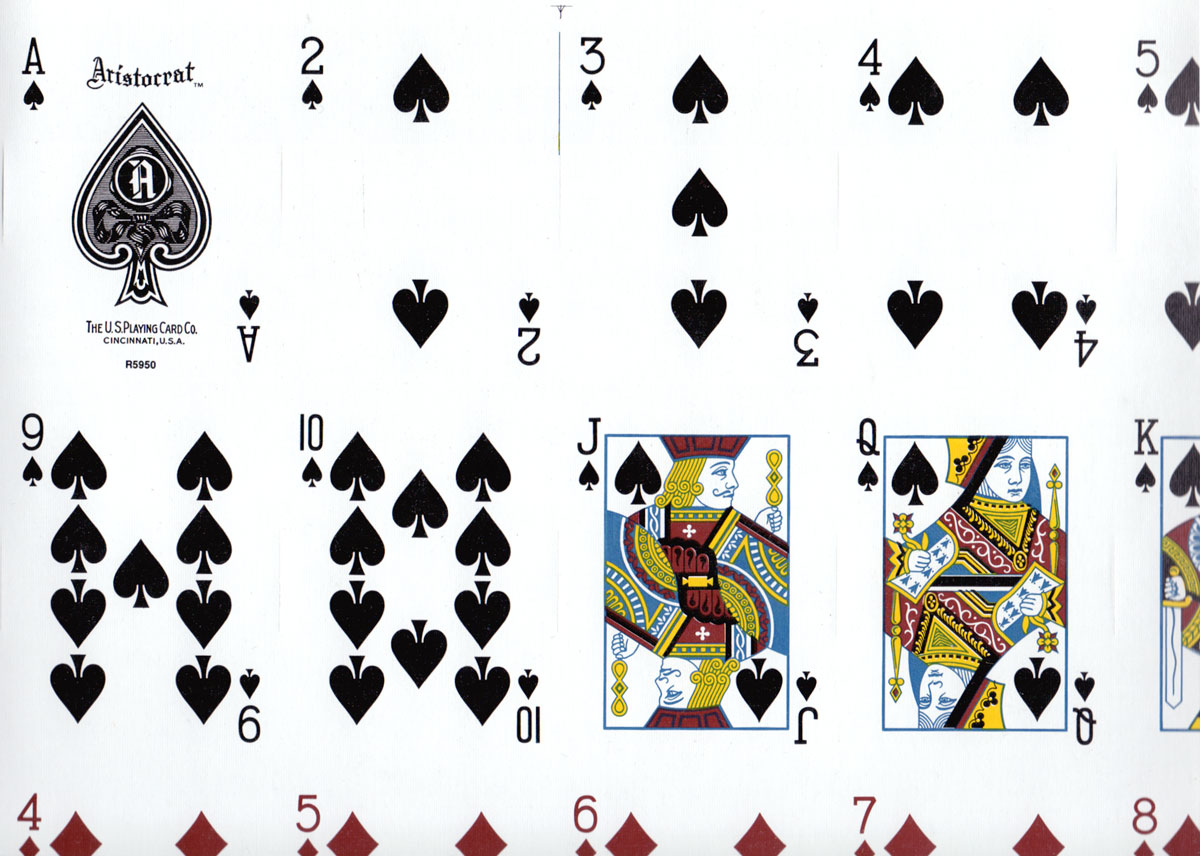
Aristocrat
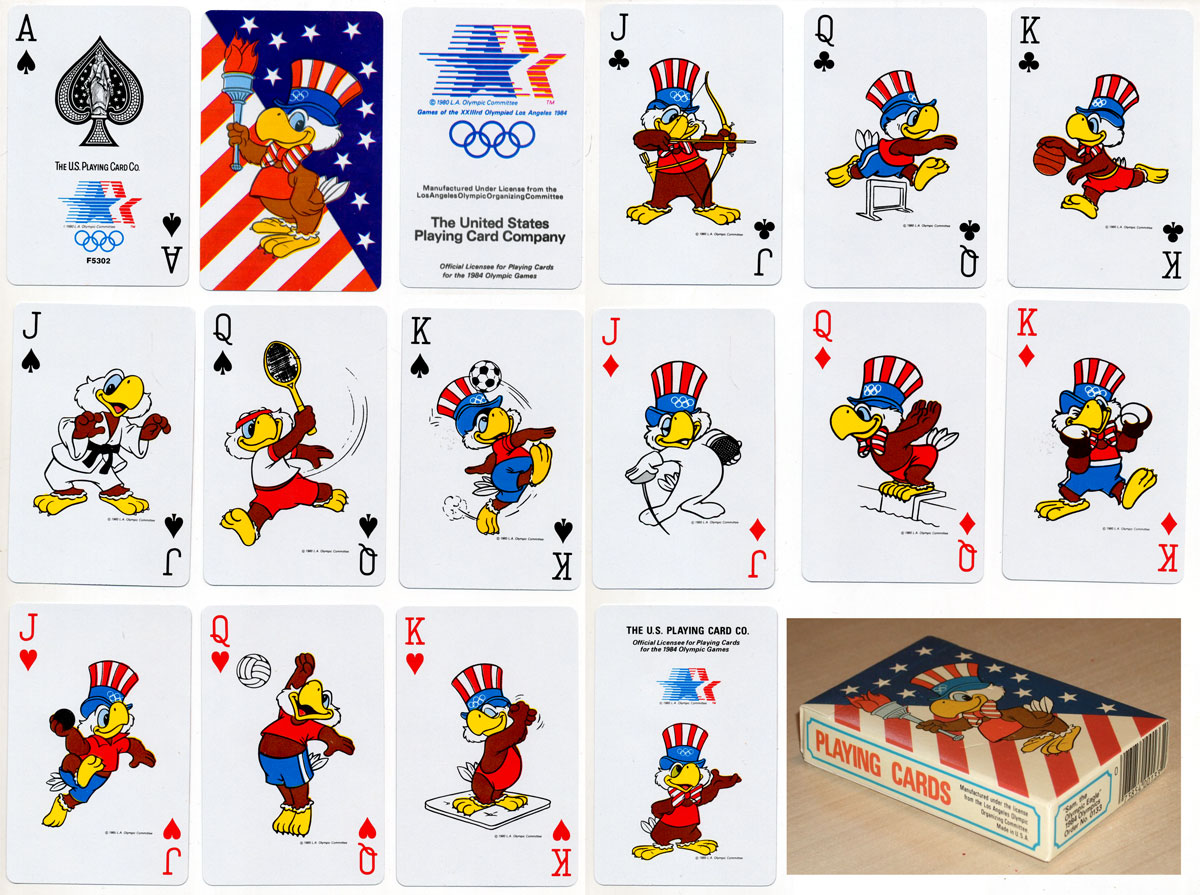
Sam the Olympic Eagle, 1984
McDonald’s
Star Wars Episode 1
Bicycle ‘Butterfly’
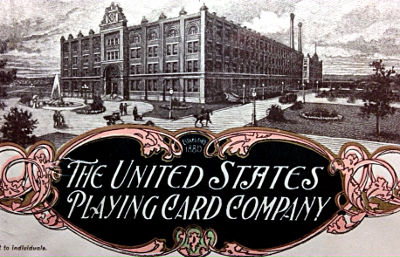
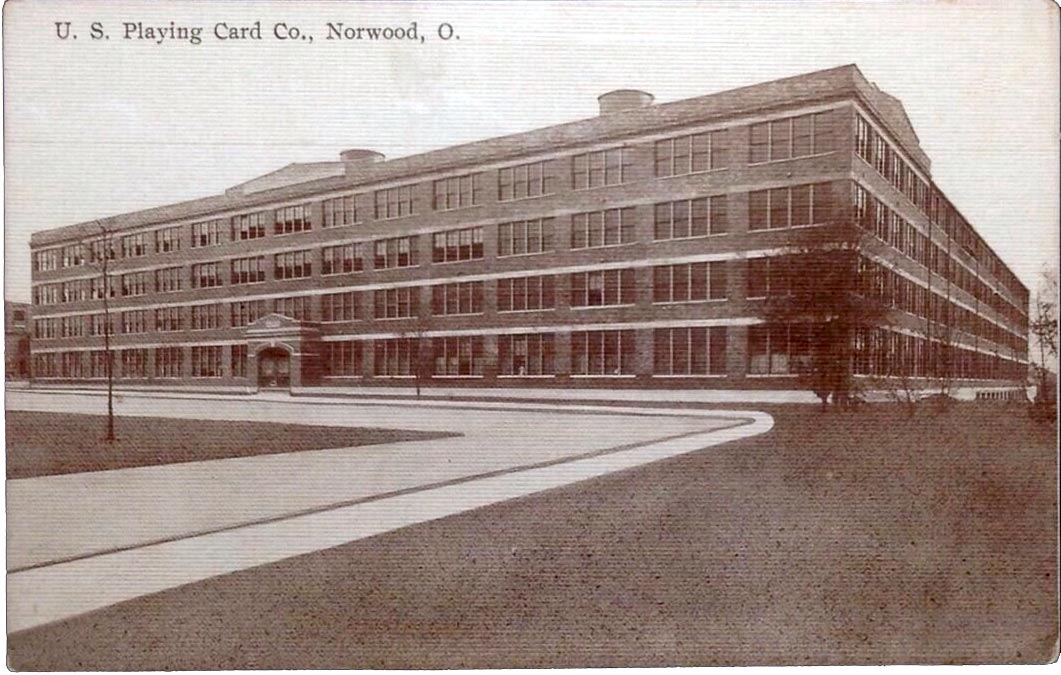
The United States Playing Card Co was established in 1894. Formerly it had been known as Russell, Morgan & Co (1881-1894). Over the years the pressures of competition and other market forces have led to many smaller manufacturers being taken over by U.S.P.C.C. These include: The Standard Playing Card Co. 1892-1895; Perfection Card Co. 1892-1895; New York Consolidated Card Co, 1892-1895; Andrew Dougherty 1907; Russell Playing Card Co. 1929; Heraclio Fournier, S.A. 1986; Arrco Playing Card Company 1987; and Hoyle Products 2001.
The outcome is that the U.S.P.C.C. is now the largest manufacturer in the United States, and has inherited many brands previously owned by smaller manufacturers.
Question & Answer
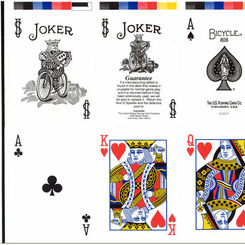
QUESTION: When did the USPCC start putting a registered trademark symbol on the ace of spades in the Bicycle 808 Rider Back pack?
I have a pack which has a date code of "P", indicating 1991, and an advert extra card talking about “over 100 years of Bicycle cards”, and yet the ace of spades lacks the registered trademark symbol (as do the jokers). The lack of a registered trade mark would indicate a date of 1971, but that wouldn't tally with the bar code on the box and the "100 years" claim - Matt Probert.
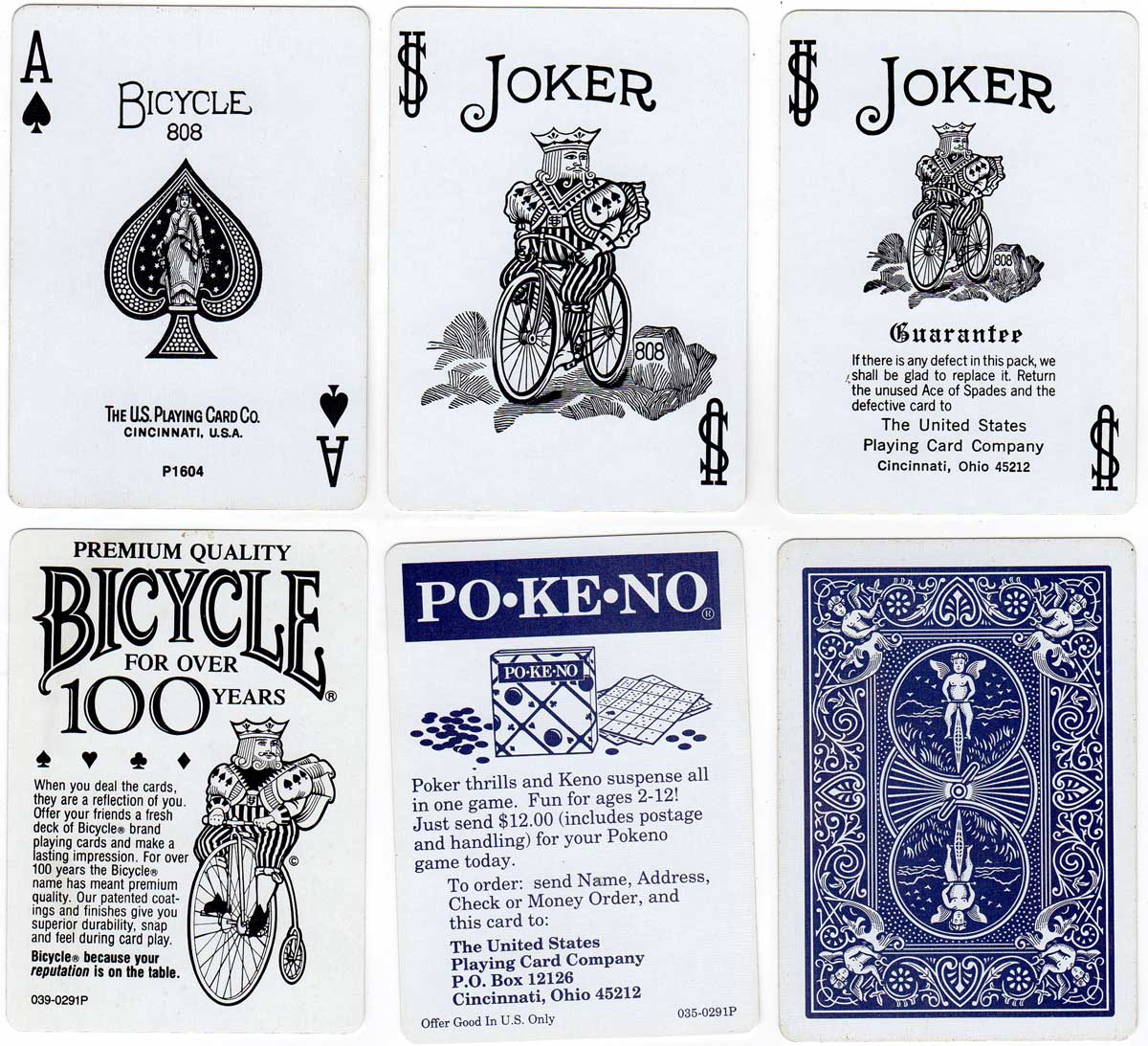
Above: Matt's pack of Bicycle 808 cards. See below "Discussion about date".
ANSWER: An interesting question. It will be necessary to keep a few facts in mind:
First, the trademark Ace of Spades was registered under No. 8,303 on May 31,1881 and, as you know, it has been and still is used for many of USPC’s other brands.
Second, the Bicycle brand was introduced in 1885 by the Russell & Morgan Printing Company.
Third, the Rider back was introduced in 1887 by the Russell & Morgan Printing Company.
Protection for the Rider back design is also covered under trademark law. Copyright protection is limited to a certain term. That term as been extended over the years but since the Rider design was introduced in 1887 copyright protection would have expired long ago.
Trademark rights, on the other hand, are valid and enforceable just as long as the trade mark is used. Holders of trademark rights are required to file an affidavit of use every year in the Office of Patents and Trade Marks in Washington, D.C. The principle is simple: ”Use it or loose it”. Obviously, the trademark Ace of Spades and the Rider back have been in continuous use for over 130 years, again satisfying the requirements for trademark protection.
The earliest Bicycle deck that I have is an 1888, US8 with a Wheel No.1 back design. It does not have the trademark notice - Rod Starling.
Discussion about Date
There appears to be discrepancies in the production codes of “P” and “N”. Generally, the codes repeated every 20 years. Checking the last listing that I have for the codes, I found that the last years listed for production code of “P” were 1971 and 1991. If we add another 20 years , we come to 2011 for the next use “P” but that, as I can show, did not happen.
Matt’s deck gives the address of USPC in Cincinnati. USPC moved to Kentucky in 2009. That means that Matt’s deck had to be made prior to 2009. So far, so good but the problem is this:
The advertising card refers to the Bicycle brand being “over 100 years”. The brand was introduced in 1885. Therefore the deck had to be made after 1995, the 100th anniversary of Bicycle.
That would rule out both 1971 and 1991. The next year for “P” would usually have been 2011 but if the deck was made in that year, the address for USPC would be Kentucky to which it moved in 2009, not Cincinnati.
To make the problem even more confusing, I have a Kentucky-made Bicycle with the code system adopted after USPC moved to Kentucky. It reads “3811-N1326H". USPC’s customer service informed me long ago how to read the first five characters. In this instance, it means that the deck was made in the 38th week of 2011. For some time I noticed that USPC carried on the 20 year cycle of the code and continued to use the letters as before. However, in the case of my deck, “N” is used. Under the old code, the next use of “P” after 1991 should have been in 2011, not the letter “N”. There are a few inexplicable breaks in the production code chart as shown in Hochman, page 4 and the first is found with the letter “N”, first used in 1910 and for which no further use is indicated.
Unfortunately, I cannot fix the date of Matt’s deck. It should have been 2011, 20 years after the last established “P” used for 1991. 2011 meets the test of being made after the 100th anniversary of Bicycle. But, as I have shown, USPC used “N” for 2011, and was located in Kentucky. So I am totally lost.
From Clay Boulware: The "P" deck in question dates to 1991. There was an error in the description that threw things off. The description states that 100 years after the introduction of Bicycle was 1995, but the actual 100 year anniversary was 1985. Someone wrote down the wrong date, Since 100 years was 1985, there is no problem with the 100 year card.

By Simon Wintle
Spain • Member since February 01, 1996 • Contact
I am the founder of The World of Playing Cards (est. 1996), a website dedicated to the history, artistry and cultural significance of playing cards and tarot. Over the years I have researched various areas of the subject, acquired and traded collections and contributed as a committee member of the IPCS and graphics editor of The Playing-Card journal. Having lived in Chile, England, Wales, and now Spain, these experiences have shaped my work and passion for playing cards. Amongst my achievements is producing a limited-edition replica of a 17th-century English pack using woodblocks and stencils—a labour of love. Today, the World of Playing Cards is a global collaborative project, with my son Adam serving as the technical driving force behind its development. His innovative efforts have helped shape the site into the thriving hub it is today. You are warmly invited to become a contributor and share your enthusiasm.

Leave a Reply

Your Name
Just now Your comment here. Your comment here. Your comment here. Your comment here. Your comment here. Your comment here. Your comment here. Your comment here. Your comment here. Your comment here. Your comment here. Your comment here. Your comment here. Your comment here. Your comment here. Your comment here. Your comment here. Your comment here. Your comment here. Your comment here. Your comment here. Your comment here. Your comment here. Your comment here. Your comment here. Your comment here. Your comment here. Your comment here. Your comment here. Your comment here. Your comment here. Your comment here.
Related Articles
New York City souvenir
New York City souvenir playing cards with 53 different views of interest, USA, 1915.
Nile Fortune cards
Nile Fortune cards no.68x published by the United States Playing Card Company, USA, 1904.
Hawaiian Souvenir playing cards
Hawaiian Souvenir playing cards, 1901.
Timothy Curtis Art
Timothy Curtis Art custom Bicycle playing cards, 2018.
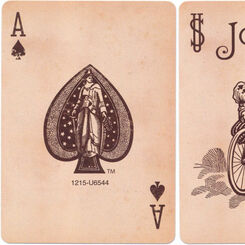
Bicycle Heritage
Bicycle Heritage playing cards by the United States Playing Card Company, 2012
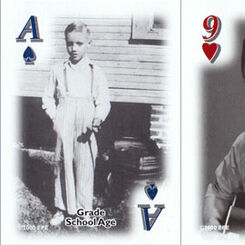
Elvis Presley
Elvis Presley playing cards published by The United States Playing Card Company, c.2002.
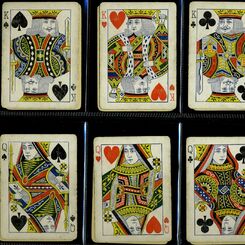
35: More Design Copies
Here I want to take another widely copied design and see how individual variation by the copier can ...
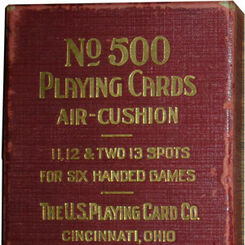
No.500 Playing Cards
No.500 Playing Cards published by U.S.P.C.C., c.1910
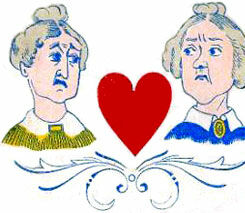
Ye Witches’ No.62 Fortune Cards
Ye Witches Fortune Telling Cards published by the United States Playing Card Co., 1896. 52 cards + J...

Hustling Joe
Hustling Joe himself appears on the Ace of Spaces dressed in red.
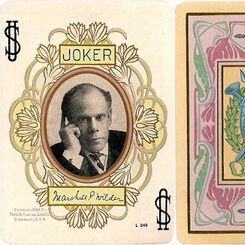
Stage Playing Cards, 1908
This beautiful deck features an oval half-tone photo of a theatre star on each card, many of them le...
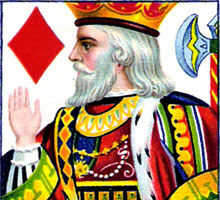
Norwood #85, c.1909
The deck features a colourful Ace of Spades and Joker, decorated Aces, unique courts and two beautif...
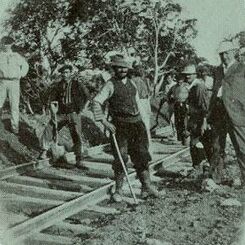
Panama Souvenir Playing Cards
Several editions of Panama Souvenir Playing Cards were issued by the USPCC between 1908 - 1926. The ...

Congress No.606
Congress Playing Cards were first produced by the Russell & Morgan Company in 1881 as the finest and...
Bicycle No.808 - page 2
The famous 'Bicycle' playing cards were first introduced by Russell & Morgan Printing Co in 1885. Th...
Bicycle Seconds
Bicycle 808 Seconds playing cards manufactured by The United States Playing Card Co, Cincinnati and ...
Bicycle No.808
The famous Bicycle playing cards were first introduced by Russell & Morgan Printing Co in 1885. More...
Historic Boston and Vicinity
Historic Boston and Vicinity Souvenir Playing Cards, 1900 & 1909.
U. S. A.
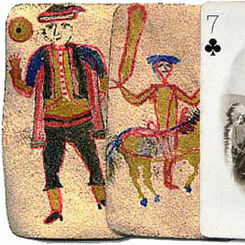
The manufacture of playing cards in America only began during the second half of the 18th century, a...
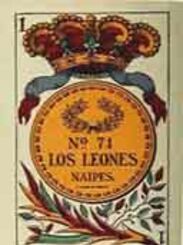
Naipes No. 71 Los Leones
Naipes No. 71 Los Leones by The United States Playing Card Co., c.1900.
Most Popular
Our top articles from the past 60 days