


Etruria Minchiate
The Cavaliers are man/beast creatures. The Valets (or Pages) are male for clubs and swords, and female for cups and coins.
Minchiate Etruria Card game, divination tool or teaching aid?
This antique “Minchiate Etruria” deck by Pietro Alligo was originally published in Florence in 1725, printed from copper plate etchings and hand coloured with water colours. Minchiate is a late-medieval card game employing a specially extended pack of 97 cards, related to tarot but including 12 zodiac signs, 4 virtues (faith, hope, charity, prudence) and 4 elements (fire, water, air, earth). The trump cards are untitled but are numbered with roman numerals in a scroll.
The game, like other Tarot games, is a trick taking game in which points are scored by capturing certain cards and sets of cards. However, the deck has also been popular with card readers who see it as a variant of the esoteric tarot because of the allegorical and symbolical content. The Cavaliers are man/beast creatures. The Valets (or Pages) are male for clubs and swords, and female for cups and coins. Further features include the replacement of the Papess, Empress and Pope by the Western Emperor, the Eastern Emperor and the addition of the Grand Duke. Some scholars believe that these cards may have served as teaching aids, because several trump allegories (Virtues, Elements, Zodiac signs) belong to categories upon which classical learning was based at that time.
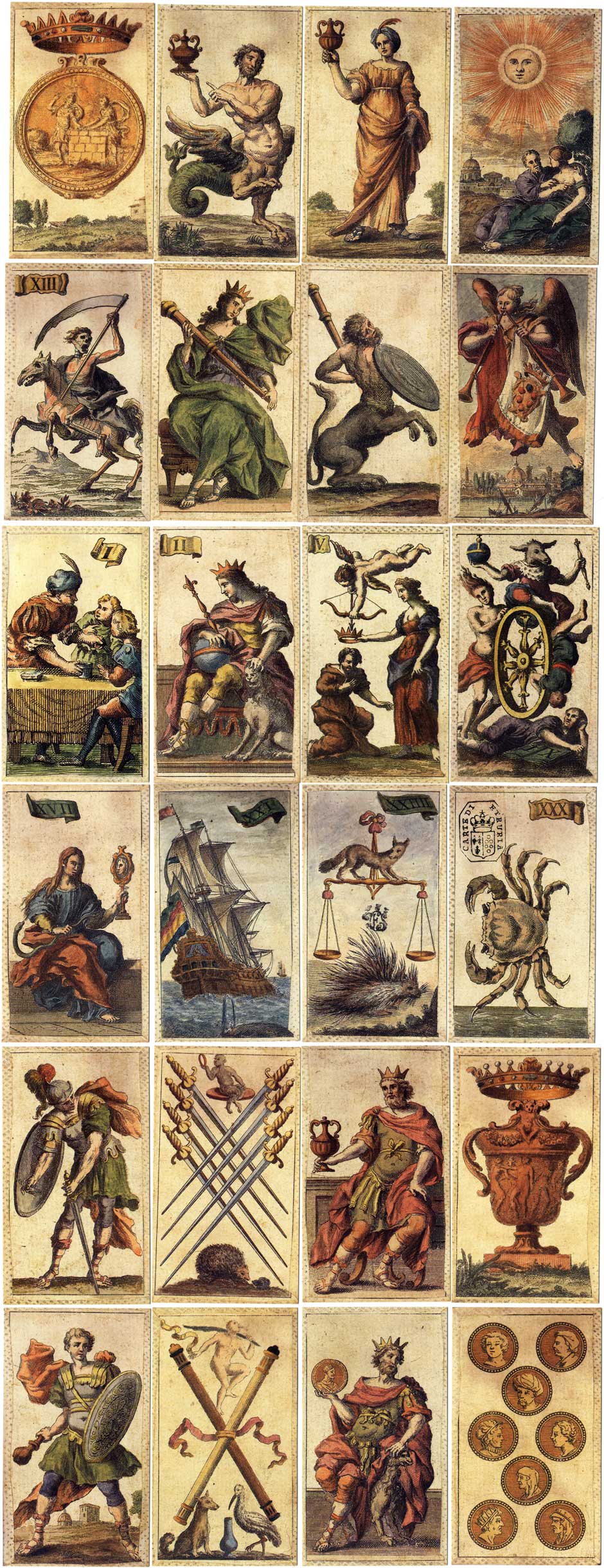
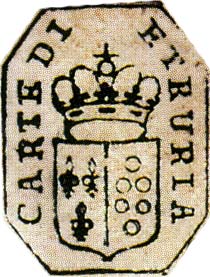
Above: "Etruria" Florentine Minchiate deck, 97 cards, facsimile edition published by Il Meneghello, Milan, Italy, 1986 & 1994. Another edition was published by Lo Scarabeo in 1996. A stamp with the text 'CARTE DI ETRURIA' appears on trump number XXX 'Cancer', hence the name "Minchiate Etruria" used for this facsimile edition.
• See also: Tarocchi di Mantegna • Mitelli Tarocchini • Tarocchino Lombardo • Tarocco Neoclassico • Corona Ferrea Tarot • Matarelli Transformation.

By Simon Wintle
Spain • Member since February 01, 1996
I am the founder of The World of Playing Cards (est. 1996), a website dedicated to the history, artistry and cultural significance of playing cards and tarot. Over the years I have researched various areas of the subject, acquired and traded collections and contributed as a committee member of the IPCS and graphics editor of The Playing-Card journal. Having lived in Chile, England, Wales, and now Spain, these experiences have shaped my work and passion for playing cards. Amongst my achievements is producing a limited-edition replica of a 17th-century English pack using woodblocks and stencils—a labour of love. Today, the World of Playing Cards is a global collaborative project, with my son Adam serving as the technical driving force behind its development. His innovative efforts have helped shape the site into the thriving hub it is today. You are warmly invited to become a contributor and share your enthusiasm.

Activity for Etruria Minchiate
Sign in to comment or save this article.

Related Articles
The Dark Knight Joker Calling Cards
Joker “Calling Card” set issued in connection with the film The Dark Knight (2008).
The Sola-Busca Tarot
Humanist Iconography, Alchemical Metaphor, and the Origins of the Illustrated Minor Arcana.
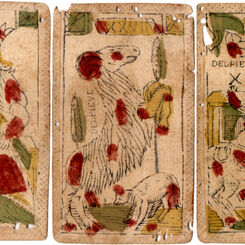
Luigi Del Pieve Minchiate
Luigi Del Pieve and the “Alli Sorte” Minchiate of Florence.
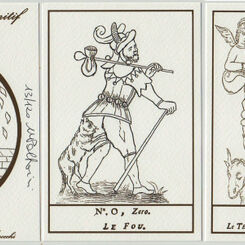
Le Monde Primitif Tarot
Facsimile edition produced by Morena Poltronieri & Ernesto Fazioli of Museo Internazionale dei Taroc...
The Lovers playing cards
Reproductions of old postcards with romantic messages for Valentine’s Day.
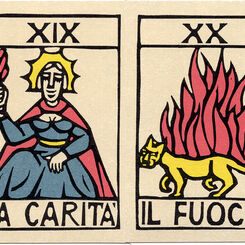
Le Nuove Minchiate di Firenze
Costante Costantini's second Minchiate deck, “Le Nuove Minchiate di Firenze”, was published by Solle...
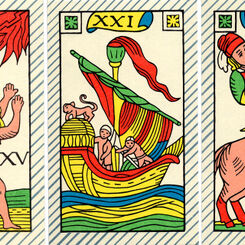
Minchiate Fiorentine
Minchiate Fiorentine created by Costante Costantini, published by Edizioni del Solleone.
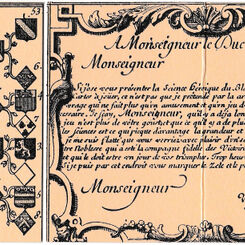
Carte Méthodique
Reproduction of a French pack by François Silvestre intended to teach heraldry, produced in Paris in...
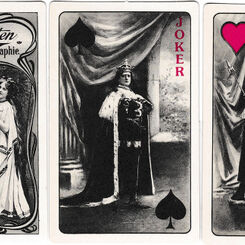
Spielkarten in Bromsilber-Photographie
“Spielkarten in Bromsilber-Photographie” facsimile edition by Vito Arienti of Edizioni del Solleone,...
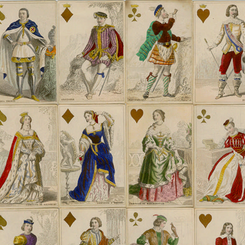
Some Facts About Facsimiles
A short note on facsimile decks: what counts as a facsimile, how reprints differ from originals, and...
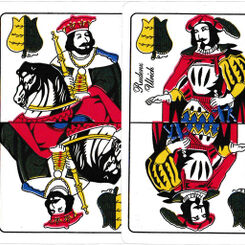
Fake ‘Four Seasons’ pattern
More than just a copy, this is a fake!
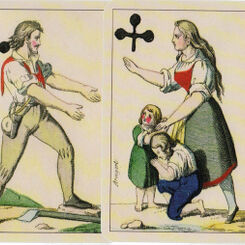
William Tell
Facsimile of Swiss William Tell deck from c.1870 published by Lo Scarabeo.
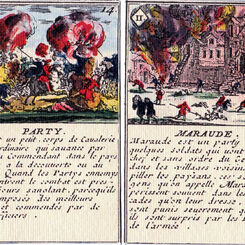
Le Jeu de la Guerre
Facsimile of “Le Jeu de la Guerre” designed by Gilles de la Boissière in 1698.
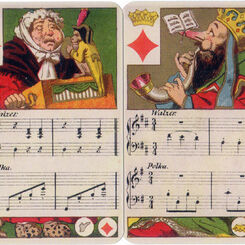
Musikalisches Kartenspiel
Facsimile of Dondorf’s “Musikalisches Kartenspiel” (c.1862) published by Lo Scarabeo, 2004
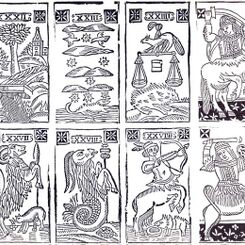
Minchiate Fiorentine, 17th C.
17th century Minchiate cards reprinted from the original woodblocks.
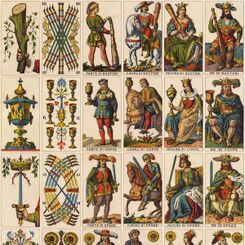
Serravalle-Sesia Tarot
Serravalle-Sesia Tarot published by Fratelli Avondo, c.1880.
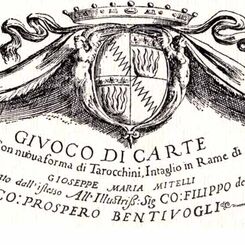
Mitelli Tarocchini
The title refers to “a new form of Tarocchini”. Mitelli's designs are to a high standard of artistic...
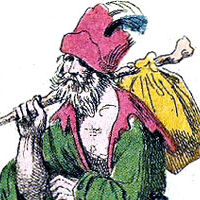
Tarocco Neoclassico
Gumppenberg published several new decks by artists or engravers of the day. The designs are clear an...
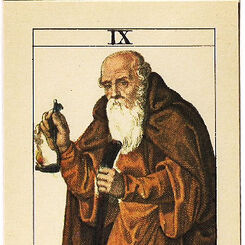
Tarocchino Lombardo, c.1835
“Tarocchino Lombardo c.1835”, a facsimile edition of 2500 by Edizione del Solleone, Italy, 1981.
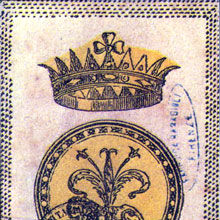
Minchiate Fiorentine
The Florentine game of Minchiate is played with a pack of 97 cards. The subjects and arrangements of...
Most Popular
Our top articles from the past 60 days


Louise Donnelly
20 March 2026, 10:40SavedSaved this article to Louise Donnelly's Collection 1