


Mamluk Playing Cards
Nã'ib, the game of lieutenants... these cards are amongst the earliest Arabic playing cards extant.
Nã'ib*, the game of lieutenants...
The early history of cards in Western Europe was related to the invasion of North Africa, Spain and Sicily by Islamic forces during the Mamluk Sultanate of Egypt which ended in 1517. This coincided with the Nasrid Kingdom of Granada in Andalusia (13th - 15th century), the last Islamic stronghold in the Iberian Peninsula. Spain was the point of contact with the Arab world, where cultural, military and commercial interactions occurred. Playing cards became established in most West European countries by c.1375, but were being banned by the authorities shortly afterwards which suggests their rapid popularity.
The cards shown below are from a reconstructed XV or early XVI century Mamluk pack, hand-drawn and hand-painted, probably belonging to a wealthy or illustrious owner. They are a beautiful example of the important and often overlooked cultural, technical and artistic influence which Islam has bestowed upon the Western world, evident in the many artistic, architectural and archæological treasures displaying their characteristic geometric construction. In this case we are looking at the ancestor of our humble playing card.
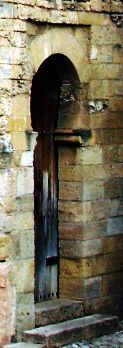
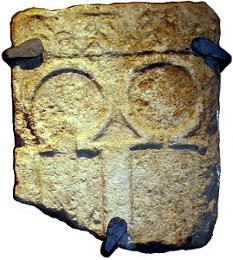
The underlying design is very simple but the surface has been ornamented. The border of some cards is in the shape of a horseshoe arch as seen in Islamic doorways, windows, friezes and gravestone decorations. The suits are coins, cups, swords and polo-sticks (emblem of the most popular of the aristocratic sports in the Mamluk Empire) and there are 13 cards per suit: the numbers 1 to 10 plus 3 court cards, the King, the Lieutenant and the Second Lieutenant (all male). The ranks of the court cards are given in the blue inscription areas at the bottom of the cards. In European packs the court cards were of course represented pictorially, and it may be noteworthy that early Italian and Spanish court-cards did not always contain queens, possibly due to their origin in the Islamic or Saracenic pack, which is also suggested by the very similar suit symbols.
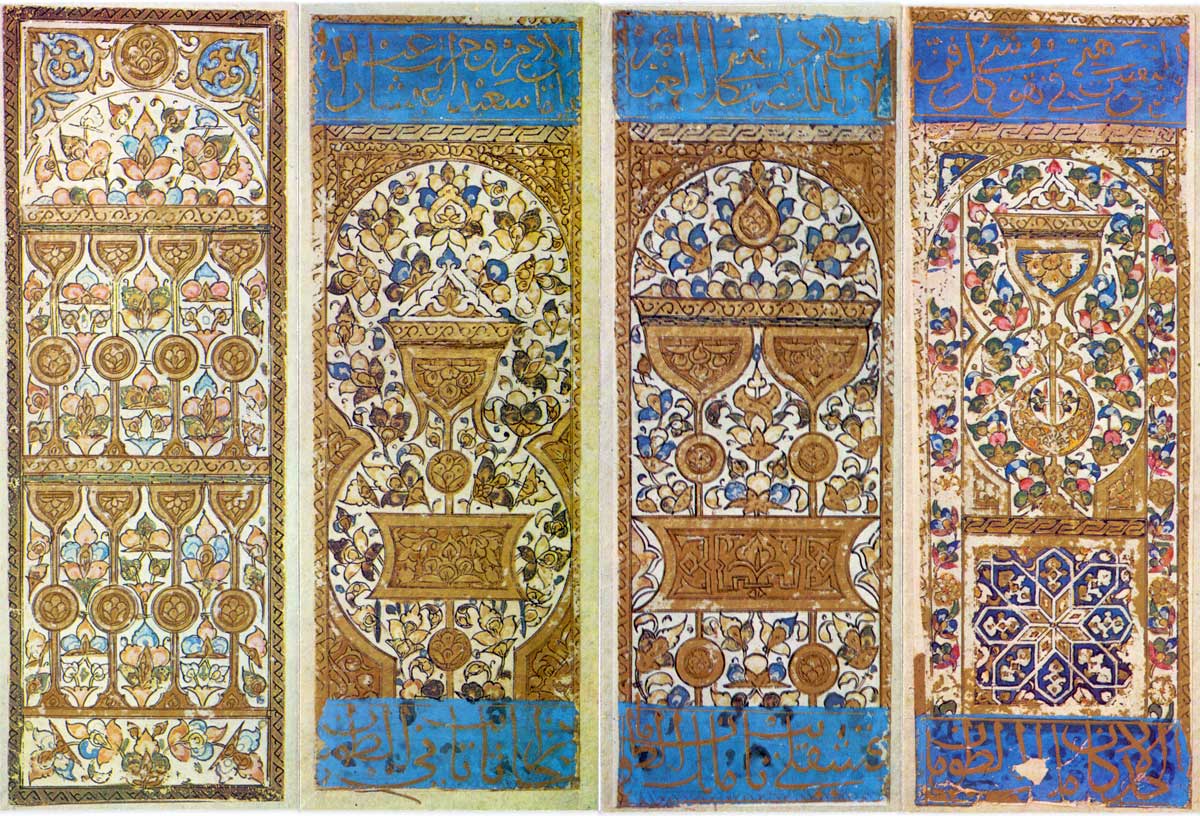
The calligraphic texts along the tops of the cards consist of rhyming aphorisms which are often very enchanting, sometimes strange, but always interesting: “With the sword of happiness I shall redeem a beloved who will afterwards take my life“ - “O thou who hast possessions, remain happy and thou shalt have a pleasant life.” - “Let it come to me, because acquired good is durable; it rejoices me with all its utility” - “Pleasures for the soul and agreeable things, in my colours there are all kinds” - “Look how wonderful my game is and my dress extraordinarily beautiful” - “I am as a garden, the like of which will never exist” - “O my heart, for thee the good news that rejoices” - “Rejoice in the happiness that returns, as a bird that sings its joy”.
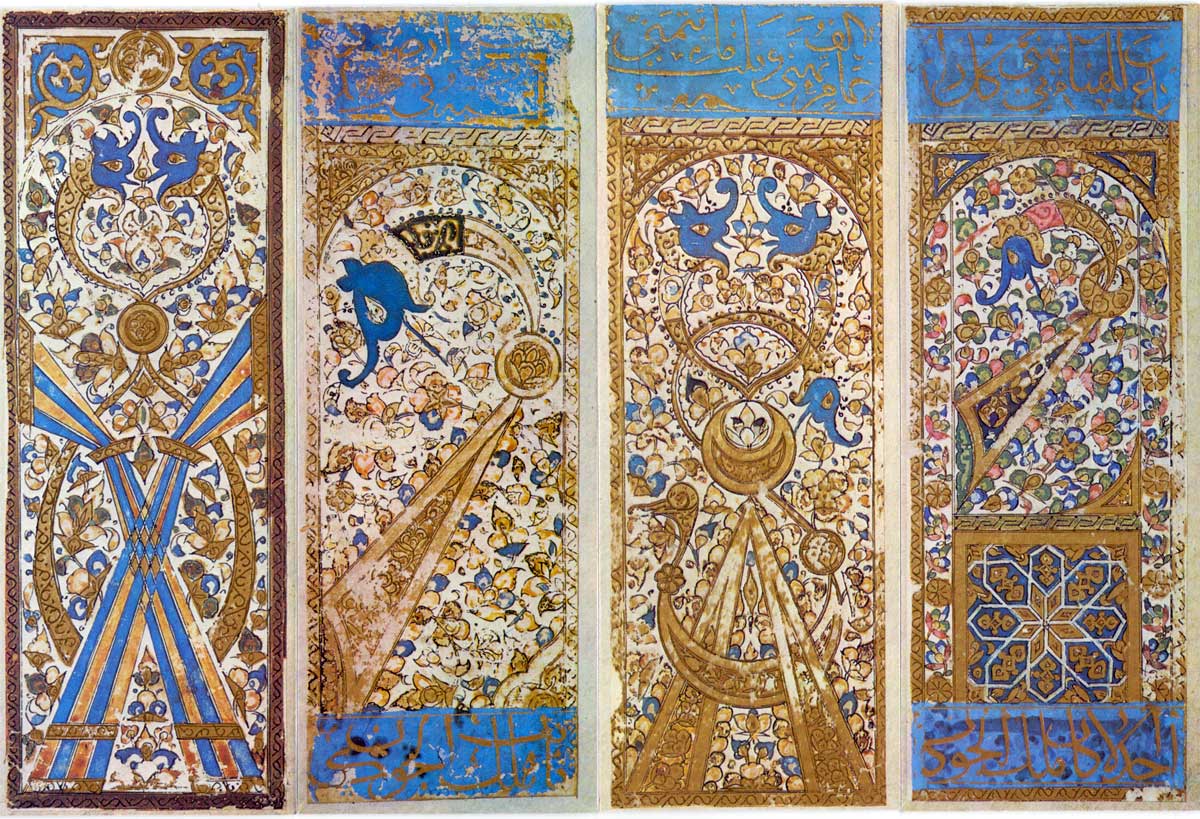
“As for the present that rejoices, thy heart will soon open up“ - “I will, as pearls on a string, be lifted in the hands of kings” - “May God give thee prosperity; then thou will already have achieved thy aim” - “Rejoice for thy lasting happiness” - “Rejoice in the pleasant things and the success of the objects” - “I am as a flower, a string of pearls is my soil?” - “The alif rejoices and fulfils your wishes” - “Whosoever will call me to his happiness, he will only see joyful looks”.
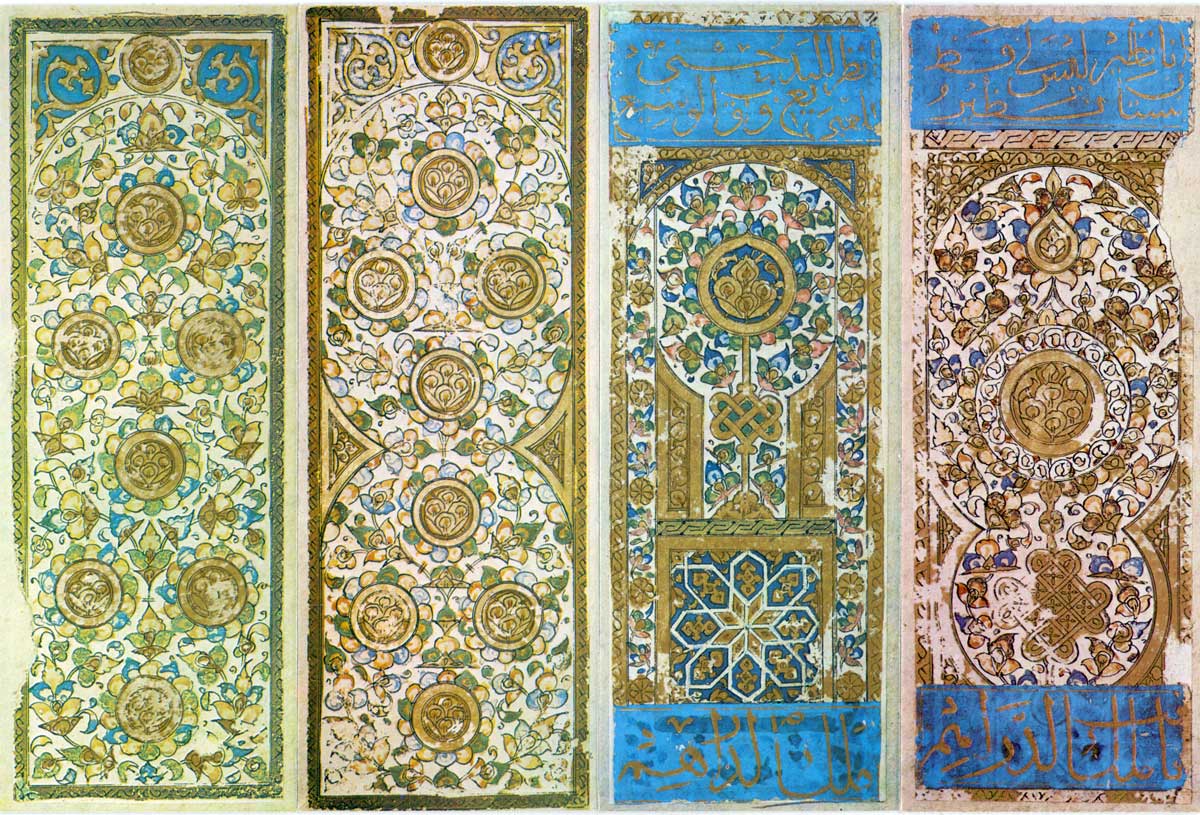
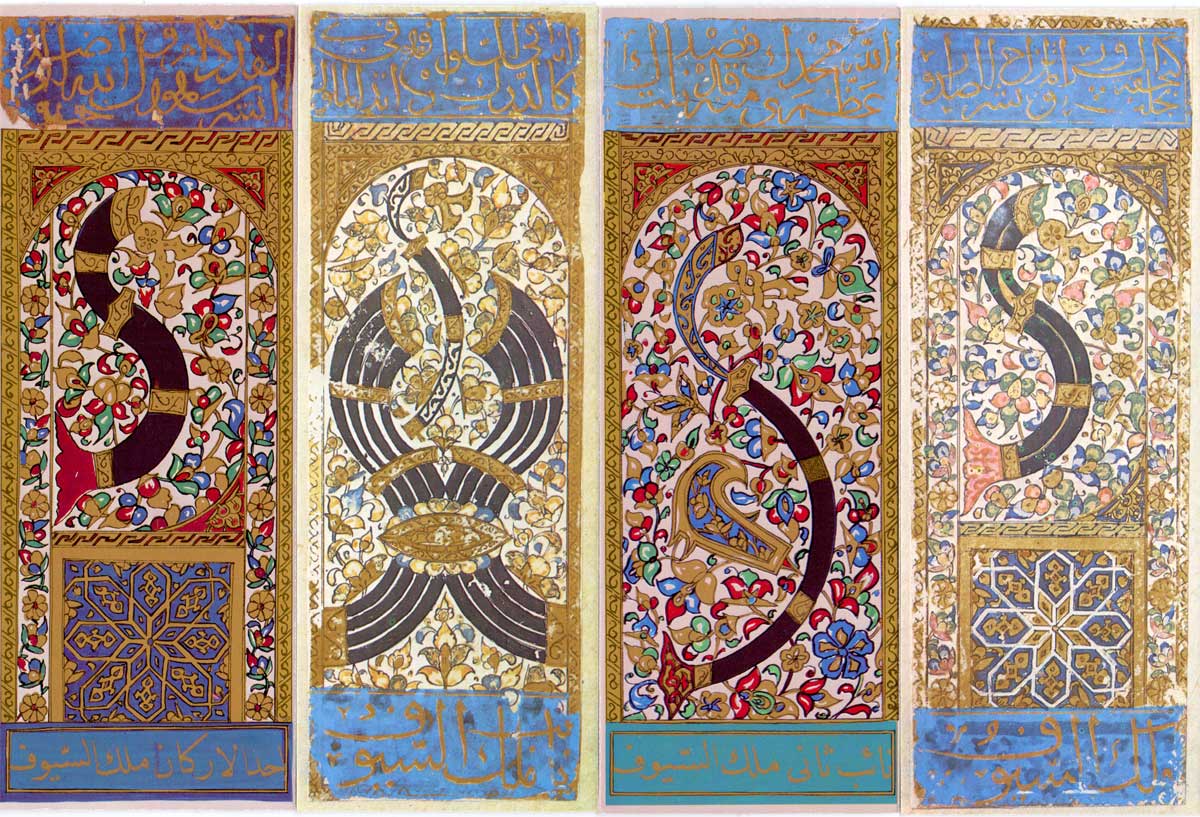
Above: hand-drawn and hand-painted Mamluk Playing Cards, XV or early XVI century. The original pack of cards is in the Topkapu Sarayi Museum in Istanbul and measures 252 x 95 mms, which makes them rather large to hold in one's hand. The cards were discovered among various other articles of the palace and nothing is known of their previous history. Mayer (1971) reckoned that "it is doubtful whether these cards were used for any length of time" as there were no greasy or dirty fingermarks on the cards. Mayer also gives his view that "these cards are obviously of Mamluk origin, and we shall probably not go wrong in attributing them to the 15th century."
The pack is incomplete and consists of 47 cards, divided into 4 suits, with 13 cards per suit, so that the complete pack would have contained 52 cards, with plain backs. The cards illustrated here are from a reconstructed facsimile edition published by Aurelia Books, Brussels and Louvain, 1972. The boxed set also contains a booklet produced by Jan Bauwens which contains the Arabic inscriptions on the cards translated by Prof. Tangi of the University of Istanbul. Unfortunately the scholarship in the analysis of the cards has been found to be inaccurate in that Bauwens mistakenly follows an earlier assessment by L.A. Mayer in thinking that the pack contained four, instead of only three, court cards per suit. Furthermore, some of the original cards have been replaced by reconstructed cards which conform to his faulty theory about which cards bore inscriptions.
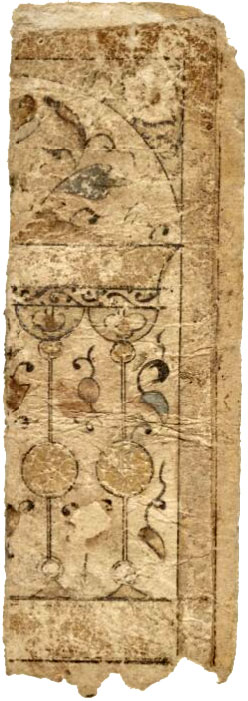
Postscript. In March 1973 Mrs. Dalu Jones communicated to us her discovery, in the Benaki Museum in Athens, of three fragments, on thick paper, which are exhibited together, although there is no information about their original provenance. One is an uncoloured 3 of Cups, from 15-century Italy, probably Venetian: the card appears identical with that on sheet i-Ioio in the Cary Collection at Yale (see p. i i5, n. 22). Another appears to be part of a 2 of Cups of Islamic origin: the intact cup has a circle just above the base, and, above that, a crescent surrounding the stem. The third fragment is equally obviously Islamic, but is probably not a playing card, although it has presumably been classified as such by the collector or the Museum. It shows part of a broad border, within which is part of a circle; this circle might be considered as a Coin suit-sign on an Ace or other low-numbered card, but the interpretation seems rather unlikely, as part of a Kufic inscription can be made out, consisting of the word 'Allah'. We are most grateful to Mrs. Jones for informing us of her important discovery, and allowing us to report it here: a more detailed description of the fragments will appear in Art and Archaeology Research Papers.
Right: a fragment of a Mamluk playing card (or a pattern for a playing card) delicately painted on soft paper, possibly deliberately torn up, part of an eight of cups. Formerly in the collection of Dr Edmund de Unger, now in the Keir Collection of Islamic Art. The floriated background decoration is typical of Islamic objects of any period.
The shape of the cup (as well as the overall card design) is basicaly the same as in the Topkapu Museum example, probably representing a traditional form which can be traced back to ancient glass forms. This suggests that the style of Mamluk cards may not have changed much over time, and that these card patterns spread from the Islamic world via Italy and Spain into Europe. Indeed, it appears that people in Spain and Italy in the late 14th and 15th centuries were aware that playing cards were also used in the Arab world, and came from there, seeing that in 1379 the Chronicles of Viterbo record that a new game called 'nayb' was introduced by a 'Saracen' (= Oriental, Arab or Muslim). In other words, playing cards had just been imported into Italy. Likewise, people in Muslim countries would have known that playing cards were used in Europe and probably some exchange of actual packs, as well as card games, took place.
* The word for playing cards used in the Italian Renaissanc (naibi) and in Spain even today (naipes) is of Arabic origin and obviously derived from nā'ib.
REFERENCES
Dummett, Michael and Abu-Deeb, Kamal: Some Remarks on Mamluk Playing Cards, Journal of the Warburg and Courtauld Institutes, Vol. 36 (1973), p. 128. Available online here►
Mayer, L.A. Mamluk Playing Cards, ed. R. Ettinghausen and O. Kurz, Leiden, 1971. This treatise was originally published in the Bulletin de l'Institut Français d'Archéologie Orientale, Le Caire, XXXV!!!, 1939, pp. 113-118.
Private correspondence from Michael Dummett to Dalu Jones, 1973.
See also: Moorish playing Cards Early References. Download article about Early Introduction of Playing Cards into Europe. (400Kb PDF)

By Simon Wintle
Spain • Member since February 01, 1996
I am the founder of The World of Playing Cards (est. 1996), a website dedicated to the history, artistry and cultural significance of playing cards and tarot. Over the years I have researched various areas of the subject, acquired and traded collections and contributed as a committee member of the IPCS and graphics editor of The Playing-Card journal. Having lived in Chile, England, Wales, and now Spain, these experiences have shaped my work and passion for playing cards. Amongst my achievements is producing a limited-edition replica of a 17th-century English pack using woodblocks and stencils—a labour of love. Today, the World of Playing Cards is a global collaborative project, with my son Adam serving as the technical driving force behind its development. His innovative efforts have helped shape the site into the thriving hub it is today. You are warmly invited to become a contributor and share your enthusiasm.

Activity for Mamluk Playing Cards
Sign in to comment or save this article.

Related Articles
Mamluk Cards and the Making of the European Deck
Mamluk “naib” cards — four suits with named courts — offer a persuasive clue to how playing c...
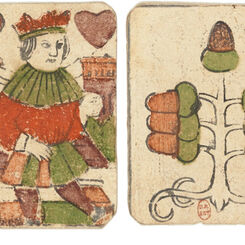
Early German playing cards
Some early examples of popular German playing cards from the XV and XVI centuries.
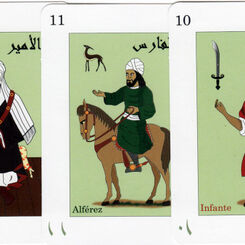
Juego de Naipes Andalusí
Andalusian playing cards designed by Marifé Montoya Carrillo with booklet by Jorge Lirola Delgado, 2...
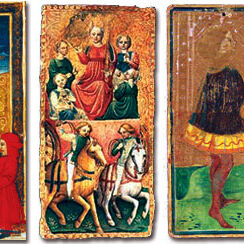
Perspectives on the History of Tarot
From a Renaissance Card Game to a Medium of Spiritual Meaning and Identity.
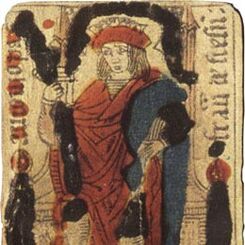
The Combination of Images and Text on early playing cards
When playing cards have titles or legends these reference a written/literary tradition of some form....
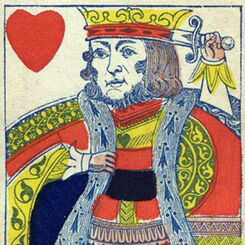
Suicide King
The King of Hearts, holding a sword behind his head, is sometimes nicknamed the “Suicide King”. He c...
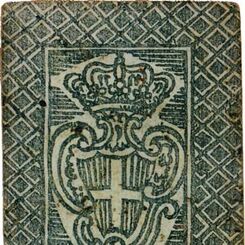
Malta
The so-called ‘Dragon Cards’, with winged monsters on the four Aces, are an enigmatic aspect of earl...
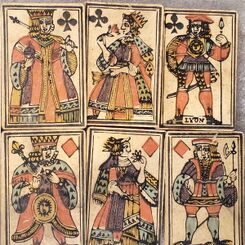
Lyon Pattern type iii
This pattern was used in various parts of eastern France but was ultimately replaced by the official...
Secondary Uses of Playing Cards
The unprinted backs of playing cards have led people to use them for secondary purposes such as memo...
History of Blackjack
Over the years the origin of Blackjack, like many other games, has eluded researchers for a long tim...
Moorish playing cards
These two uncoloured, uncut sheets of early Moorish playing cards were formerly preserved in the Ins...
Paris Pattern
The Paris pattern was established as such around the middle of the seventeenth century (based, perha...
Italian Playing Cards
The first reliable evidence that playing cards were being used in Italy is from 1376, when a game ca...
The History of Playing Cards
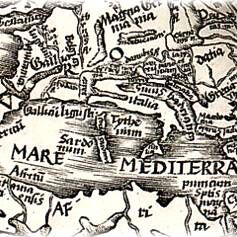
Playing cards appear in European records in the late 14th century, but their earlier history lies fu...
Baraja Morisca — Early XV century playing cards
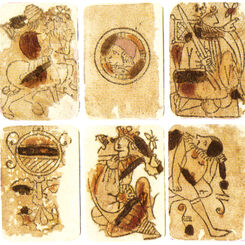
Primitive Latin suited pack, dated by paper analysis as early XV century, which makes this one of th...
History of Court Cards
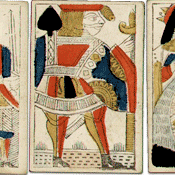
The court cards in English packs of playing cards derive from models produced by Pierre Marechal in ...
History of English Playing Cards & Games
The History of English Playing Cards dates probably from the mid 15th century
Early History of Playing Cards & Timeline
Out of an apparent void, a constellation of references in early literature emerge pointing to the su...
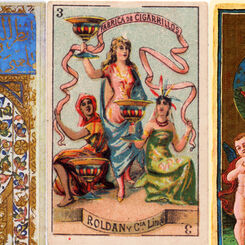
Art in Playing Cards
Playing cards have long served as miniature canvases—hand-painted, gilded, engraved and printed with...
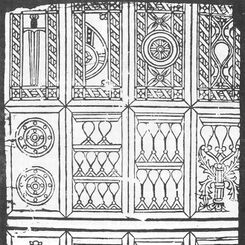
A Moorish Sheet of Playing Cards
This article was originally published in “The Playing-Card”, the Journal of the International Playin...
Most Popular
Our top articles from the past 60 days


Stephen Scharber
07 April 2026, 17:27SavedSaved this article to Stephen Scharber's Collection
Jason Somers
14 June 2026, 16:47SavedSaved this article to Jason Somers's Collection