

Charles Hodges
Charles Hodges produced engraved geographical and astronomical decks, London, c.1827-30.
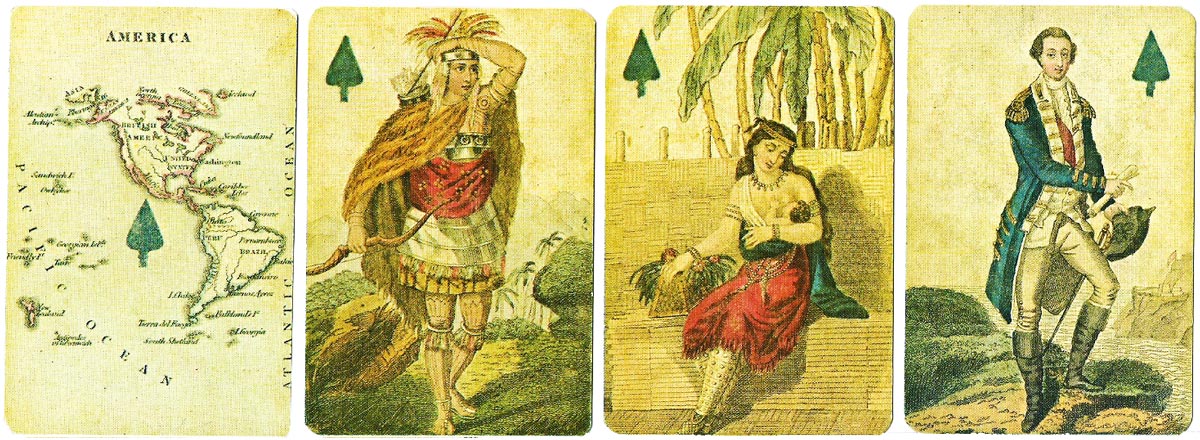
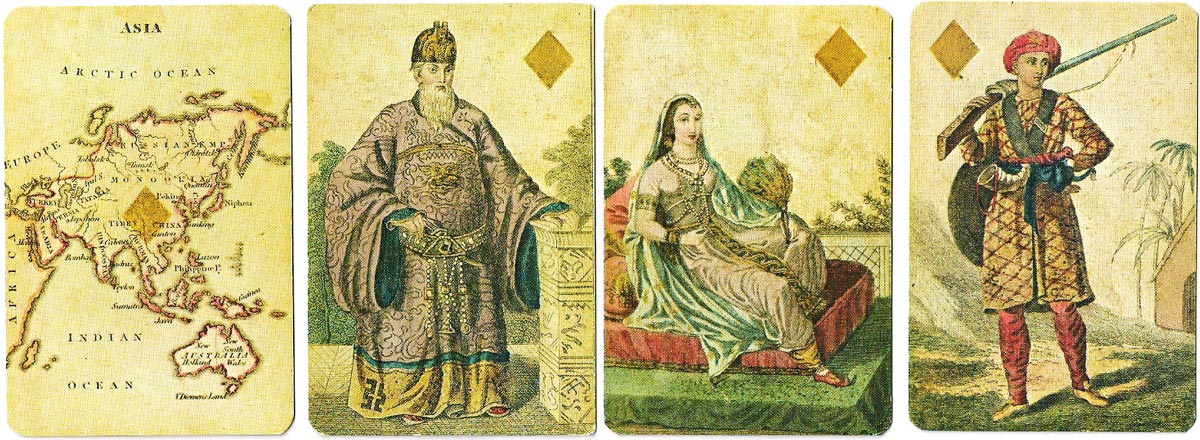
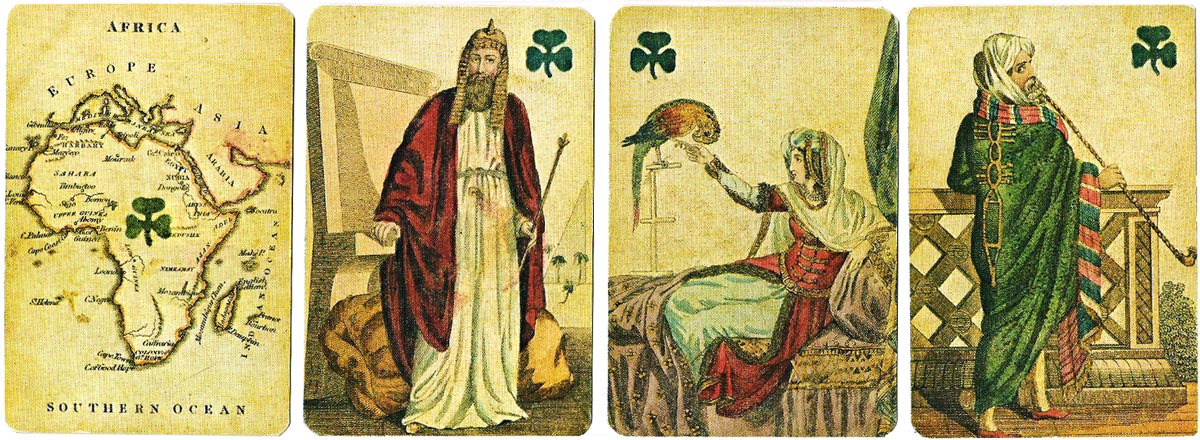
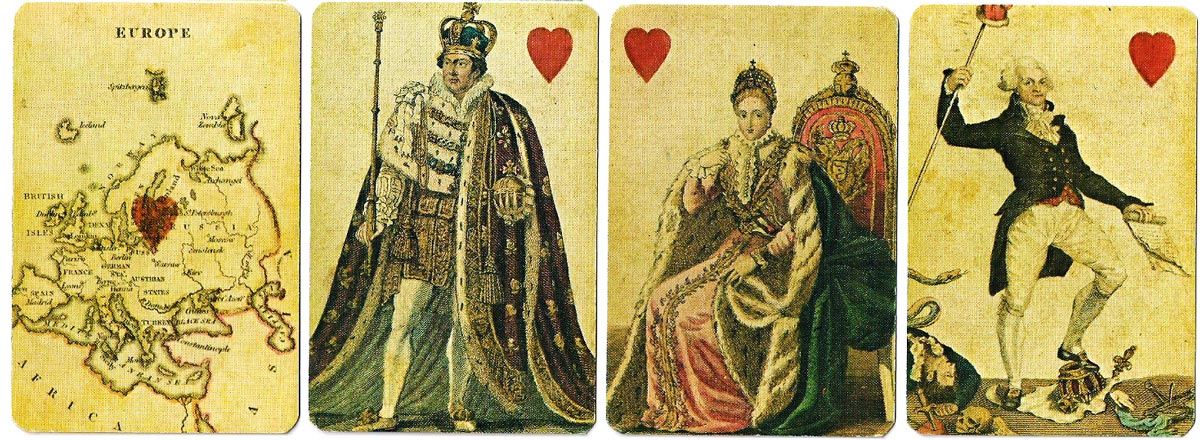
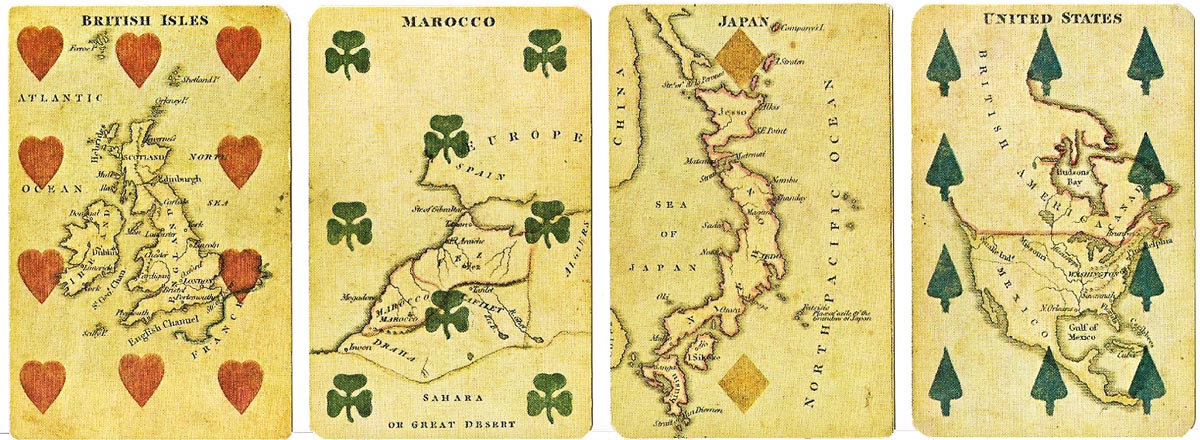
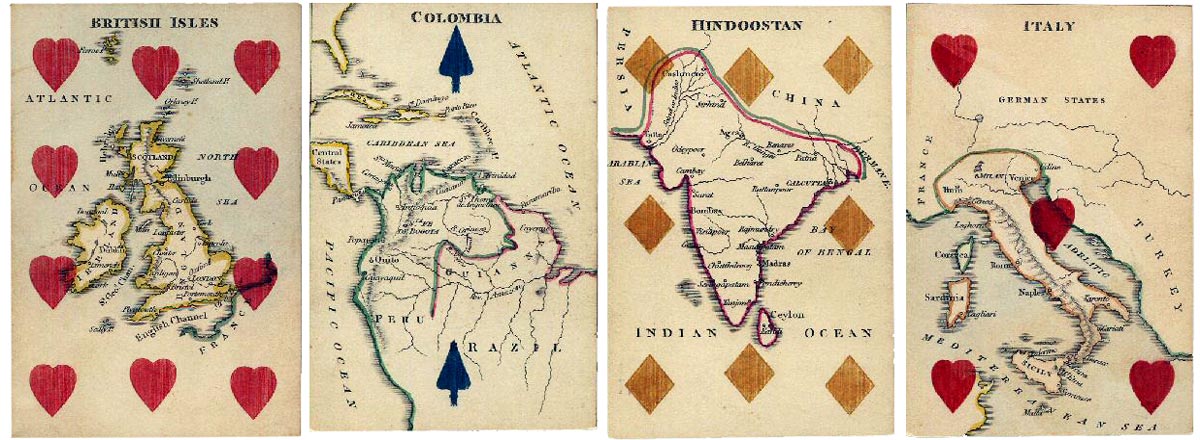
Above: Charles Hodges' Geographical cards were originally published in 1827. The Aces carry maps of the four continents; the court cards depict historical persons representing the four continents and the other numeral cards show maps of the respective countries. The aces of Spades Hearts, Diamonds and Clubs respectively represent the Americas, Europe, Asia and Africa. George Washington appears as the King of Spades and King George IV as the King of Hearts. A magnificent Chinese Emperor appears as the King of Diamonds. These maps from the numeral cards were re-used for the Astrological cards shown below. The images above are from a facsimile edition of cards in the Cary Collection at Yale University. Images courtesy Rod Starling.
Charles Hodges operated as a bookseller and stationer at 27 Portman Street, Portman Square, London, from 1825-6 until 1830. Following the tradition of engraved pictorial playing cards depicting educational, scientific and other subjects, which had its heyday in England during the 17th-18th centuries, Hodges published these Geographical and Astronomical packs starting in around 1827. The Geographical cards (shown above) were probably inspired by a pack made in France by René Janet in 1825 called “Boston de l'Univers ou Jeu des quatre parties du Monde”. The English version is believed to have been made for Hodges by Stopforth & Son in London. The Astronomical pack (shown below) was also likely made by Stopforth & Son. These are amongst the last of the finely engraved English packs as chromolithography was soon to take over.
Astrophilogeon, c.1828
Hodges' companion pack dealing with astronomy had numeral cards carrying diagrams of constellations and their pictorial representations; the court cards represent classical deities. The aim of the game was to obtain pairs of map and constellation cards from similar parts of the terrestrial and celestial globes. Information about the locality was printed at the bottom of the cards and the latitude or declination was displayed as a corner index at the top left under a large 'N' or 'S'. The maps which were used in the Geographical cards were again re-used, without any suit signs stencilled in, to complete the Astrophilogeon decks.
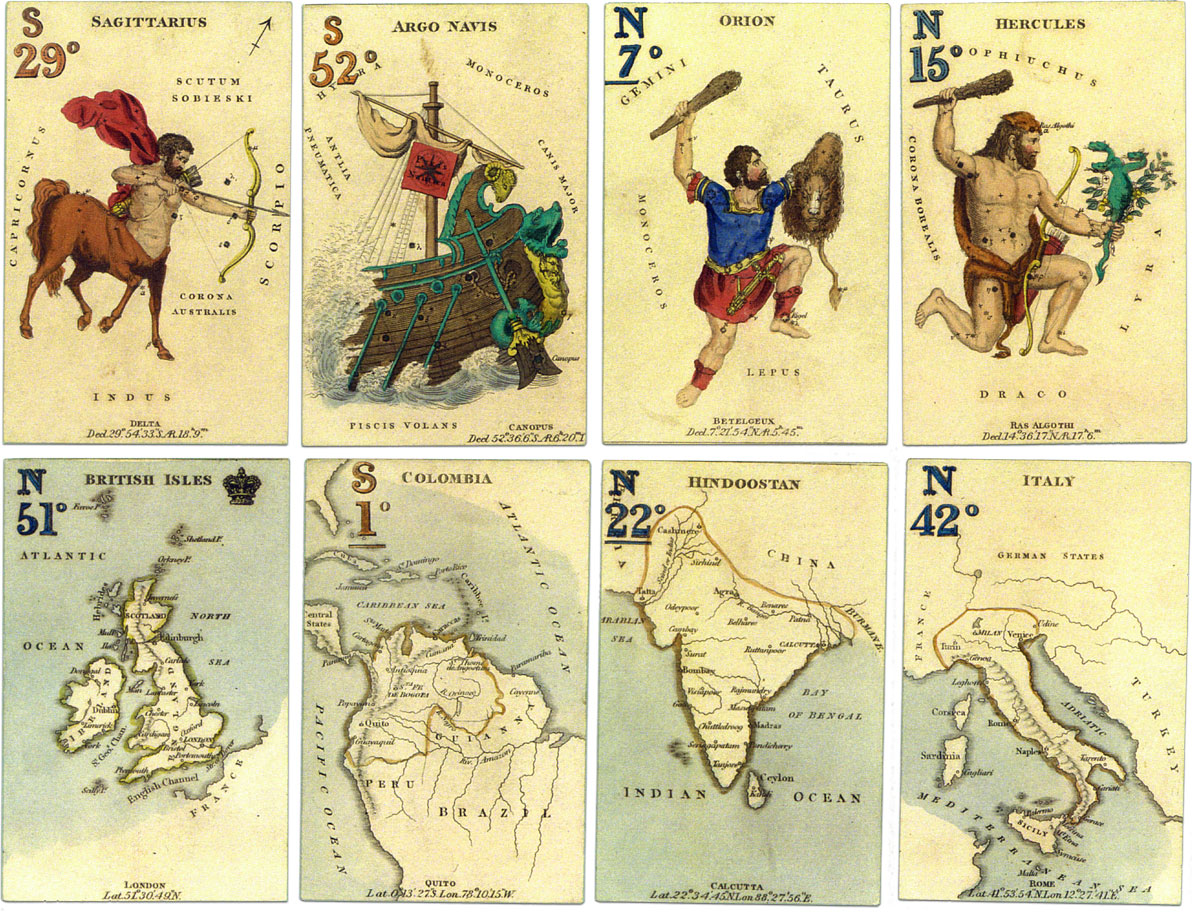
Above: Astrophilogeon, c.1828, made for Charles Hodges by Stopforth & Son. The basic aim of the game was to obtain pairs of map and constellation cards from similar parts of the terrestrial and celestial globes. The maps used in the Geographical cards with stencilled pips (below) were re-used in the Astrophilogeon decks (above) with the extra information over-printed from a second plate.
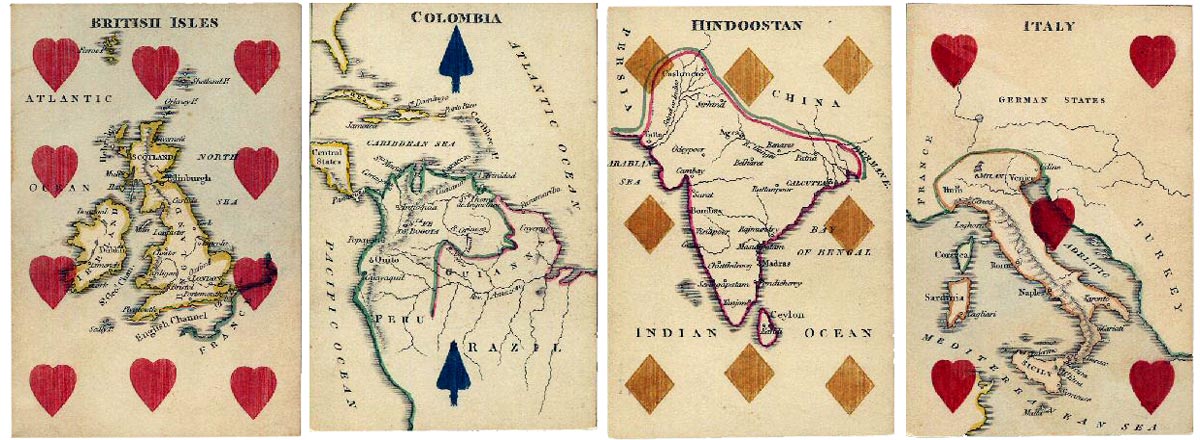
Hodges had published supplementary sets of 40 map or constellation cards with no suit signs or other information printed on them, or accompanying court cards, as New Geographical Cards and New Astronomical Cards, and was able to re-use the same plates for both his Geographical and Astrophilogeon decks with the additional information over-printed from separate plates or stencils. After Hodges ceased trading in c.1830 the packs were re-issued in 1838-9 by William and Henry Rock possibly, at first, using the same plates but subsequently moving to lithographic printing.
REFERENCES
Berry, John: Hodges' Artful Dodges, in "The Playing-Card", vol.30, no.2, Sept/Oct 2001.
Mann, Sylvia: All Cards on the Table, Jonas Verlag/Deutsches Spielkarten-Museum, Leinfelden-Echterdingen, 1990
See also: Robert Morden's Map cards, 1676 • Knavery of the Rump, 1679 • Arms of English Peers, 1688 • Mechanical instruments, c.1700 • Marlborough's Victories, 1707 • Fortune-Telling Cards, c.1714 • South Sea Bubble, 1720 • The Beggar's Opera, 1728 • Cries of London, 1754 • Transformation Cards, 1811 • Imperial Royal pack, 1828

By Simon Wintle
Spain • Member since February 01, 1996 • Contact
I am the founder of The World of Playing Cards (est. 1996), a website dedicated to the history, artistry and cultural significance of playing cards and tarot. Over the years I have researched various areas of the subject, acquired and traded collections and contributed as a committee member of the IPCS and graphics editor of The Playing-Card journal. Having lived in Chile, England, Wales, and now Spain, these experiences have shaped my work and passion for playing cards. Amongst my achievements is producing a limited-edition replica of a 17th-century English pack using woodblocks and stencils—a labour of love. Today, the World of Playing Cards is a global collaborative project, with my son Adam serving as the technical driving force behind its development. His innovative efforts have helped shape the site into the thriving hub it is today. You are warmly invited to become a contributor and share your enthusiasm.

Leave a Reply

Your Name
Just now Your comment here. Your comment here. Your comment here. Your comment here. Your comment here. Your comment here. Your comment here. Your comment here. Your comment here. Your comment here. Your comment here. Your comment here. Your comment here. Your comment here. Your comment here. Your comment here. Your comment here. Your comment here. Your comment here. Your comment here. Your comment here. Your comment here. Your comment here. Your comment here. Your comment here. Your comment here. Your comment here. Your comment here. Your comment here. Your comment here. Your comment here. Your comment here.
Related Articles
Heathen Divinities
Handmade playing cards from the British Museum depicting classical Greek and Roman gods and goddesse...
Instructive and Educational Playing Cards
Playing cards with an educational and instructive purpose first trended in mid-17th century France, ...
Myriorama
Myriorama of Italian scenery, 1824.
Transformation Cards for Christmas
Hand-drawn Transformation cards, c.1870.
Aesop’s Fables
Aesop’s Fables playing cards by I. Kirk, c.1759.
Arms of English Peers
The Arms of English Peers playing cards were first published in 1686. Heraldry, or a knowledge of th...
2000 Pips Transformation
Peter Wood’s “2000Pips” transformed playing cards reveal the artist’s love of nature.
Transformation c.1880
Hand-drawn transformation cards, c.1880
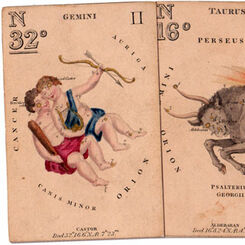
Hodges’ Constellations
Hodges’ pack dealing with astronomy had numeral cards carrying diagrams of constellations and their ...
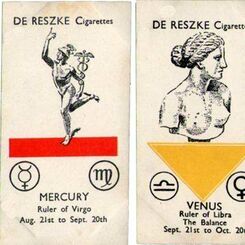
De Reszke Cigarettes “What the Stars Say”
De Reszke Cigarettes “What the Stars Say” astrology cards issued by J. Milhoff & Co., 1934.
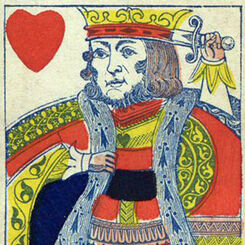
Suicide King
The King of Hearts, holding a sword behind his head, is sometimes nicknamed the “Suicide King”. He c...
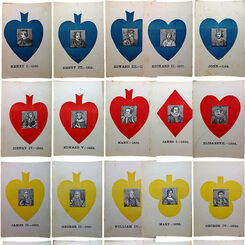
Quits
Jaques' Quits card game, c.1880-85, with portraits of monarchs inside suit symbols in red, blue and ...
Zodiac Bridge
Zodiac Bridge was designed by René Marcel Rivière and printed by AGM Müller in c.1989. A different s...
Russell Grant tarot
Russell Grant astro-tarot with optimistic and motivational illustrations by Kay Smith.
National Gallery (British School)
Jaques' The National Gallery Card Game, c.1895.
Hidden Mickeys
HiddenMickeys
The Llewellyn Tarot - Welsh tarot cards
The Llewellyn Tarot - Welsh tarot cards
Robert Morden’s Playing Cards
The 52 Counties of England and Wales described as a pack of cards first published in London in 1676....
Picture Show — Zodiac Fortune Telling Cards
Zodiac Celebrities fortune-telling cards presented with 'Picture Show' magazine, 1930. The cards wer...
2000Pips Transformation Pack
2000Pips Transformation Pack
Most Popular
Our top articles from the past 60 days


