Spanish-Suited Playing Cards in Latin America
The journey of Spanish-Suited decks from Conquistadores to local makers.
The Arrival and Spread of Playing Cards in Central and South America
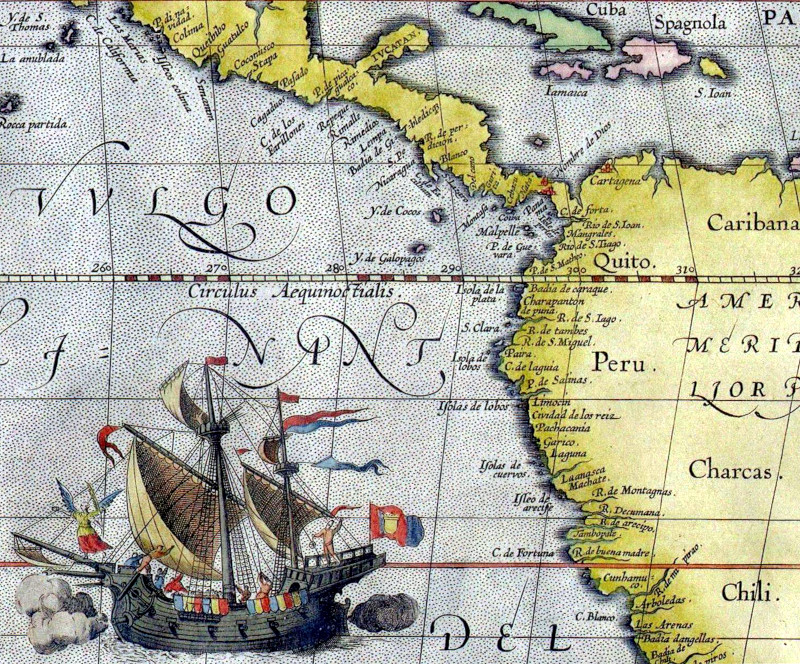
Playing cards reached the Americas with early European explorers and settlers in the decades following Columbus’s first voyages in the 1490s. Thrust into unfamiliar environments and facing hunger, disease, and armed resistance from poisoned arrows, many expeditions were driven primarily by the pursuit of gold and loot, and violence was a frequent feature of early encounters with indigenous tribes. The conquistadores (mostly Spaniards) were also keen gamblers, and gambling was a well-established feature of their social life. Early accounts from the Americas, however, more often mention dice rather than cards, possibly because dice were sturdier and better suited the damp, unstable conditions of ships and frontier settlements. At the same time, Indigenous peoples also had their own gaming traditions, often tied to ritual, divination or social exchange, before playing cards reached them.
The violence was not simply the result of individual excess. It was supported by legal and theological doctrines. From 1513 onward, Spanish expeditions carried The Requerimiento, a formal declaration written by the jurist Juan López de Palacios Rubios (1450–1524). Read aloud, often without translation and out of earshot, it asserted papal and royal authority over newly encountered lands and peoples, giving Spaniards automatic entitlement. Indigenous resistance was framed as rebellion against divine and imperial law, justifying enslavement and dispossession. Basicaly, human lives could be reduced to property, a logic that permeated colonial society and, at times, extended even into games of chance.
A frequently cited early account illustrates the brutality of the gambling practices:
“... Estos esclavos eran herrados y luego vendidos en almoneda en la misma Santa María o bien en Cuba y en La Española, cuando no se jugaban a los dados como rebaño humano. Se refiere que en una sola apuesta el gobernador en persona perdió la cantidad de cien indios”. (“…These slaves were branded and then sold at auction in Santa María, or else in Cuba and Hispaniola, otherwise they were gambled away at dice like a human herd. It is reported that in a single wager the governor himself lost as many as one hundred Indians.”) ¹
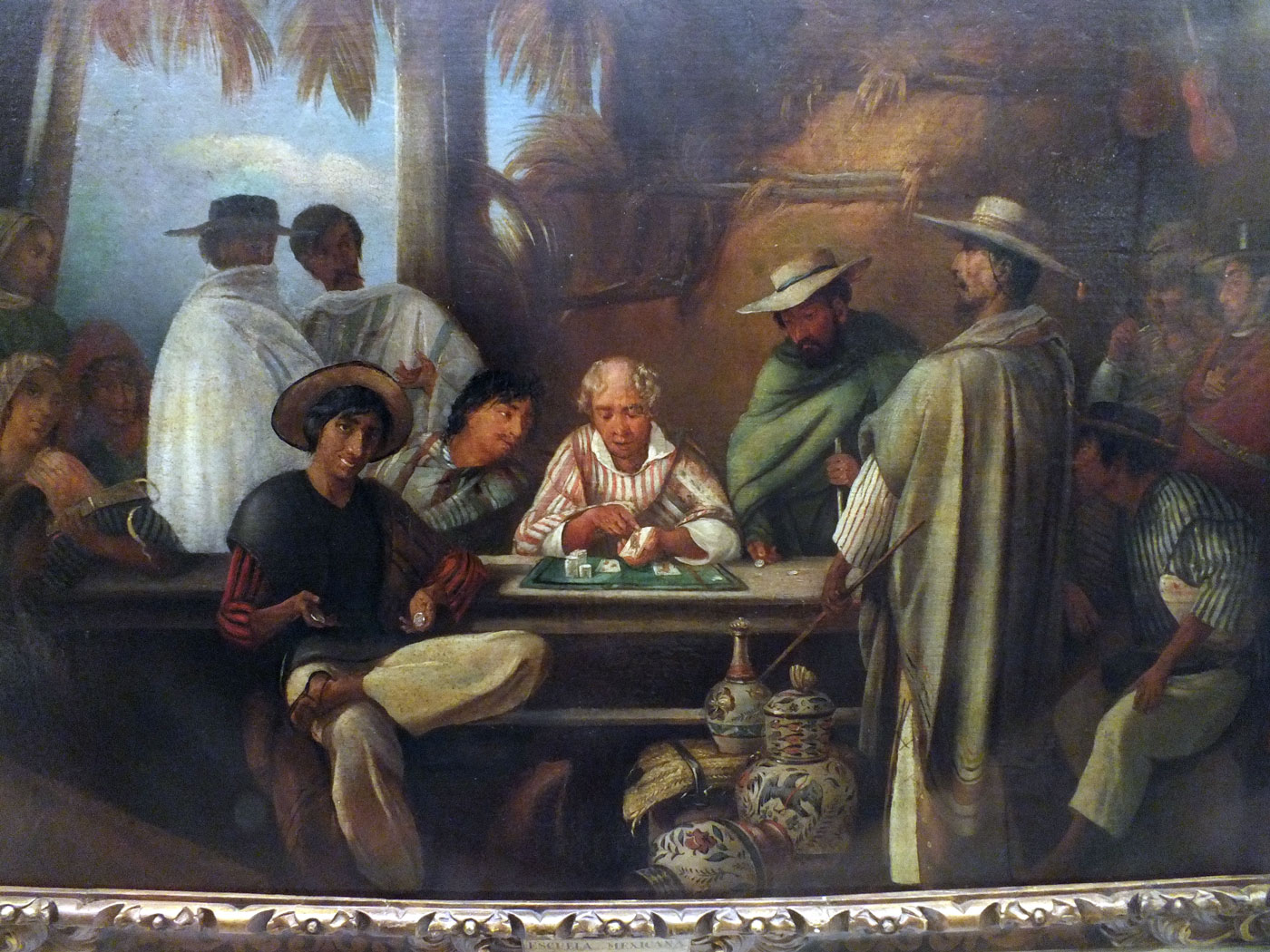
Although playing cards are not mentioned in these early accounts, their presence can be traced through legal and administrative records. By the late 1520s, royal laws in New Spain were already attempting to restrict gambling with both dice and cards, citing financial losses, disputes over property, social disorder and so on.² ³ This suggests that cards were already widely used. Mulattos, blacks, enslaved people, Indigenous communities, and Europeans all took part in card play.⁴ Cards thereby also served as light entertainment in homes, taverns, and aboard ship, forming part of everyday social life.
Alongside The Requerimiento, the legal framework governing Spanish overseas possessions had been laid earlier, notably with the Treaty of Tordesillas (1494), in which the Catholic Monarchs of Spain and John II of Portugal divided rights to future discoveries along a meridian west of the Cape Verde Islands. While these treaties and laws did not concern cultural practices such as gaming, they established the geopolitical context within which European customs - including playing cards and gambling - were transplanted to the Americas.
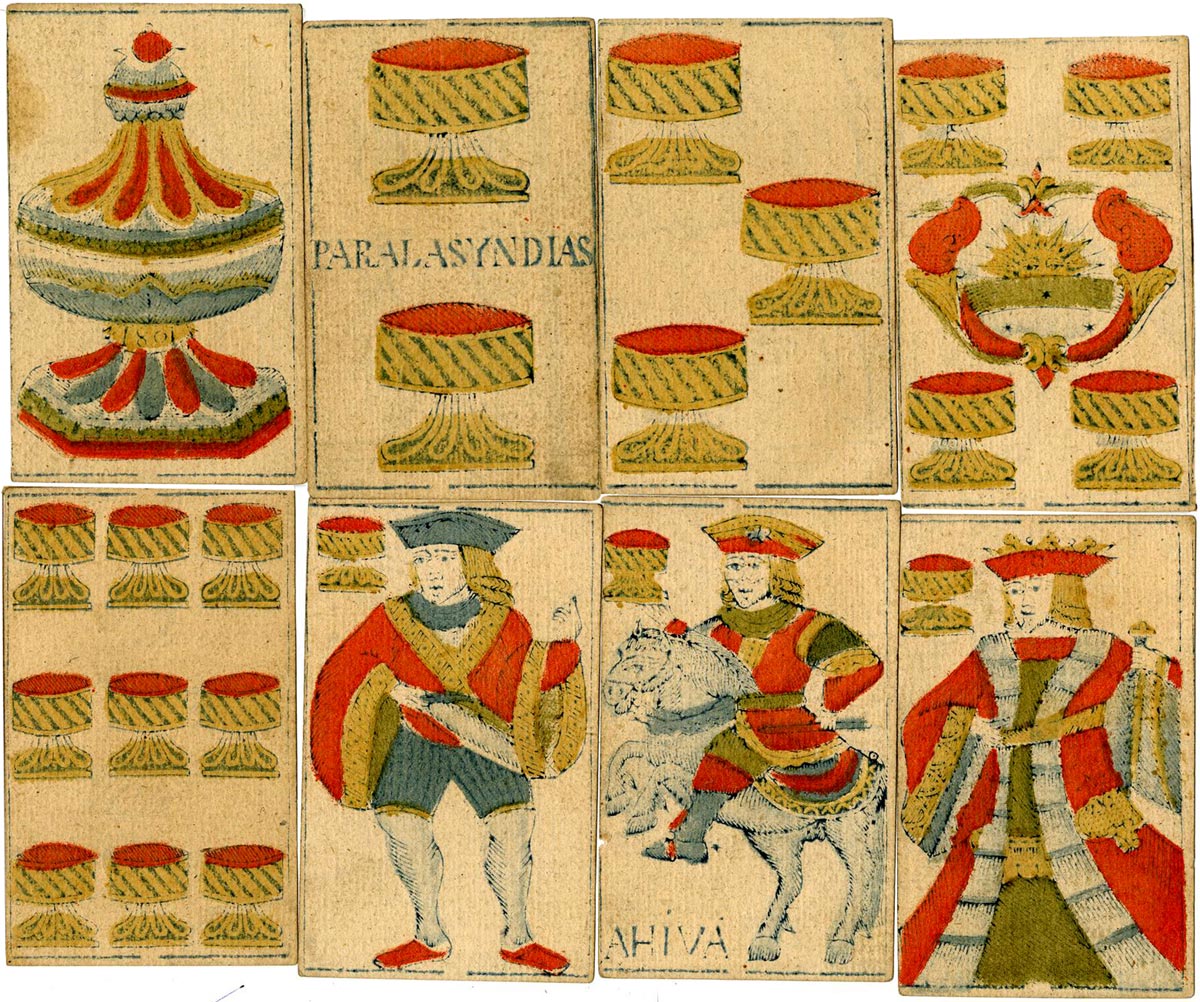
Below is a selection of early Spanish playing cards which might have been carried by explorers to the new colonies in America, giving an idea of what may have been used for the first 200-300 years or so after Spanish settlers arrived.
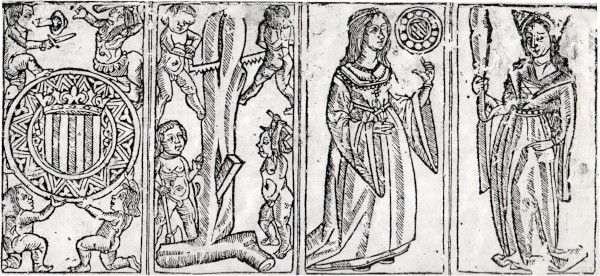
Above: Gothic Spanish-suited cards from the Catalonia area, 15th century. Cards with similar characteristics were produced in several areas but are now obsolete.
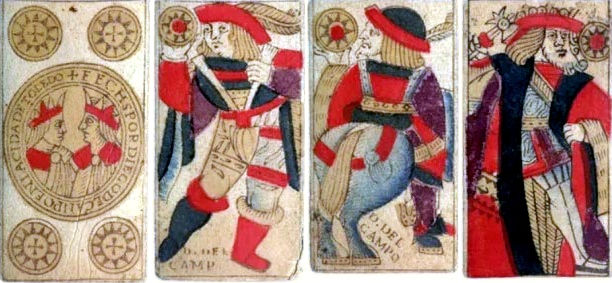
Above: 48-card Franco-Spanish pattern deck by Diego del Campo c.1550, Phelippe Ayet, 1574, and several others, produced and used in both France and Spain.
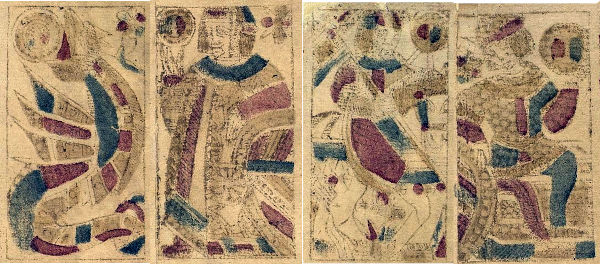
Above: archaic sixteenth century Spanish playing cards by Francisco Flores, preserved in the Archivo de Indias, Seville. Cards of this type have been discovered in various parts of the world, jncluding archaeology excavations in Peru. The pattern is now obsolete.
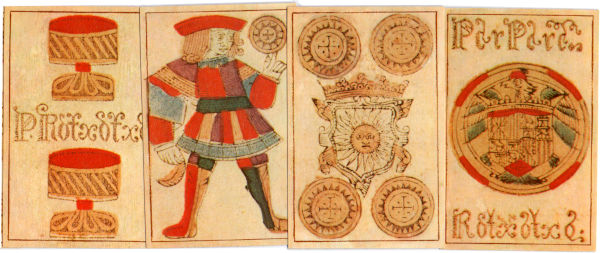
Above: probably originating in Spain in the seventeenth century or even earlier, the “Spanish National” pattern was extensively exported to Latin American colonies. Cards like these (and the ones above) may have been used for the first 300 years or so after Spanish settlers arrived.
By the mid-16th century, Spanish authorities shifted from prohibition to regulation, a more pragmatic, revenue generating approach rather than social control. Playing cards became a taxable commodity, and by 1552 royal monopolies for their manufacture and sale had been established, beginning in Mexico and later extending further south towards Peru. What was first seen as a social vice is now turned into a taxable, controllable activity. Production relied on imported paper and materials, making cards expensive, and coupled with their taxation, this encouraged contraband and smuggling.
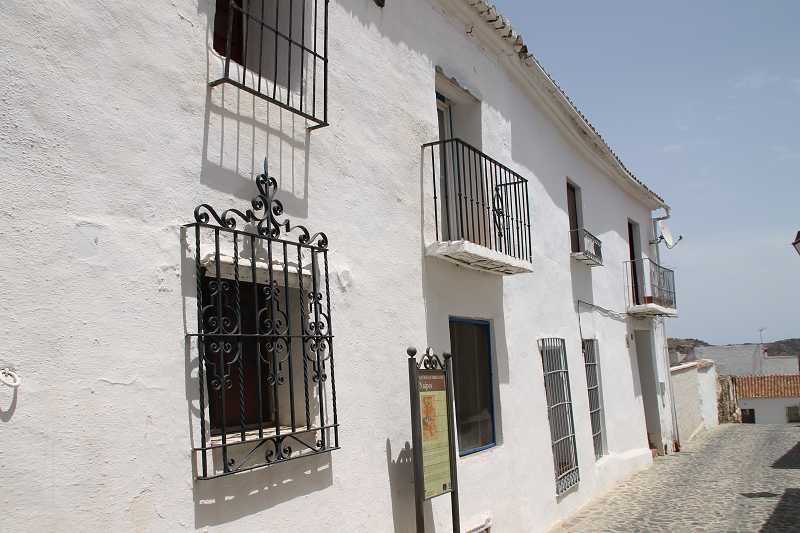
Above: the former playing card factory at Macharaviaya. Photo credit: © 2017 Diputación de Málaga.
In 1776, the Royal Factory at Macharaviaya near Málaga in Spain, was established not for traditional grape cultivation but to supply playing cards to overseas markets in the Americas. By September 1777 some 15,000 packs had been shipped "for the Indies". The venture, however, soon declined and the factory closed in the early 19th century. Its failure opened the market to local manufacturers, who began to supply cards independently and to develop their own export networks.
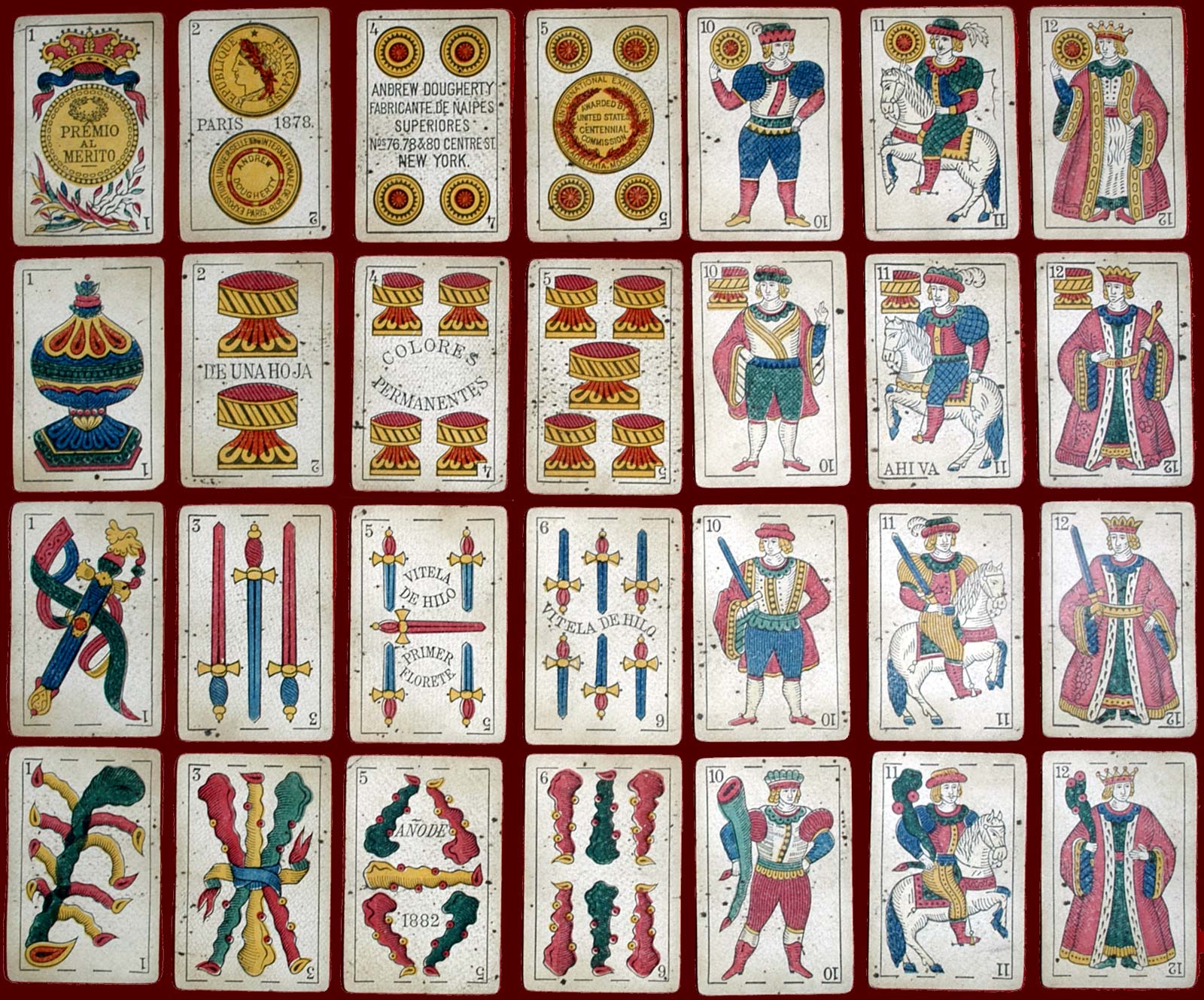
During the 18th and 19th centuries, an era shaped by steam power and enterprise, Italian card makers (such as Pedro Bosio, Agostino Bergallo and Giuseppe Cattino) were shipping playing cards to Spanish colonies in South America. By the 19th century the main market of the Cadiz naiperos became exporting to Latin America, the Philippines, and Spanish-speaking communities in the United States. A long list of European and U.S. manufacturers (including Fournier, Comas, Dondorf, Dougherty, Goodall, Grimaud, Müller USPCC and Wüst) all began to export cards to The Indies.
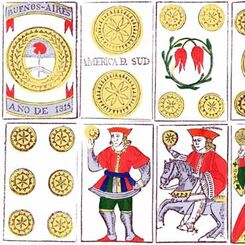
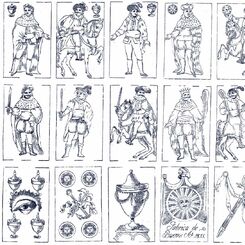
The first Latin American manufacturers began to appear in the early 19th century (among them Gandarillas, Quercia y Possi, Solano García, Bartolo Borrego), at the time of the wars of independence (c. 1810–1825) when Spanish royal monopolies began to be disrupted and trade restrictions weakened. Although the Spanish National pattern was still preferred, having been produced at the Royal Factory at Macharaviaya until its demise, other patterns began to gain favour, particularly the Cadiz pattern produced by Andalusian makers, and the Catalan pattern, associated with Barcelona. Several importing agents were also bringing Spanish and American cards into the market (including Fló Hermanos, Bertrand Domec, Gath & Chaves). At the same time, immigrants relocating to Buenos Aires opened playing card factories there (including Francisco Girbau, Igor Domicelj, Luis Fourvel & Justo Rodero), often bringing new techniques, designs and know-how with them. So there was a gradual shift from importation towards local production.
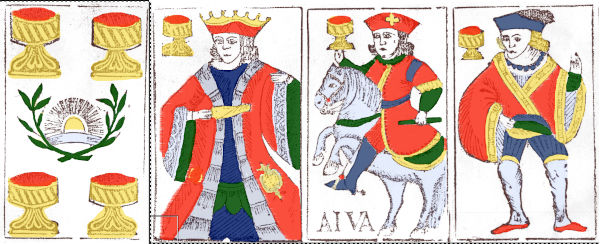
Above: Spanish National pattern by Manuel José Gandarillas, Buenos Aires, 1816. Independence (from Spanish government) is represented by the rising sun.
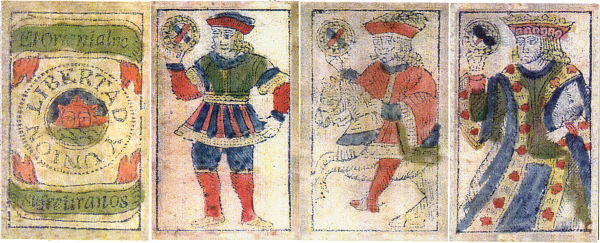
Above: Naipes Artiguistas based on Spanish National pattern published in Concepción del Uruguay in 1816, with political slogans on some cards.
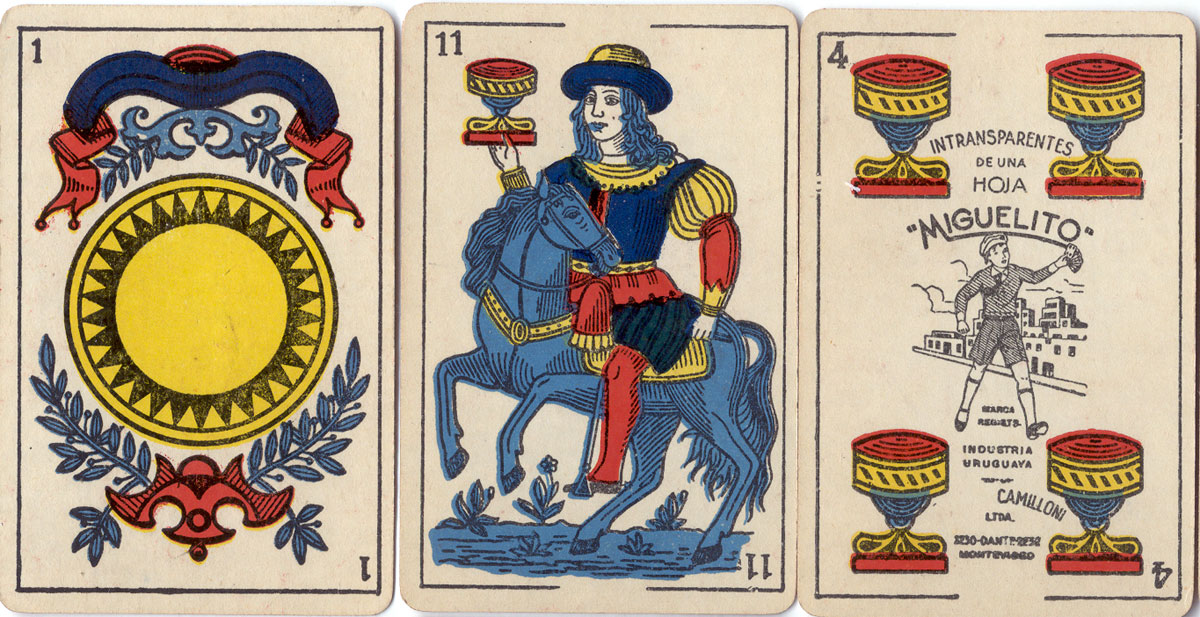
Above: Naipes ‘Tito’, Camilloni Hnos, Montevideo, c.1950, based on designs produced in France for export to South America during the 19th century.
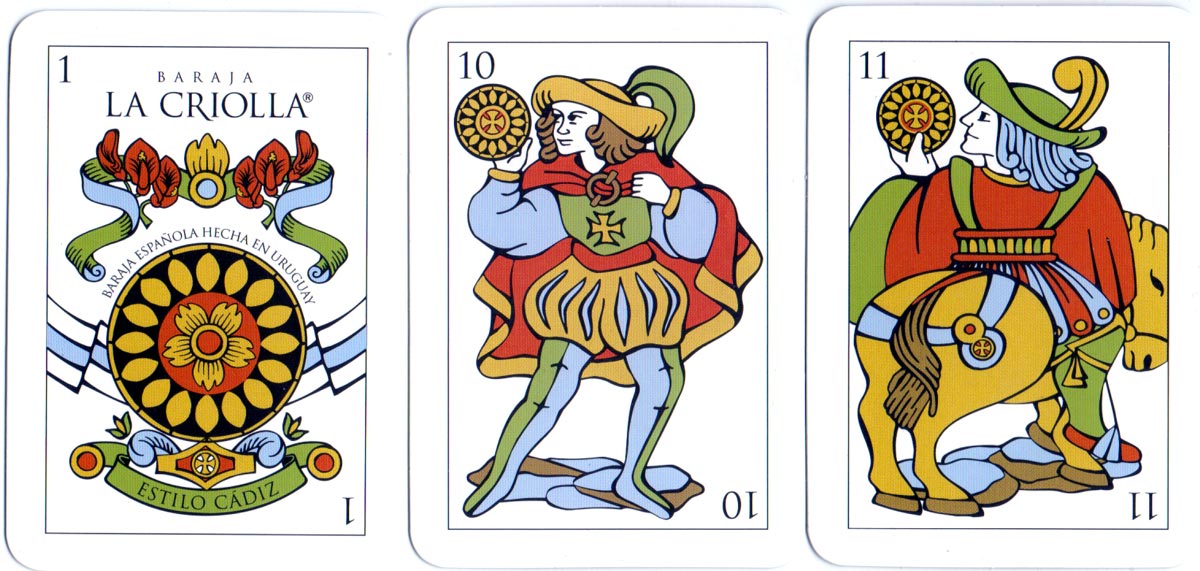
Above: Naipes ‘La Criolla’ designed by Uruguayan graphic designer Anabella Corsi, 2008, inspired by the archaic Franco-Spanish pattern used during the 16th and 17th centuries.
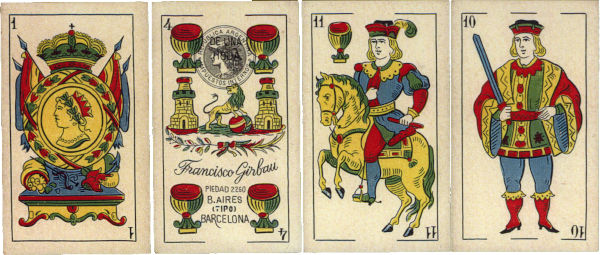
Above: Catalan pattern by Francisco Girbau, Buenos Aires,c.1900. This design was also used by Fourvel, Cappellano and Justo Rodero.
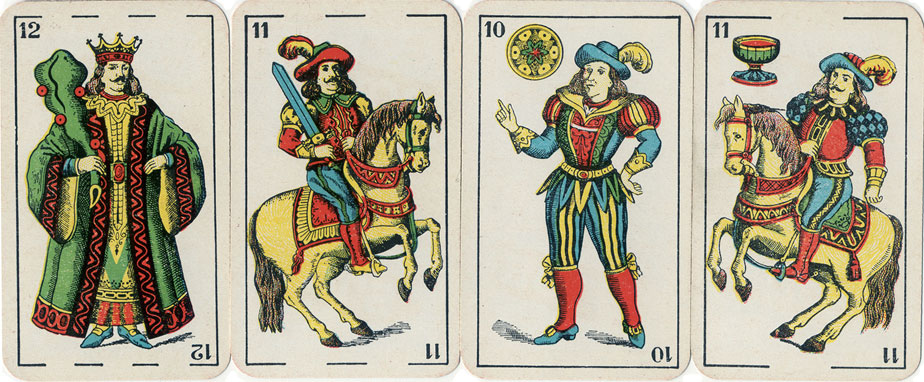
Above: Cadiz pattern by Igor Domicelj, Buenos Aires, c.1955 based on Segundo de Olea (Cadiz) which had been imported into Argentina since the 19th century.
Independence transformed the market, dismantling Spanish monopolies and encouraging the rise of local manufacturers and new patterns. The rich visual and material legacy of Pre-Columbian civilizations continues to shape cultural identity. Elements of indigenous daily life, costume or representations of rulers and deities are often incorporated into the imagery of 20th century decks themed around Aztec, Maya and Inca cultures, as well as in regional traditions such as gaucho decks or bullfighting. In some cases, indigenous communities themselves produced playing cards modeled on the Spanish pack; Native American cards, particularly those associated with Apache groups and other tribes, represent a distinctive spin-off and adaptation of Spanish cards.
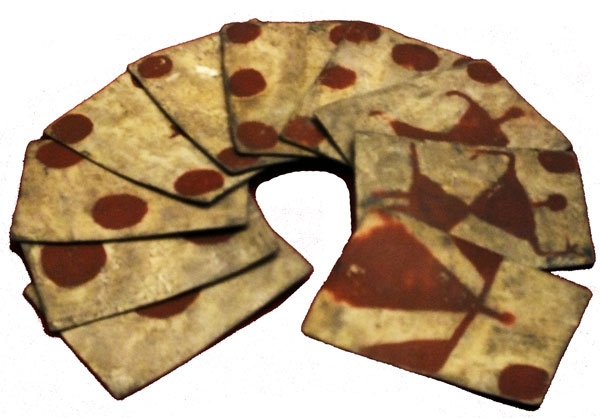
Above: Spanish-suited playing cards made on rawhide by the Mapuche Indians, Chile, XVI-XVII century.
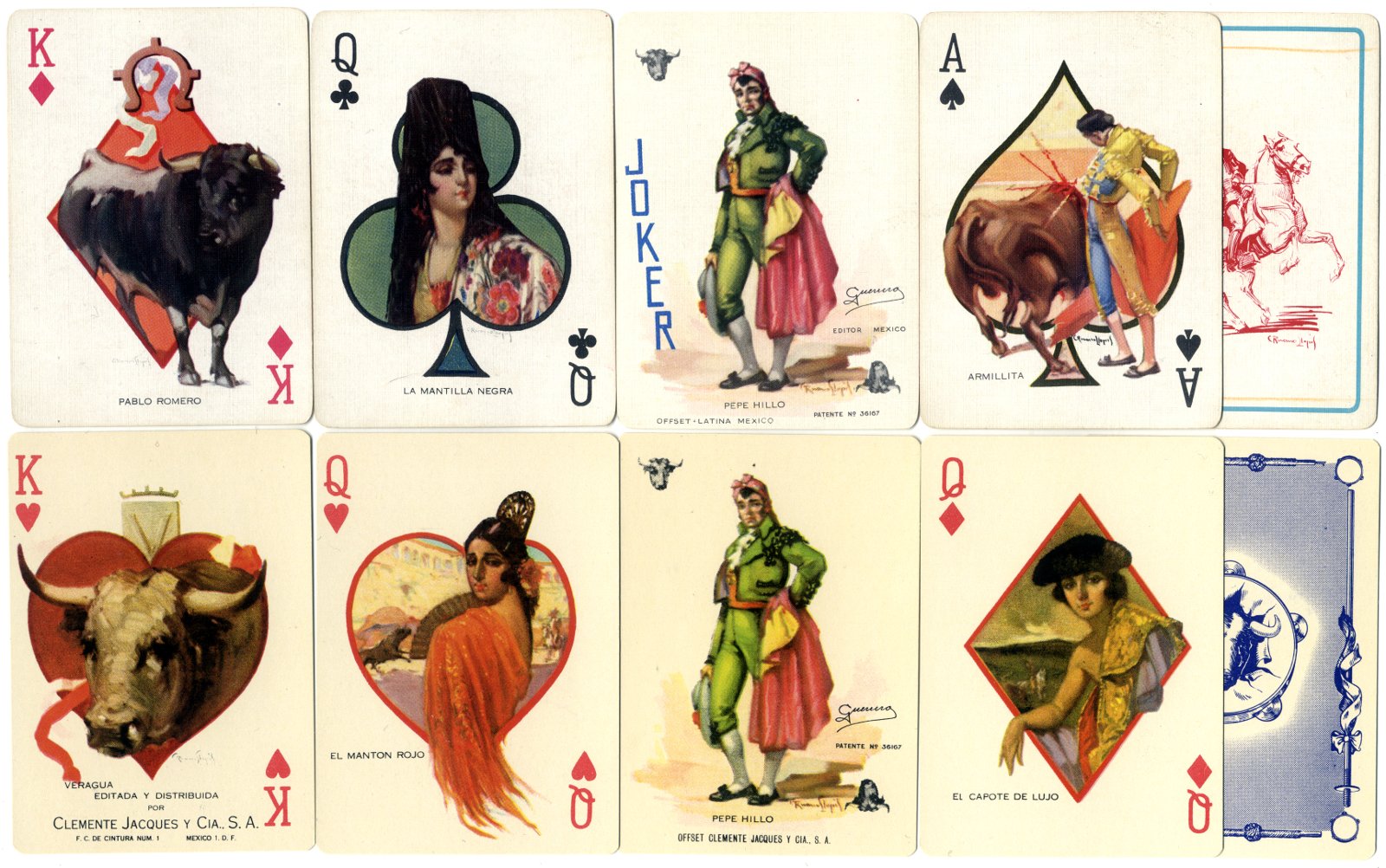
Above: Poker Taurino bullfight pack with paintings by Carlos Ruano Llopis, published by by Clemente Jacques y Cia, S.A., Mexico, c.1950.
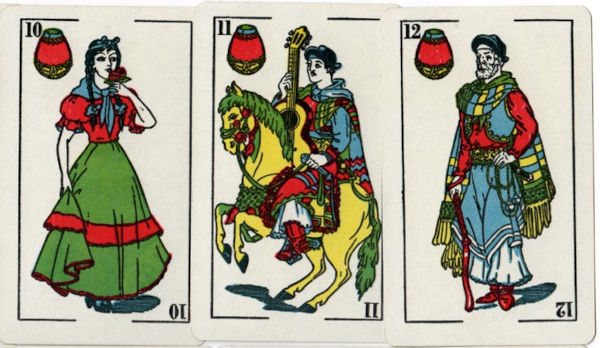
Above: Naipes Casino Estilo Argentino by Justo Rodero, c.1950.
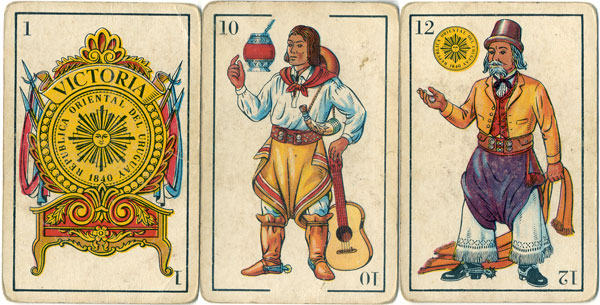
Above: Naipes Victoria gaucho-themed pack, manufactured by Compañia General de Fósforos Montevideana, c.1975.
Note: Spanish-suited and French-suited (Anglo-American) cards followed largely separate historical paths in Latin America, overlapping only later. Anglo-American cards are discussed in Ken Lodge's blog here & here►
References
- Aritio, Luis Blas : “Vasco Núñez de Balboa, La Crónica de los Cronistas de Indias”, Ediciones Balboa, Panama, 2014, p.322.
- Jorge Cañizares-Esguerra : Spanish Deck►
- Teresa Lozano Armendares : Los Juegos de Azar ¿Una pasión Novohispana?►
- Gorostiza, M. Llano : Naipes Españoles, Ediciones Indubain, 1975, p.113 ff.
Cuello Martinell, María Angeles : La Renta de los Naipes en Nueva España, Escuela de Estudios Hispano-Americanos, 1966 digital version►
Sanz Tapia, Ángel : Culturas Precolombinas, Ajuntament de L'Hospitalet, 1994.
British Museum : uncut sheet illustrating the costumes of South America►
Wikipedia : El Requerimiento►

By Simon Wintle
Spain • Member since February 01, 1996 • Contact
I am the founder of The World of Playing Cards (est. 1996), a website dedicated to the history, artistry and cultural significance of playing cards and tarot. Over the years I have researched various areas of the subject, acquired and traded collections and contributed as a committee member of the IPCS and graphics editor of The Playing-Card journal. Having lived in Chile, England, Wales, and now Spain, these experiences have shaped my work and passion for playing cards. Amongst my achievements is producing a limited-edition replica of a 17th-century English pack using woodblocks and stencils—a labour of love. Today, the World of Playing Cards is a global collaborative project, with my son Adam serving as the technical driving force behind its development. His innovative efforts have helped shape the site into the thriving hub it is today. You are warmly invited to become a contributor and share your enthusiasm.

Leave a Reply

Your Name
Just now Your comment here. Your comment here. Your comment here. Your comment here. Your comment here. Your comment here. Your comment here. Your comment here. Your comment here. Your comment here. Your comment here. Your comment here. Your comment here. Your comment here. Your comment here. Your comment here. Your comment here. Your comment here. Your comment here. Your comment here. Your comment here. Your comment here. Your comment here. Your comment here. Your comment here. Your comment here. Your comment here. Your comment here. Your comment here. Your comment here. Your comment here. Your comment here.
Related Articles
America
“America” playing cards designed by Teodoro N Miciano, 1960.

Naipes Españoles “El Mexicano”
Standard Catalan-type deck, titled "El Mexicano", by an anonymous Argentinean manufacturer, c.1980s....

Baraja Hispanoamericana
“Baraja Hispanoamericana” published by Asescoin, with artwork by Ortuño, illustrates memorable peopl...

La Española Classic
‘La Española Classic’ is a traditional ‘La Española’ Spanish-suited pack and is produced in several ...
Naipes ‘Baccarat’
An example of the typical version of the Spanish Catalan pattern which is widely used in South Ameri...

Axe Deodorant
Clearly promoting good personal hygiene, each card shows a young female model posing seductively and...
Playing Cards in Cuba
During the colonial years and afterwards, Spanish-suited packs were imported into Cuba.

Colombia
Colombian playing cards.
Uruguayan Playing Cards
Until the 19th century playing cards were imported into Uruguay from Spain.

Joker S.A.
Playing cards manufactured by Joker S.A.
Argentinian Playing Cards - Naipes Argentinos
Playing cards were introduced to the Americas by Spanish explorers in the 16th century.

Native Indian Hand-made Cards made on rawhide
Native Indian hand-made cards made on rawhide.
J. M. Gandarillas, Buenos Aires, c.1815
Playing cards believed to have been designed in 1815 by the Chilean immigrant Manuel José Gandarilla...
Quercia y Possi, Buenos Aires 1815-16
José Maria Quercia y Possi was an Italian immigrant who joined the Chilean Independence army. He se...
Playing Cards in Honduras
Honduras shares a long tradition with Spain in the field of playing cards.
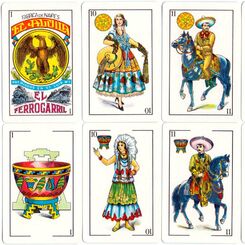
Playing Cards from Mexico
MEXICO shares a long tradition with Spain in the field of playing cards and also merges two complete...
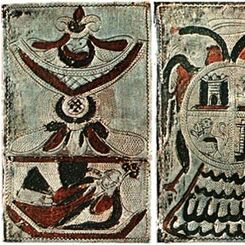
Silver Cards from Peru
Spanish-suited silver cards, richly embellished and enamelled, from a former Spanish Viceroy in Peru...
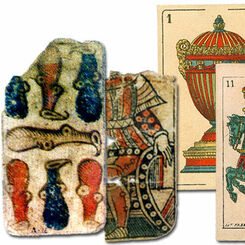
Peruvian Playing Cards
Playing cards have been travelling from Spain to South American colonies ever since Christopher Colu...
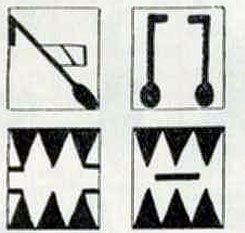
Las Cartas de Tacuabe by Manos del Uruguay
Tacuabé was a Charrúa native from Uruguay, an indigenous tribe that became extinct following Europea...
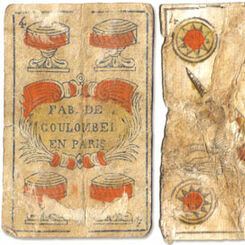
The ‘Parisian’ Spanish pattern
A version of the old Spanish National pattern which was manufactured by Parisian card makers in the ...
Most Popular
Our top articles from the past 60 days