German playing cards
Card-playing rapidly became popular in medieval Bavaria and German printers were quick to supply the goods.
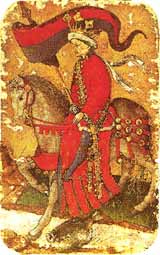
Above: Stuttgart luxury cards, c.1430
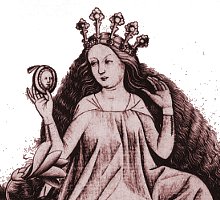
Above: Master of The Playing Cards
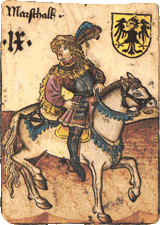
Above: Hofamterspiel c.1460
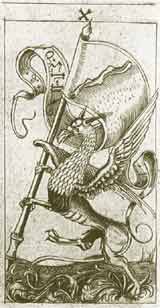
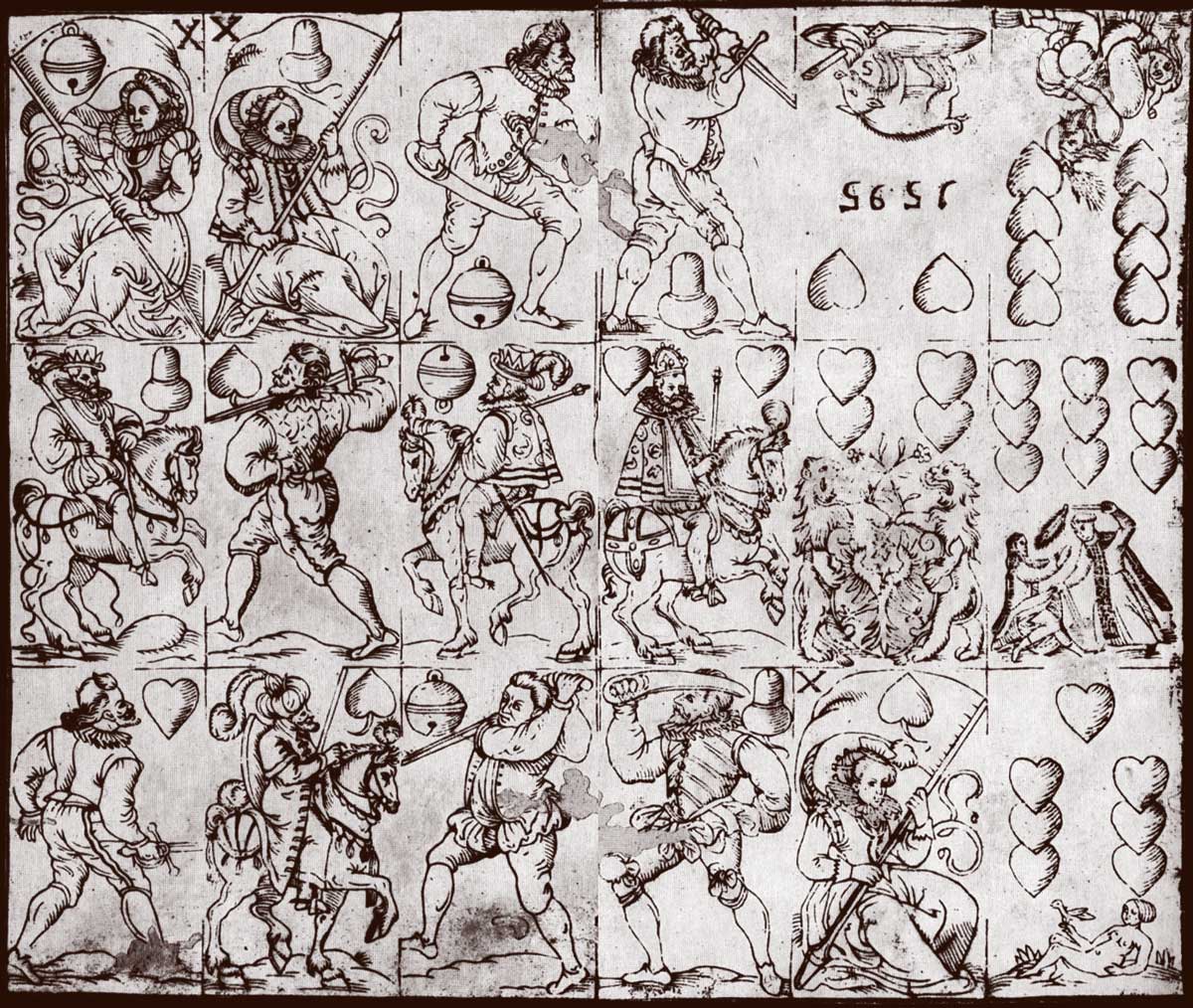
Above: South German Engraver, c.1495
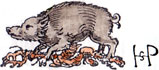
Above: Hans Beham, c.1523
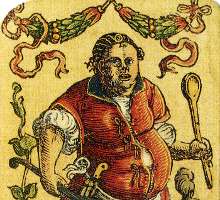
Above: Peter Flötner, c.1545
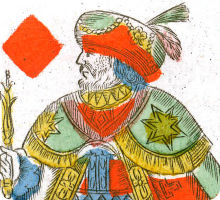
Above: Johann M. Backofen, c.1800
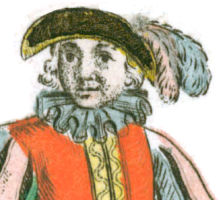
Above: Joseph Losch, c.1800
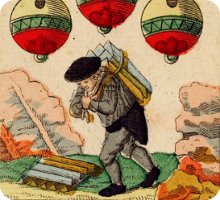
Above: Bergmannskarte, c.1816
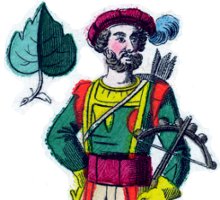
Above: Schiller Deck, c.1818
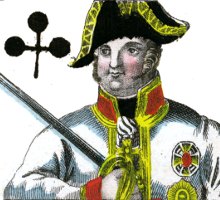
Above: Anti-Napoleon Deck
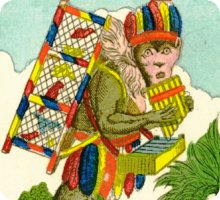
Above: Verkehrte Welt Tarock, c.1850
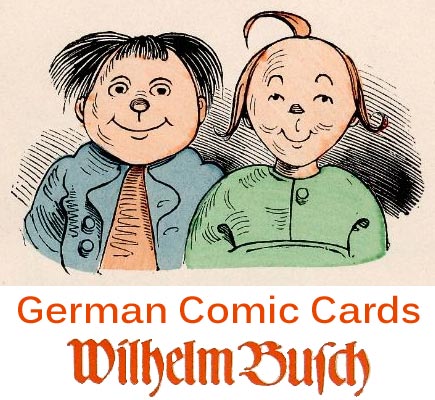
Above: Wilhelm Busch (1832-1908)
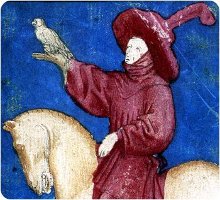
Above: Princely Hunting pack, c.1445
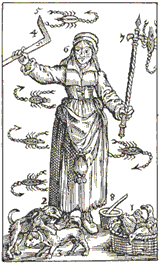
Above: Thomas Murner, 1507
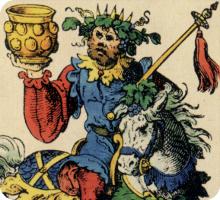
Above: Jost Ammon, 1588
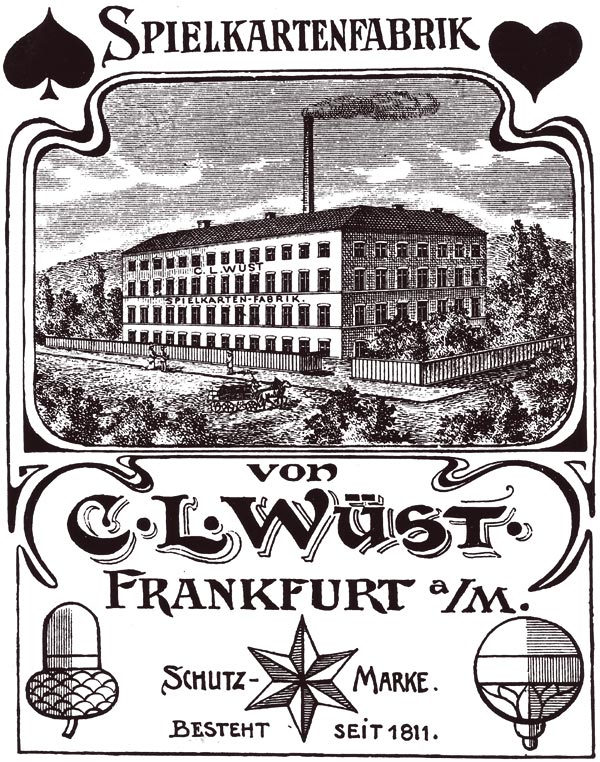
Above: C.L. Wüst (1811-1927)
Above: B. Dondorf (1833-1933)
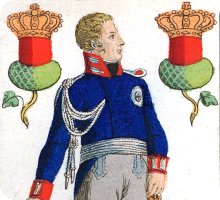
Above: Victory deck by Friedrich Gotthelf Baumgärtner, Leipzig, 1815
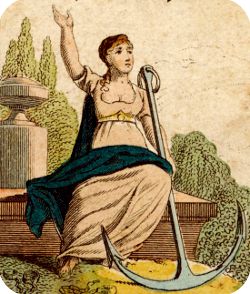
Above: Fortune Telling Deck by Industrie Comptoir, Leipzig c.1818
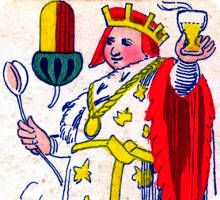
Above: Narren-Karte by Christian Heinrich Reuter, Nürnberg, c.1860
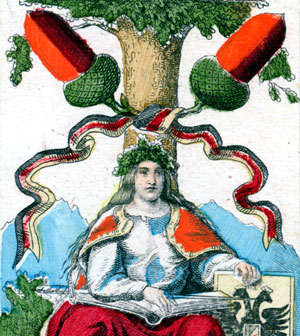
Above: Johann Jegel's Historical Deck, c.1850
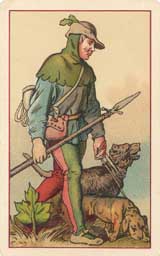
Above: T. O. Weigel, 1885
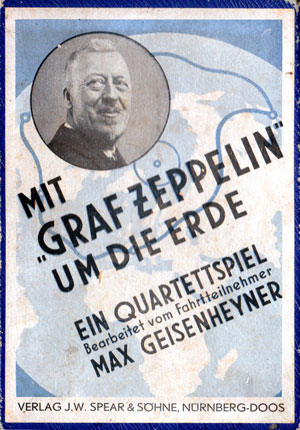
Above: “Graf Zeppelin Round the World Flight”, 1930
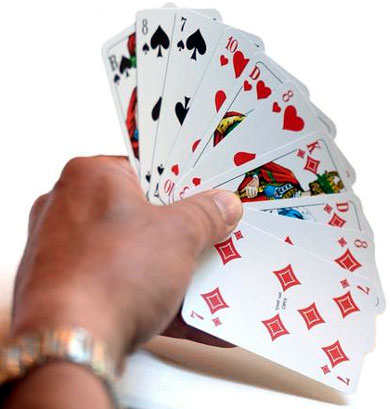
Throughout their long history the quantity and quality of German cards has been outstanding. Card playing caught on rapidly in medieval Bavaria and German printers were quick to respond to the demand with a prodigious range of output which now can be regarded as an early example of popular art. German packs were produced with a variety of suit symbols and great freedom of design. learn more →
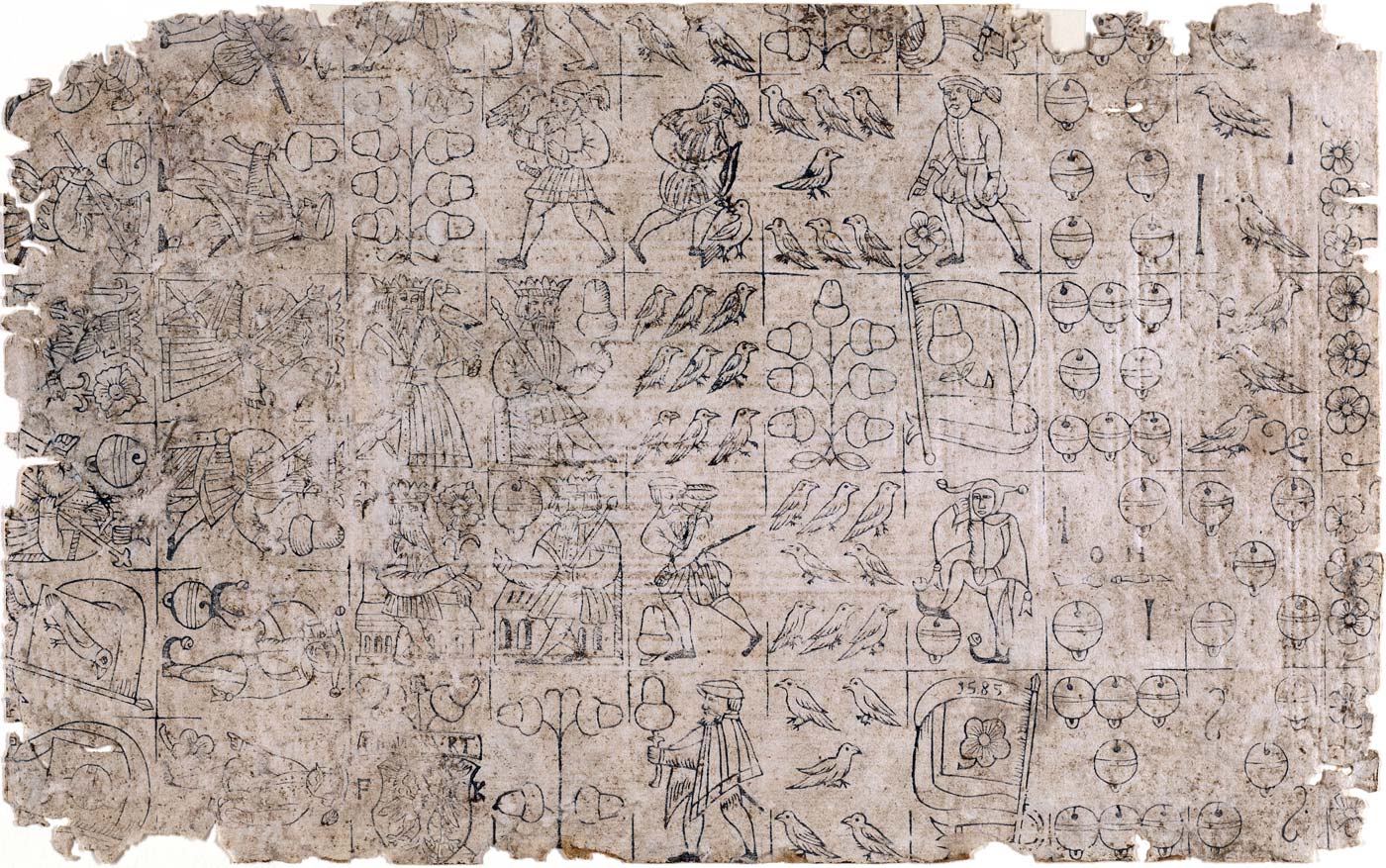
Above: archaic German cards by Heinrich Hauk, dated 1585. The suit symbols are: acorns, bells, birds and flowers. Beinecke Rare Book and Manuscript Library, Yale University: GER sheet 249►
Suits were divided into two colors, green and red. The pips of one green suit were acorns, and of the other, leaves. The red suits were, and still are, hearts of the conventional shape and hawk bells. Germans have varied their pips perhaps more than any other people.
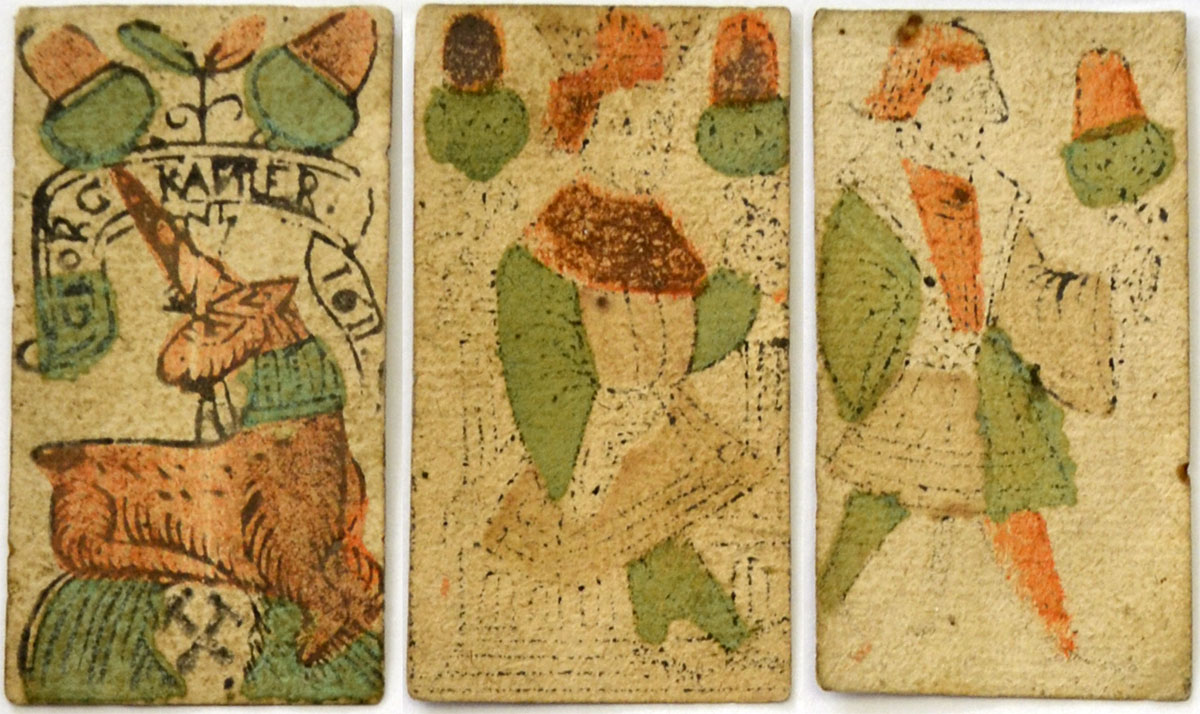
Above: archaic German-suited playing cards manufactured by Georg Kapfler, dated 1611.
Probably spreading northwards across the Alps, card playing reached Basle in 1377. In the same year the Dominican monk Johannes von Rheinfelden from Basle wrote an allegory on the pack of cards. Cards are mentioned in the archives of Nuremberg between the years 1380 and 1384. From 1392 there are many references to playing cards in the guild books and registers of German towns. The names of both card-makers and card-painters are recorded, many of whom were women. To begin with most cards were made in the south in cities such as Augsburg, Munich, Nuremberg and Ulm. During the second half of the fifteenth century a succession of masterly German engravers practised their art and engraved playing cards reached a zenith. Many of these packs have survived as precious objets d'art - see more →. During the sixteenth century wood-block playing cards evolved so that miniature burlesque scenes decorated the lower half of each card.
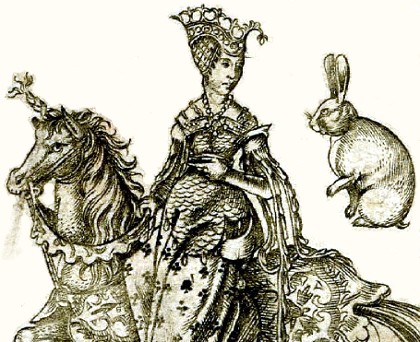
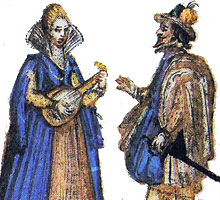
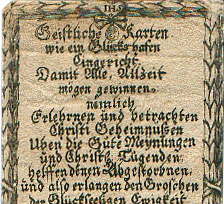
Playing cards in Germany first appeared with several different archaic suit systems involving a variety of everyday objects including flowers, animals, hunting equipment or coats of arms. Gradually standardisation occurred and today the German national suit marks are: Hearts (Herzen), Bells (Schellen), Leaves (Laub) and Acorns (Eicheln). In a true German pack a second Knave is substituted for the Queen, the two Knaves being called Obermann and Untermann (abbreviated into Ober and Unter), and the 2 (Daus) takes the place of the Ace.
It was not until the late 17th century that packs with French suits were made and during the eighteenth century German card-makers excelled with their imaginative and artistic approach to card design. The existence of several German states and their varying fortunes is reflected in the different patterns still used in these areas today. But just as these states have become engulfed in the whole, so the cards are doing the same thing and regional differences are disappearing. German-suited cards are now in the minority, and if standard English cards are not used, then the Berliner or North German pattern is the most prevalent.
Germany abolished tax stamps on playing cards in 1939, and the revenue collection became only administrative. The revenues were not particularly spectacular: in 1966, 4 million DM, in 1976, 6 million DM. The Spielkartensteuer (playing card tax) was abolished in Germany in 1981 [1].
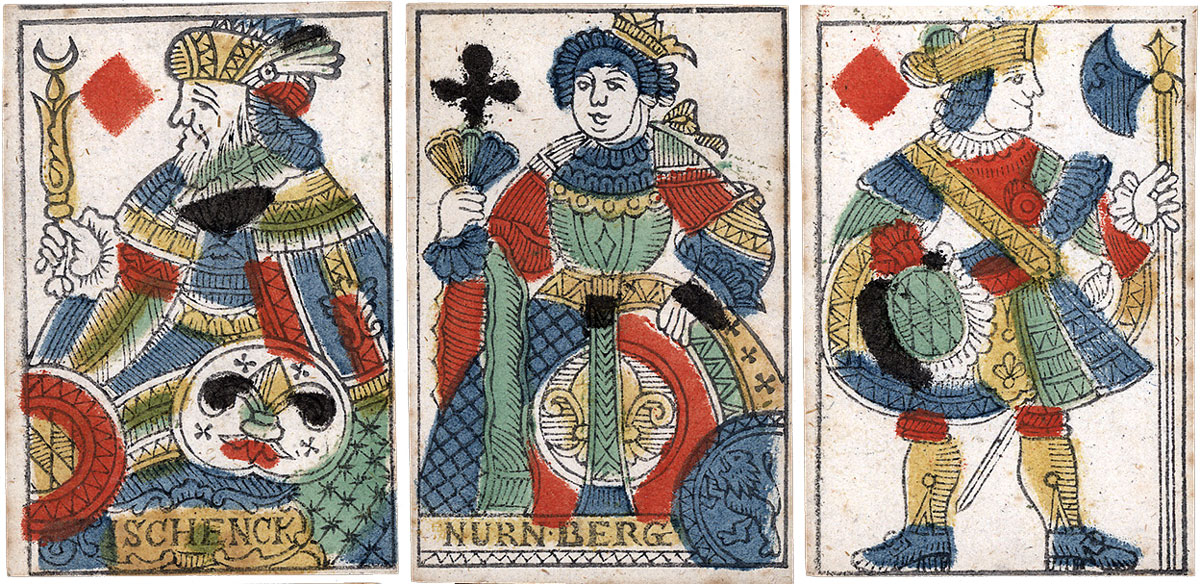
Above: playing cards manufactured by I. Schenck, Nuremberg, XIXth century more →
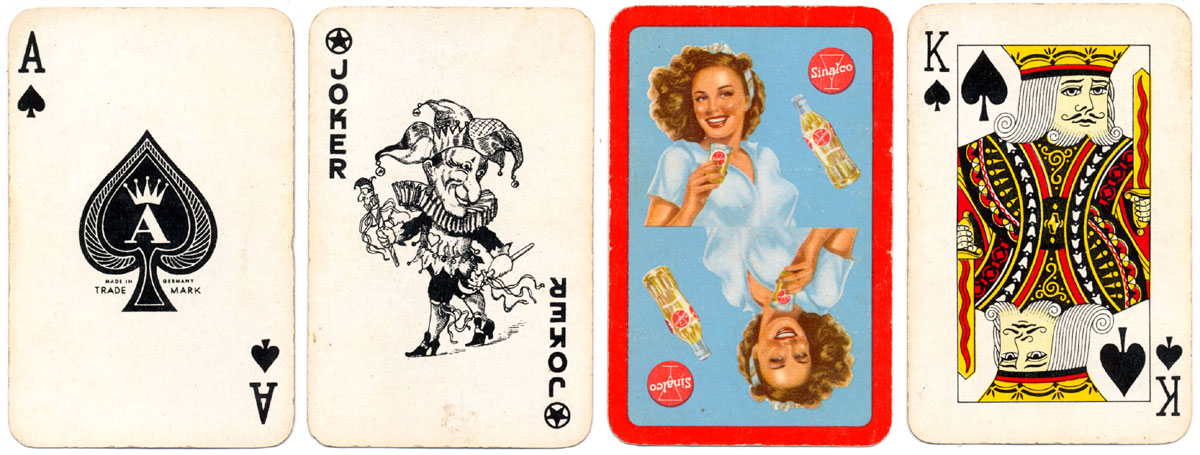
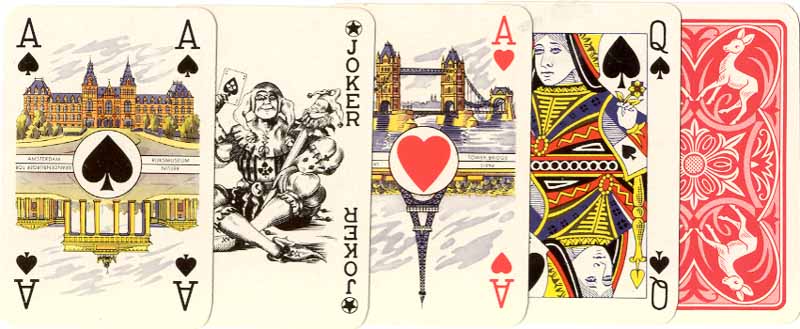
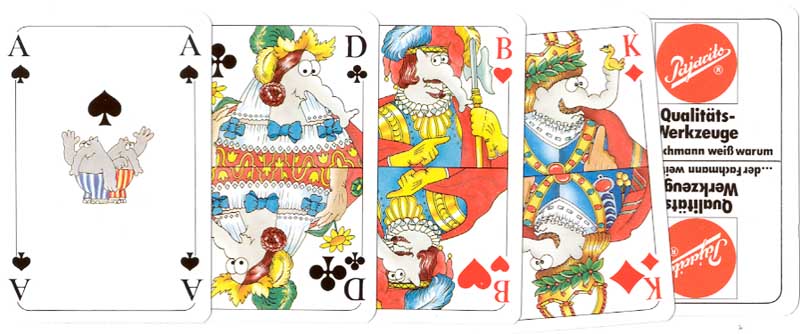
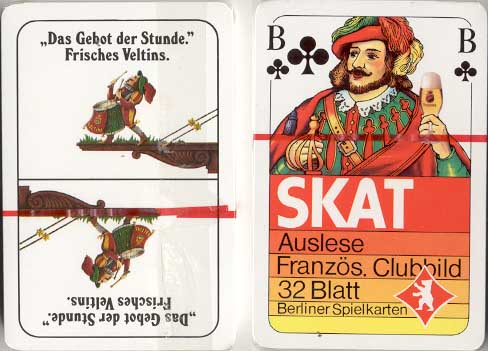
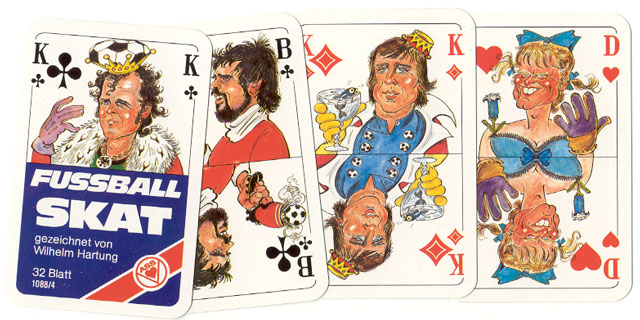
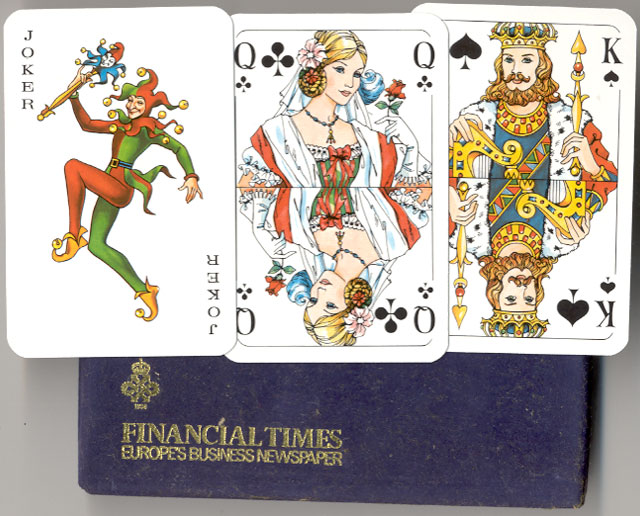
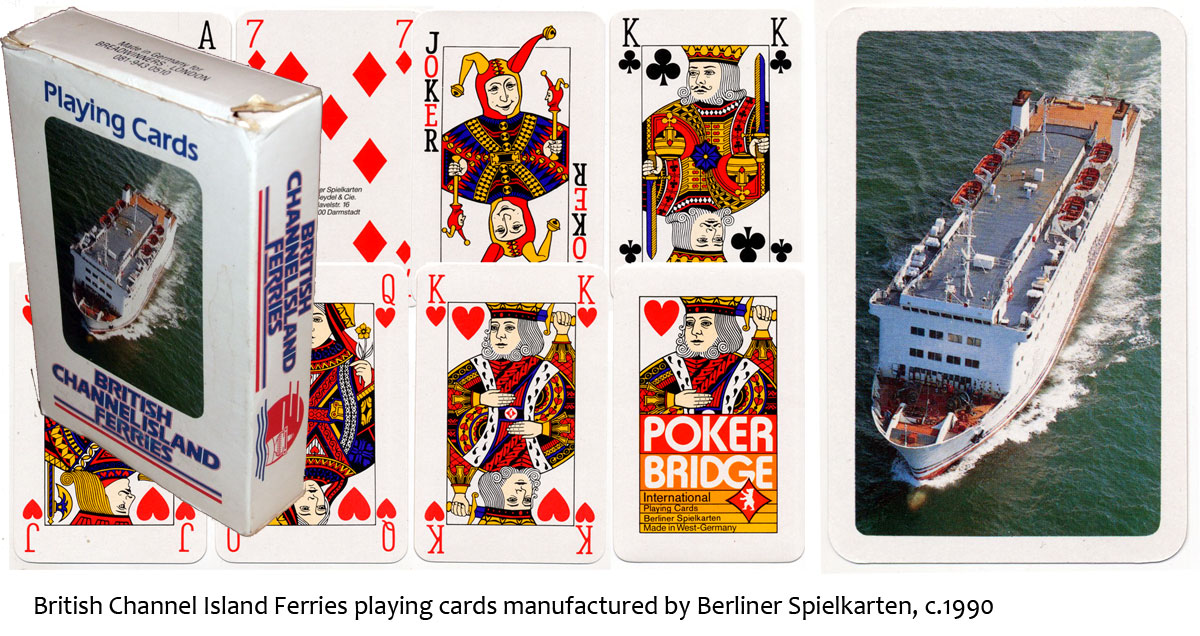
Stuttgart Pack • Princely Hunting Pack • Master of the Playing Cards • Hofämterspiel • Hans Beham, 1523 • Heinrich Hauk, 1595 • I.M.F. Engraved Cards, 1617 • Thomas Murner • Peter Flötner • Early German Engraved Cards • The South German Engraver • Book of Trades • Master PW Circular Cards, c.1500 • Geistliche Karten, Augsburg, 1718 • Johann Jobst Forster • Old Bavarian pattern • Joseph Losch, c.1800 • Joh. Matheus Backofen, c.1800 • ‘Prague’ or ‘Bohemian’ pattern • Saxon pattern • ‘Victory Deck’, c.1815 • Anti-Napoleon Deck, c.1815 • Bergmannskarte, c.1816 • Cartomancy Deck, c.1818 • C. A. Müller “Antike Götter”, c.1830 • C.L. Wüst • Schiller Deck, C.L. Wüst, c.1830 • Wüst Swiss Album Patience • C.L. Wüst: Brazil Scenic Aces • Bourgeois Tarot • Mlle Lenormand Cartomancy Cards • North German pattern • Verkehrte Welt Tarock, c.1850 • Johann Jegel's Historical Deck, c.1850 • Bavarian Military Cards • Bavarian pattern • T.O.Weigel: Luxus Skatkarten, c.1860 • Narren-Karte by C. H. Reuter, c.1860 • Neue Deutsche Spielkarte, c.1883 • Deutsches Schützenfest 1884 • Liebig Beef Extract, 1891 • Prussian Pattern • B. DONDORF (1833-1933) • F. A. LATTMANN • Wilhelm Busch Comic Card Games • Otto Tragy Jugendstil Spielkarten • Badische Spielkartenfabrik • Walter Scharff • Sinalco advertising • Bambi playing cards • Schmid Argentina S.A. • Pajarito Skat • Veltins Skat • Fussball Skat • Schwäbisch Hall, c.1975 • Financial Times • Bosco playing cards made for Perú> • Birkel Schwarzer Peter Circus game • Klipp Klapp Karten, 2004 • British Channel Island Ferries
Thanks to Klaus-Jürgen Schultz (https://spielkarten-sammlung.de) and Barney Townshend for contributing many packs from their collections to this site. If you would like to contribute some antique or interesting items please use the Feedback & Enquiries form in the footer below.
References
1. Cremers, Filip: Belasting is Troef, Nationaal Museum van de Speelkaart, Turnhout, 1992, pp.106-107.

By Simon Wintle
Spain • Member since February 01, 1996 • Contact
I am the founder of The World of Playing Cards (est. 1996), a website dedicated to the history, artistry and cultural significance of playing cards and tarot. Over the years I have researched various areas of the subject, acquired and traded collections and contributed as a committee member of the IPCS and graphics editor of The Playing-Card journal. Having lived in Chile, England, Wales, and now Spain, these experiences have shaped my work and passion for playing cards. Amongst my achievements is producing a limited-edition replica of a 17th-century English pack using woodblocks and stencils—a labour of love. Today, the World of Playing Cards is a global collaborative project, with my son Adam serving as the technical driving force behind its development. His innovative efforts have helped shape the site into the thriving hub it is today. You are warmly invited to become a contributor and share your enthusiasm.

Leave a Reply

Your Name
Just now Your comment here. Your comment here. Your comment here. Your comment here. Your comment here. Your comment here. Your comment here. Your comment here. Your comment here. Your comment here. Your comment here. Your comment here. Your comment here. Your comment here. Your comment here. Your comment here. Your comment here. Your comment here. Your comment here. Your comment here. Your comment here. Your comment here. Your comment here. Your comment here. Your comment here. Your comment here. Your comment here. Your comment here. Your comment here. Your comment here. Your comment here. Your comment here.
Related Articles
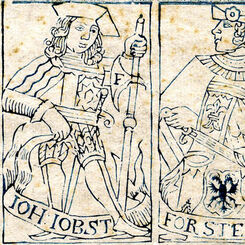
Uncut Sheet by Johann Jobst Forster
A proof sheet containing twelve court cards of conventional French type.
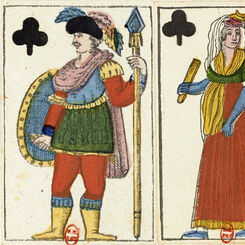
Fantasy deck by Joseph Fetscher
Fantasy French-suited pack produced by Joseph Fetscher, Munich, c.1825.
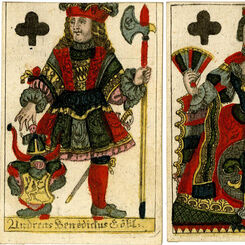
Standard French-suited Bavarian deck by Göbl
French-suited Bavarian deck by Andreas Benedict Göbl, late 18th c.
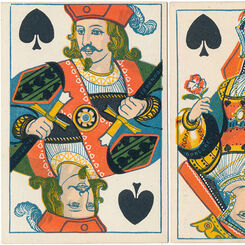
Englische Karten nr.190
Dondorf Nr.190“Englische Karten”, 1867-1895.
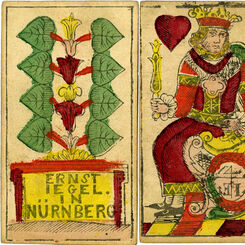
Bavarian pattern by Ernst Jegel
Bavarian pattern published by Ernst Jegel, Nuremberg, late 19th C.
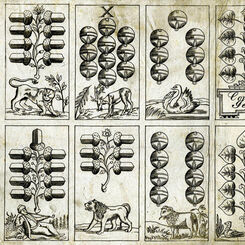
Conrad Jegel proof sheets
Two uncut German-suited proof sheets by Conrad Jegel, Nuremberg.
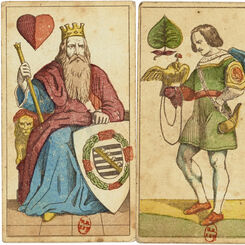
Fantasy Bavarian pack
An early Bavarian-style deck by Johann Conrad Jegel, Nürnberg, Germany , c.1835.
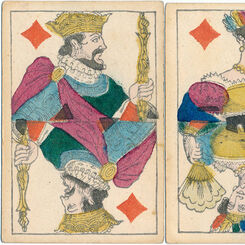
Anonymous possibly Kaspar Traugott Knaut.
The maker is possibly Kaspar Traugott Knaut (1799-1881).
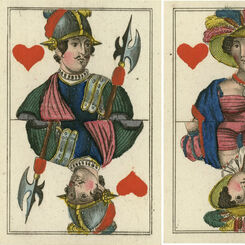
Unknown Maker
Early German deck by unknown maker, c.1825

Schwarzkopf BC Bonacure
Schwarzkopf BC Bonacure playing cards promoting the ultimate hair perfection.
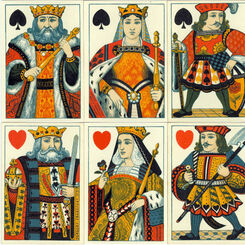
Birma Karte or Englische Karten
Based upon older ‘standard’ patterns, the Kings and Queens are three-quarter length figures whilst t...
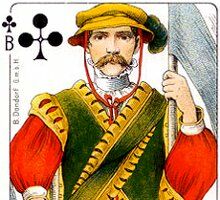
Hauptstadte Spiel
Each Ace shows views of two European capital cities.
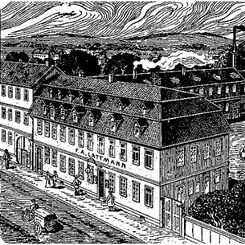
F.A. Lattmann
After the family printing business had been handed down for several generations, in 1794 Ernst Wilhe...
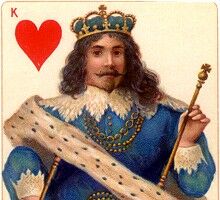
Whist No.178 ‘Stuart Zeit’
Although not historically accurate this example is subtitled “Stuart period”, with rich costumes cre...
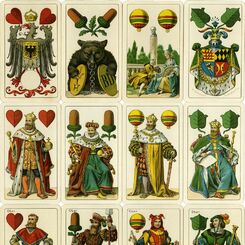
Einköpfige Deutsche Spielkarte No.303
Dondorf's ‘Einköpfige Deutsche Spielkarte No.303’ (‘Single-ended German Playing Cards’) were produce...
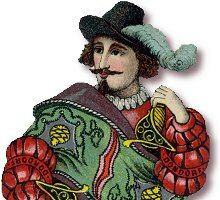
Club Karte
There have been many variations in the design of “Club Karte” including the introduction of borders,...
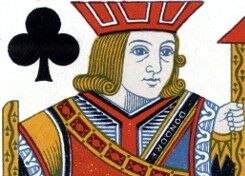
Poker No. 140
Dondorf Poker-Karte No. 195, re-issued as Poker No. 140 for the "Argentina Compañia General de Naveg...
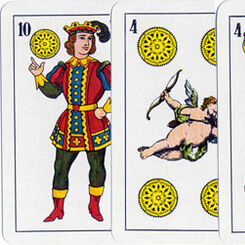
No.407 Naipe Español by F. X. Schmid
Naipe Español No.407 by F. X. Schmid, c.1980.
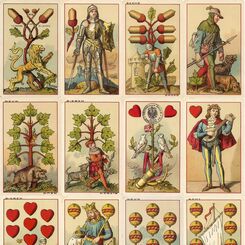
T O Weigel, Leipzig, 1885
Cards from a pack designed by Ludwig Burger, 1885
Most Popular
Our top articles from the past 60 days