


Happy Families
Happy Families is probably one of the most popular card games ever invented, with educational benefits relating to sorting and matching of sets, as well as early literacy and elementary genealogy, flowers or bird identification, etc.
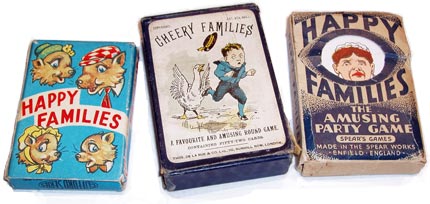
Introduction
The format of the pack of playing cards - with its suit symbols, numeral cards, court hierarchy - lends itself to many secondary purposes, especially early learning. Alongside standard playing cards we have every possible kind of card game. Victorian children's playing cards were intended to have educational value. A good example is Quartet games and Happy Families which have educational benefits for children, encouraging congenial play and developing counting, sorting and matching skills, as well as early literacy and familiarity with different occupations.
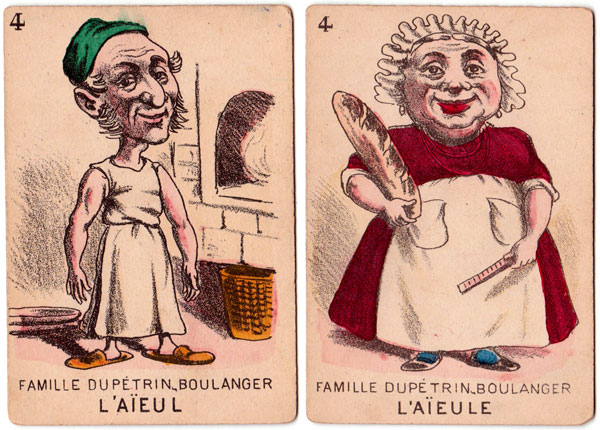
Above: “Jeu de Sept Familles” produced by Mauclair Dacier in the late 19th century. More...
The Anglo Saxon “Happy Families” was possibly inspired by the “Doctor Busby” game invented by Anne Abbot in around 1840 to entertain her children and later sold to W & S B Ives of Salem Massachusetts. It proved to be very popular in the USA and UK. “Doctor Busby“ has sets of 5 cards depicting four members of a household and a symbol of their trade. Jaques may have been influenced by this game when they published their “Happy Families” in about 1851.
The French game of “Jeu de Sept Familles” is first known from 1876 designed by André Gill, a cartoonist. The game was intended more for adults at first rather than children. The families consisted of Father, Mother, Son, Daughter Valet and Cook. They were also definitely not tradesmen as most of the Happy Families packs were. M Gill went for Doctor, Lawyer, General, Minister etc although there were a few unsavoury characters thrown in too, like a Smuggler. In time the families became more like the ones we are familiar with and had comic names with a connection to their trades.
Jaques’ Happy Families, 1851
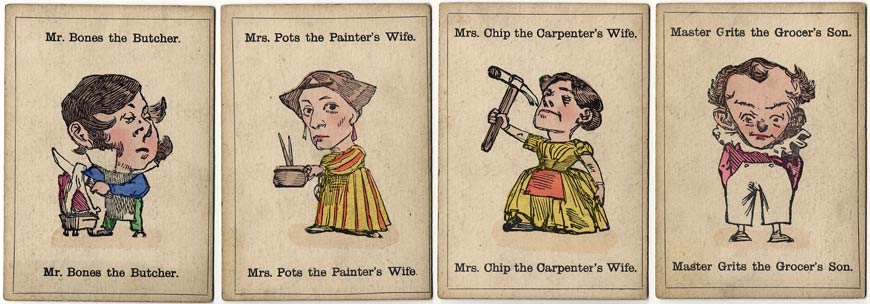
Above: four cards from an 1880s edition of Happy Families published by John Jaques & Son, 102 Hatton Garden, London, which included 11 families of four members each. Jaques' Happy Families was originally published in 1851 and shown at the Great Exhibition of that year. It was an instant success, rapidly superseding similar games in which players collected sets of four cards. More...
Happy Families is probably one of the most popular games ever invented. The production of Jaques' Original Happy Families in the mid-nineteenth century, with cartoons designed by John Tenniel (later Sir John, chief cartoonist of Punch), led to the appearance of numerous other 'family'-type games. It is interesting to see the great variety of different names given to the copy-cat games and the families. Jaques' Original Happy Families designs were copied, sometimes with only slight modifications, by later manufacturers as recently as the 1970s, testifying to their enduring popularity.
Various alternatives of ‘Happy Families’ were mirrored in several countries. A similar game appeared in Germany called ‘Quartett’ and a French game ‘Jeu de Sept Familles’ featured seven families with six members each. At that time Jaques may have been able to assert a copyright on the title, as some of the alternate names for ‘Happy Families’ were: Cheery Families; Funny Families; Merry Families; Jovial Families; Jolly Families and Familiar Families.
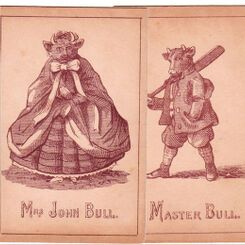
“John Bull” published by W. Cremer, c.1865
It is curious that "John Bull" is not called Happy Families although the sets are described as "families" on the instruction card. more →
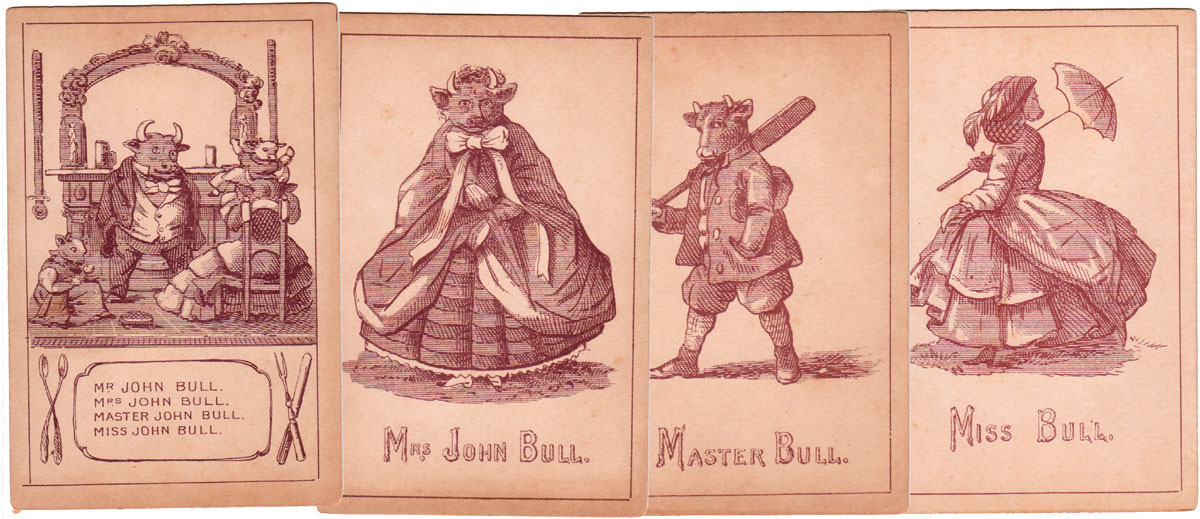
Above: “John Bull”, the Capital English Game published by W. Cremer, c.1865. more →
De La Rue’s Cheery Families, c.1890
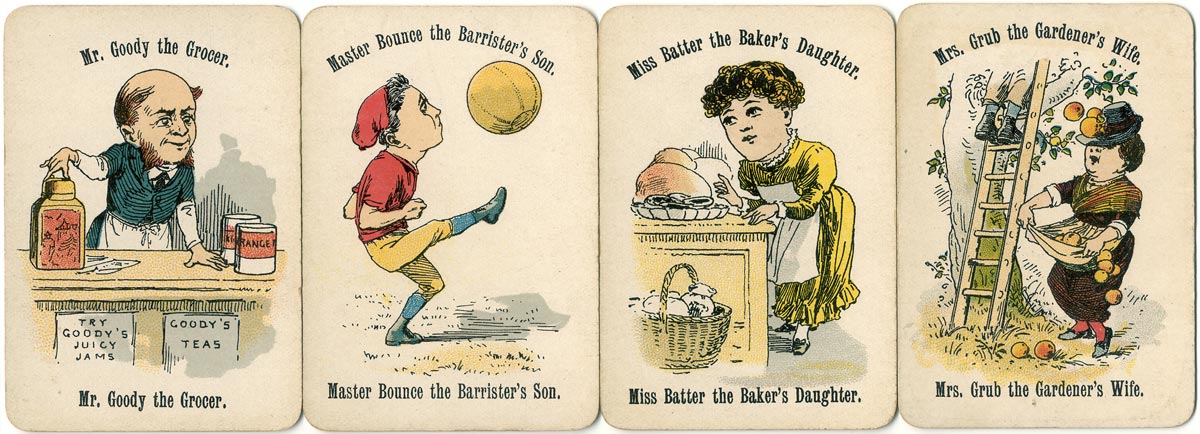
Above: cards from Cheery Families manufactured by De La Rue, London, c.1890. More...
The Chad Valley Games Happy Families, c.1914
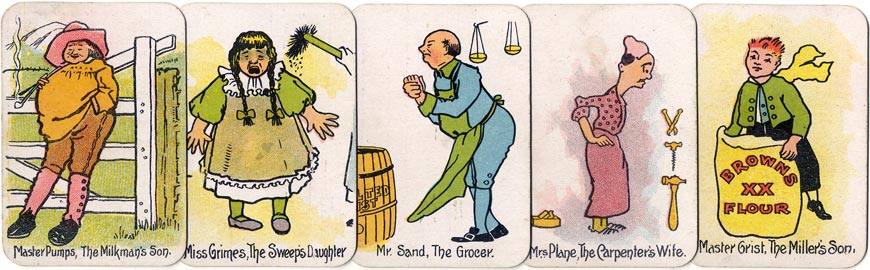
Above: cards from The Round Card Game of Happy Families, published by Chad Valley Games, England. 1914 more →
Spear’s Games Happy Families, c.1925
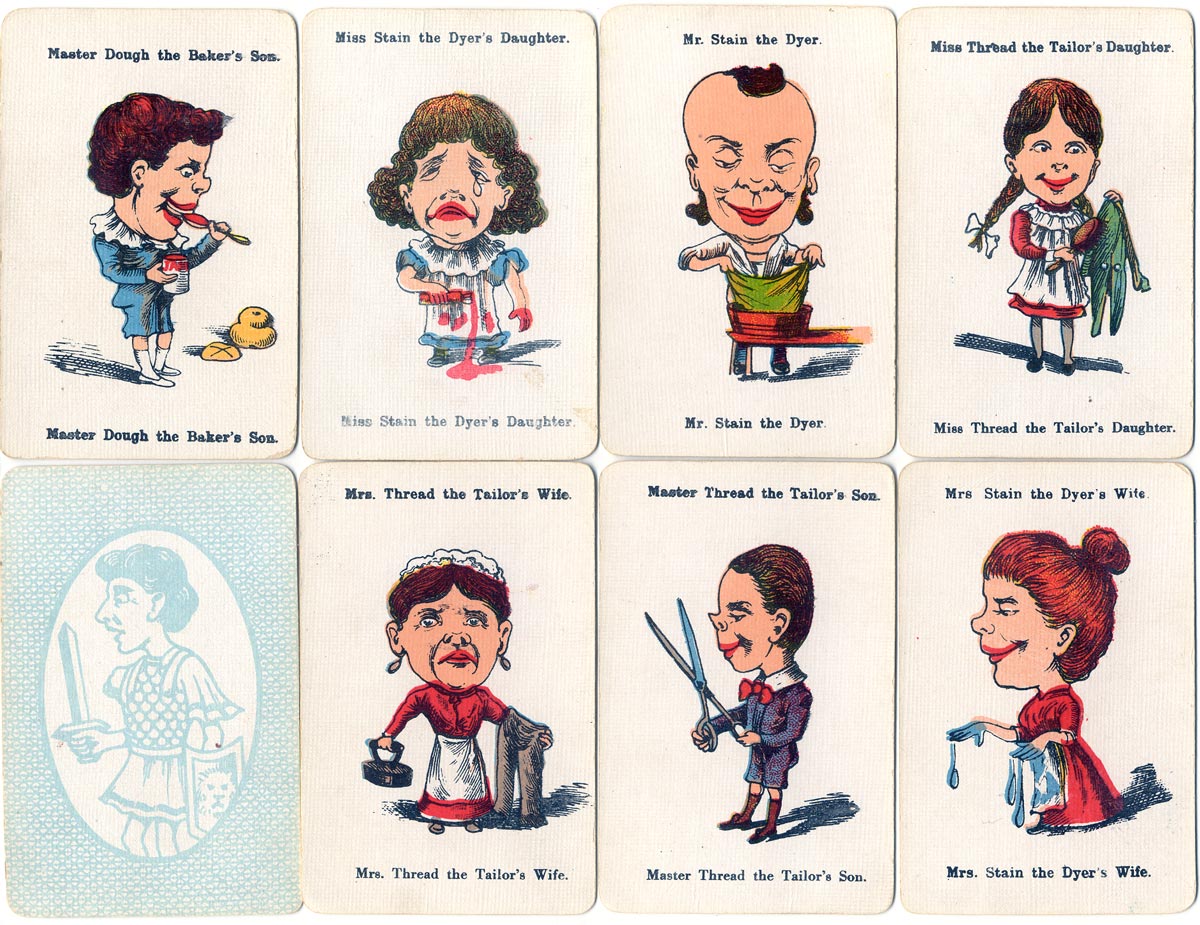
Above: cards from Happy Families - the amusing party game, published by Spear's Games, Enfield, England. c.1925. The set has eight families, making a total of 36 cards. The design of the cards has reverted to the slightly grotesque style originated by Jaques, with large heads and the addition of bright red lips. The rules are printed on the back of the box, and in this version players must contribute counters to a pool, which the winner and runner-up collect and share between them, thereby introducing a business element into the game. J. W. Spear & Son also produced 'ABC Happy Families', 'Merry Families' and 'Funny Families' in several editions as well as a variety of other interesting games.
Teddy Bear Happy Families
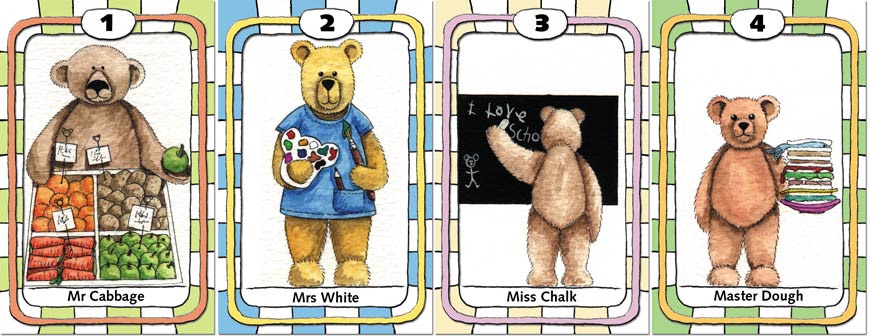
Above: cards from Teddy Bear Happy Families designed by Peter Wood and Simon Wintle. More...
Happy Families is one of the most popular card games ever devised, and it comes in many different guises. In all cases they offer the same benefits for early learners for developing matching and pairing skills, communication and social etiquette. Other variations on the same theme include quartet games based around Animals, Flowers or Bird sets, and also the well-known ‘Top Trumps’ series of quartet games featuring cars, aeroplanes, ships and so on.
More card games on this site: Animal Grab • Belisha • Black Peter • British Towns • Cartes Questions-Devinettes • Change for a Shilling • Counties of England • Cromy • Card Games • Cow & Gate Happy Family game • Dartex • Editorial Gráfica Flores • El Negrito Pedro • El Reloj Card Game • Famous Five • Golden Egg Game • Gnav • Happy Families • Jack-of-all-Trades • Hijitus • Hee Trading Co • Illustrated Proverbs • Jaques' Games • Jaques' Happy Families • Jewish Quartet Game • Kay Snap • Kingdoms of Europe • London Post • Hee Trading Co, Malaysia • Marché 7 Familles • Mauclair Dacier Sept Familles • Mexican Lottery Game • Noddy Happy Families • Pekka-Peli • Pepys Games • Peruvian Animals Quartet • Proverbs & Maxims • Reshuffle • Snip Snap • Tower Press • Vic Joc de Cartes • Walt Disney • Wereldvlucht Kwartet • Wild Flower Sevens • Woodland Old Maid • Woodland Snap • Zoo Comics
In the casino, blackjack is the most popular card game. When you would like to play the card game blackjack you can play it for free or for real money. Be sure to check your local rules for gambling online.

By Simon Wintle
Spain • Member since February 01, 1996
I am the founder of The World of Playing Cards (est. 1996), a website dedicated to the history, artistry and cultural significance of playing cards and tarot. Over the years I have researched various areas of the subject, acquired and traded collections and contributed as a committee member of the IPCS and graphics editor of The Playing-Card journal. Having lived in Chile, England, Wales, and now Spain, these experiences have shaped my work and passion for playing cards. Amongst my achievements is producing a limited-edition replica of a 17th-century English pack using woodblocks and stencils—a labour of love. Today, the World of Playing Cards is a global collaborative project, with my son Adam serving as the technical driving force behind its development. His innovative efforts have helped shape the site into the thriving hub it is today. You are warmly invited to become a contributor and share your enthusiasm.

Activity for Happy Families
Sign in to comment or save this article.

Related Articles
Jeu de Quaternes ‘Rizá’
Jeu de Quaternes ‘Rizá’
Trades People Happy Families
Happy Families card game depicting trades people from 1920s.
Boekenkwartet
Boekenkwartet featuring illustrations from children's books, 1970s.
Jeu des 7 Familles
Jeu des 7 Familles © K.F.S. Opera Mundi c.1960.
Chief Cities Quartettes
Hand-made ‘Chief Cities Quartettes’ card game, c.1910.

Doctor Busby
The Game of “Doctor Busby” published by Parker Brothers, Salem, Massachusetts, USA, c.1890.
John Bull
“John Bull”, the Capital English Game published by W. Cremer, c.1865.
Funny Families
“Funny Families” card game manufactured by Woolley & Co, 1890s.
Happy Families, c.1950
Chad Valley “Happy Families” card game, c.1950.
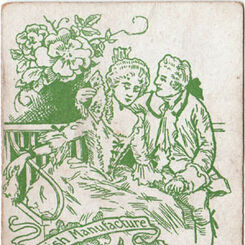
Happy Families, c.1930
“Happy Families” game published by Chad Valley c.1930 drawn in the slightly grotesque style of the V...

Linda Edgerton Happy Families
Linda Edgerton ‘Happy Families’ published by Chad Valley Games, Harborne, England, c.1925.
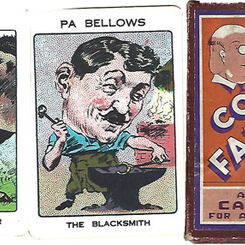
Comic Families
“Comic Families” card game from Australia, c.1940s

Jeu des 7 Familles by J.J.F
“Jeu des 7 Familles” by Jeux et Jouets Français of Paris, 1904.

Happy Families
Happy Families designed by A.E. Kennedy, 1930s.
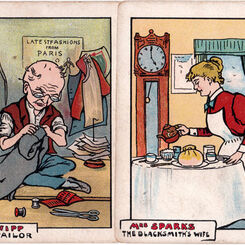
Busy Families
C. W. Faulkner’s “Busy Families”, c.1903.
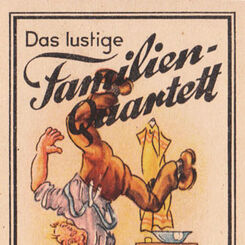
Das Lustige Familien Quartett
“Das Lustige Familien Quartett” published by Eugen Schmidt K.G., Dresden, c.1930s
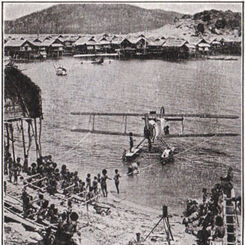
Wereldvlucht Kwartet
Published in 1933, this game celebrated the burgeoning passenger services by air around the world. S...
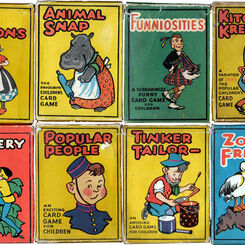
Waddy Productions
Waddy Productions Ltd was a member of the giant Amalgamated Press group and only published card game...
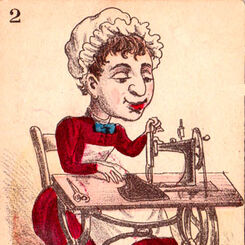
Mauclair Dacier Familles
This “Jeu de Sept Familles” was produced by Mauclair Dacier in the late 19th century.
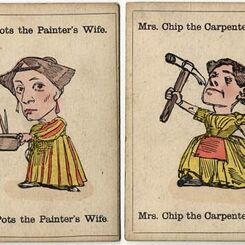
Jaques’ Happy Families
In 1851 the games manufacturer John Jaques of London (founded in 1795) commissioned a set of drawing...
Most Popular
Our top articles from the past 60 days


